
Vox Populi
A curated webspace for Poetry, Politics, and Nature with over 6,000,000 visitors since 2014 and over 9,000 archived posts.
St. John of the Cross: Dark Night of the Soul (English and Spanish)
I.
In a dark night,
With anxious love inflamed,
O, happy lot!
Forth unobserved I went,
My house being now at rest.
II.
In darkness and in safety,
By the secret ladder, disguised,
O, happy lot!
In darkness and concealment,
My house being now at rest.
III.
In that happy night,
In secret, seen of none,
Seeing nought myself,
Without other light or guide
Save that which in my heart was burning.
IV.
That light guided me
More surely than the noonday sun
To the place where He was waiting for me,
Whom I knew well,
And where none appeared.
V.
O, guiding night;
O, night more lovely than the dawn;
O, night that hast united
The lover with His beloved,
And changed her into her love.
VI.
On my flowery bosom,
Kept whole for Him alone,
There He reposed and slept;
And I cherished Him, and the waving
Of the cedars fanned Him.
VII.
As His hair floated in the breeze
That from the turret blew,
He struck me on the neck
With His gentle hand,
And all sensation left me.
VIII.
I continued in oblivion lost,
My head was resting on my love;
Lost to all things and myself,
And, amid the lilies forgotten,
Threw all my cares away.
—–
Public Domain.
Translated by David Lewis. London: Thomas Baker, 1908.
~~~~~
Noche oscura del alma
En una noche oscura,
con ansias en amores inflamada
¡oh dichosa ventura!
salí sin ser notada,
estando ya mi casa sosegada.
A oscuras y segura,
por la secreta escala, disfrazada,
¡oh dichosa ventura!
a oscuras y en celada,
estando ya mi casa sosegada.
En la noche dichosa,
en secreto, que nadie me veía,
ni yo miraba cosa,
sin otra luz y guía
sino la que en el corazón ardía.
Aquesta me guiaba
más cierto que la luz del mediodía
a donde me esperaba
quien yo bien me sabía,
en parte donde nadie parecía.
¡Oh noche, que guiaste!
¡Oh noche amable más que la alborada!
¡Oh noche que juntaste
Amado con amada
amada en el Amado transformada!
En mi pecho florido,
que entero para él solo se guardaba,
allí quedó dormido,
y yo le regalaba,
y el ventalle de cedros aire daba.
El aire de la almena,
cuando yo sus cabellos esparcía,
con su mano serena
en mi cuello hería,
y todos mis sentidos suspendía.
Quedé y olvidéme,
el rostro recliné sobre el Amado;
cesó todo, y dejéme,
dejando mi cuidado
entre las azucenas olvidado.
~~~~
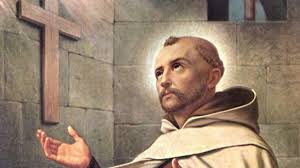
John of the Cross OCD (Spanish: Juan de la Cruz; born Juan de Yepes y Álvarez; 1542 –1591) was a Spanish Catholic priest, mystic, and Carmelite friar of converso origin. He is a major figure of the Counter-Reformation in Spain, and he is one of the thirty-seven Doctors of the Church.
John of the Cross is known for his writings. He was mentored by and corresponded with the older Carmelite Teresa of Ávila. Both his poetry and his studies on the development of the soul, particularly his Noche Obscura, are considered the summit of mystical Spanish literature and among the greatest works of all Spanish literature. He was canonized by Pope Benedict XIII in 1726. In 1926, he was declared a Doctor of the Church by Pope Pius XI, and is also known as the “mystical doctor”.
Raised as an orphan in brutal conditions, as a young man John took vows as a priest and came under the influence of Teresa of Ávila in her attempt to reform the corrupt Carmelite order, an alliance which resulted in the young priest having many enemies. On the night of 2 December 1577, a group of Carmelites opposed to reform broke into John’s dwelling in Ávila and took him prisoner. John was brought before a court of friars in Toledo and sentenced to a term of imprisonment. He was subjected to weekly public lashings and a penitential diet of water, bread and scraps of salt fish. During his imprisonment, he composed and committed to memory a great part of his most famous poem, Spiritual Canticle, as well as a few shorter poems. He managed to escape eight months later, on 15 August 1578, through a small window in a room adjoining his cell.
John went on to become an influential reformer in the Church and is venerated today as a Christian mystic and one of Spain’s most important poets. The poem Dark Night of the Soul narrates the journey of the soul to the mystical union with God. The time or place of composition are not certain, but many scholars believe the poem was composed while John was imprisoned in Toledo.
~~~
Bio adapted from a number of sources including Wikipedia and Eric Rosenbloom’s translation and commentary.
Discover more from Vox Populi
Subscribe to get the latest posts sent to your email.

Staggeringly great.The translation gives the gist, but the Spanish is the very soul of the Spanish poetic tradition.
LikeLike
I agree, Alfred.
>
LikeLike
This is immensely intriguing. The he-ing and she-ing and in Spanish the so very telling “Amado con amada / amada en el Amado transformada!” which would be literally translated “Male beloved with female beloved / female beloved transformed into male beloved.”
LikeLike
Wow! Thank you, Rose Mary!
>
LikeLike
Again and again I wake
an unwelcome
vision
let your music kill me
St John of the Crosswalk
holding your little sign
the traffic
of the heart unbearable
wounded
by my eyes he says
is seeing God dangerous
to God he wants
to know the soul
is like a hardworking
civil servant
a career trajectory
from entry level
scrubbing floors
in the marble halls
of the city on the hill purging
human limitations
then a betrothal
to the Boss’s
daughter and finally
to the perfect
marriage of self
and unself
a trap
set of rhythm
and soul
the beatific
flowers meadows rivers
ecstasies visions voices
the scent of strange perfumes
the hearing of sweet sounds
are signs of dementia
psychologists
say perhaps a tumor
in the brain
spreading its crab claws
into your spiritual limpness
to penetrate
the soft wet organ of
a three
fingered god? Should we,
approach the irrational
with reverent
rationality
should Jesus
and his swinging
band of angels be just
another metaphor for what
we would wish away? Death
is not something
we can analyze
it happens to the best of us
radical quietism
leads to hallucination
they say and the
Cloud of Unknowing
asks us to love
and choose
not to listen
for the song of angels
and succumb
to the taint of quietism
with its invitation
to the terrible vision
of the soul
as it is
inducing first
self-abasement
then self-purification
the beginning
of all spiritual growth and
the necessary antecedent
of all knowledge
of God
they say visions and
ecstasies
are not indications of Divine favor
but hallucinations
accidents
of the senses
and not pure
ghostliness. But I say
they are real, to be mad
is to be sane, let
the mad lead us
O Taye of the Garden
were we truly spiritual
we would not need visions
for our communion
with reality
would then be the ineffable
intercourse
of like with like
not this dark mist
of rationality
LikeLike
Thank you for providing the Spanish original, too. Reading this in our times, I see so many layers in it: the historical context and the context of John’s life and belief, of course but also the sexual imagery, the longing and comfort, as well as the mesmerizing music of it. I love Frank Bidart’s version, especially: https://awp.diaart.org/poetry/87_88/bidart2.html
LikeLiked by 2 people
Wow, I love Bidart’s version. Thank you, Maura.
LikeLike
Dear Michael,
This morning I’ve been browsing through the Vox Populi archive. I’m filled with gratitude for this rich and layered gift you offer to the world / your readers, for the connections and networks set into play, the lives-points of view-exploration of humanity-outrage-love shared through this portal. Just saying…
A decade-long Canadian reader
LikeLiked by 3 people
Oh, my. What a lovely message to receive. Thank you so much, Hele! Your encouragement is much appreciated!
Sincerely, Michael (Simms)
>
LikeLiked by 2 people