
Vox Populi
A curated webspace for Poetry, Politics, and Nature with over 6,000,000 visitors since 2014 and over 9,000 archived posts.
Robert Cording | Notes: August, 2020, Whidbey Island
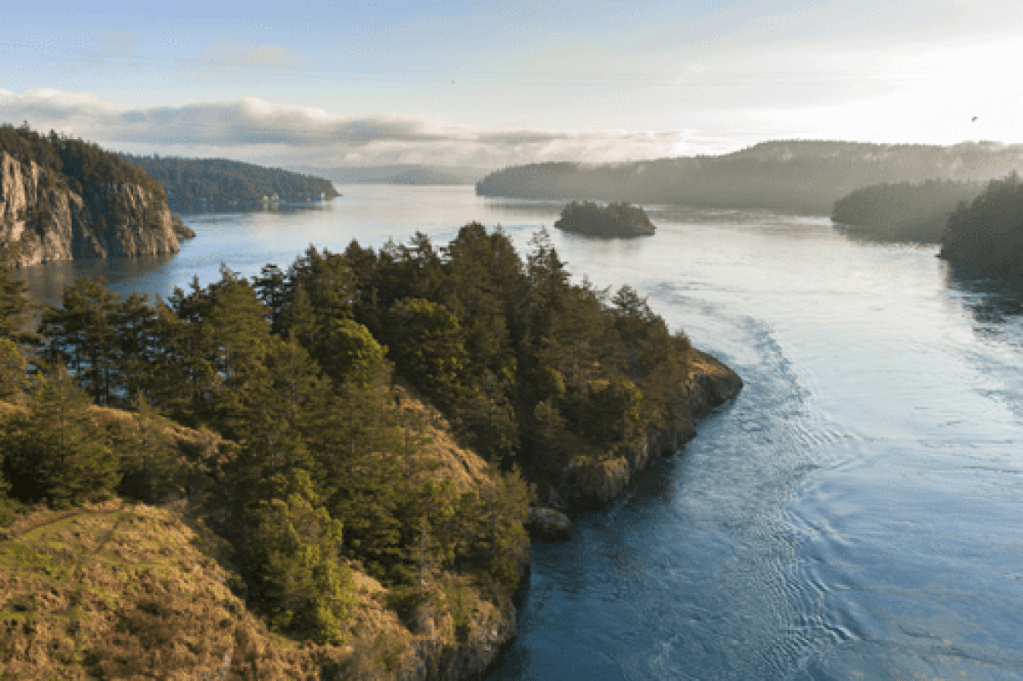
A quarter moon doubles itself on Puget Sound.
On one side of the water, the Cascades,
and, on the other, the Olympics appear
and disappear most days like a thought lost in sleep.
When visible, the mountains go on and on,
like a sentence out of Faulkner
that tries to hold the contradictions of a past
that’s never past. I’m sitting on the porch
of a house built for officers when this college campus
was a naval base. Some of my students
walk in lines across the field, their flashlights
advancing into the dark where drills were run.
The field still ends in cement bunkers
that once held cannons pointed toward the water.
Waves break and recede over the beach stones.
I think of Matthew Arnold who, hearing
this same sound, thought of Sophocles
who heard human misery in the grating roar.
Here, my thoughts are interrupted by the roar
of fighter jets from the Oak Harbor Naval Base
thundering over the fertile mid-island plains
as they perform their practice maneuvers.
After, the silence deepens. Eight deer graze
the grass across from me in the darker darkness
under the pines where bald eagles like to sit
in the morning. I like to watch the pleasure boats,
fishing trawlers, freighters, and Navy destroyers
that move up and down the narrows
between Fort Casey and Port Townsend.
Some days all of America—the whole messy idea of it—
seems to be right here, the military meeting
the idyllic so casually. Many tonight are caught up
in the news: BLM protests in Seattle, in Portland,
attempts to make real that always elusive old promise
of equality. Tomorrow our class will talk
about endings, how every poem holds inside
its unwritten, yet-to-be conclusion. We call it a workshop—
a word that suggests something always being built,
the steps that must be taken to move the piece
closer to what was first imagined.
~~~~
Robert Cording is professor emeritus at College of the Holy Cross where he taught for 38 years and served as the Barrett Chair of English and Creative Writing. After his retirement, he worked for five years as a poetry mentor in the Seattle Pacific University low residency MFA program. His many books include Heavy Grace (Alice James, 2022) and In the Unwalled City (Slant, 2022).
Copyright 2025 Robert Cording
Discover more from Vox Populi
Subscribe to get the latest posts sent to your email.

Robert:
With apology I’ve come to this late (What was it kept me from my reading your poem on the morning it posted?)
Gathering bulls to the cowpens to show and sell to an early arriving customer, cold wind intermixed with rain, certain seasonal malaise?
Yet—I’ve caught you now, transported to that setting by this half memoir, half travelogue, (much of it taken through the “indoors” of the heart), and I’m so glad to have made the journey. I suspect my life, like this poem might carry me at the same even pace all the way home.
LikeLike
I’ll be sharing Robert’s poem with my MFA students! Adore this one and so much of Robert’s work.
LikeLike
I love this poem as well, Meg. Thank you.
>
LikeLike
“When visible, the mountains go on and on,
like a sentence out of Faulkner
that tries to hold the contradictions of a past
that’s never past.”
I think this as I look across the small lake where I live to the mountains beyond.
LikeLike
It’s a great simile.
>
LikeLiked by 1 person
Robert Cording is a writer whom I value highly.
LikeLiked by 1 person
Thanks, Bonnie. Me too.
>
LikeLike
What a “large and generous” response. Thank you. You have helped lessen the pain of our new/old president who is anything but.
Bob Cording
LikeLiked by 2 people
Really appreciated this today. Our country, like a poem, moving towards it’s yet unfolded conclusion.
LikeLiked by 2 people
Oooh! so many marvelous lines, including these:
“how every poem holds inside / its unwritten, yet-to-be conclusion.”
Thanks for this one!
LikeLiked by 2 people
Yep. Bingo.
LikeLiked by 2 people
Cording’s meditation holds so many realities in tension, natural world and human penchant for war, how it’s all imperfect, able (we hope) to be re-made. Beautiful!
LikeLiked by 2 people
Honestly — I’m green with envy at this:
“the mountains go on and on,
like a sentence out of Faulkner
that tries to hold the contradictions of a past
that’s never past.”
What a large and generous poem!
LikeLiked by 3 people
Large and generous. Yes, that’s a good description of this poet’s work.
LikeLiked by 1 person
the steps that must be taken to move the piece
closer to what was first imagined.
What a poem! How much feeling here, it breathes without being named…
LikeLiked by 2 people
“[…]We call it a workshop— / a word that suggests something always being built, / the steps that must be taken to move the piece /
closer to what was first imagined.” So true. After reading the whole poem we come to this. Excellent.
LikeLiked by 2 people
Yes
>
LikeLiked by 2 people
First thought: Cording’s poem covers an amazing amount of ground.
From the half awake state of its stirrings, through Sophocles on Arnold’s Dover Beach, the dichotomies of war and peace, (including personal memories for me, the reader), but also, (to use my philosopher friend’s words: to the phenomenology of an ending). And then to step away from the poem, as Cording hints, to share with a workshop the stratagems of ending such a poem.
In essence, by reading a poem together, discussing, talking of endings, the poem has not ended Discussion carries it forward in the mysterious ways of dialogue.
LikeLiked by 2 people
Thanks, Jim!
>
LikeLiked by 2 people
I love Robert Cording’s poems. His language is subtly musical, and the voice feels real, a man meditating while he sings.
LikeLiked by 3 people