
Vox Populi
A curated webspace for Poetry, Politics, and Nature with over 6,000,000 visitors since 2014 and over 9,000 archived posts.
Video: The Physarum Experiments | Heather Barnett
Creeping through mazes, repelling adversaries – the slow-motion smarts of slime moulds.
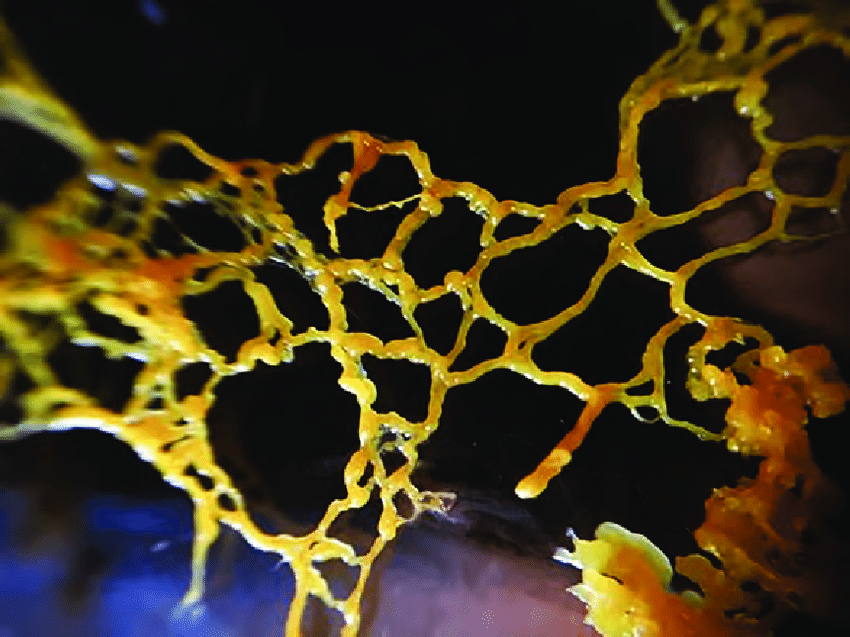
To the naked eye, the organism Physarum polycephalum – commonly referred to as ‘slime mould’ – might seem an unexceptional creature, despite its bright-yellow glow, as its acellular existence is dedicated to tracking nutrients at a speed of 1mm per hour. But this protist’s surprising computational cunning becomes apparent when viewed in time-lapse, revealing a life form that seems to possess intelligence despite lacking a nervous system. Between 2009 and 2018, the UK artist and researcher Heather Barnett conducted a series of clever experiments in which she probed slime moulds’ capacities for forming complex tube networks and adjusting to obstacles.
Barnett works with the slime mould as material, model and metaphor, investigating the organism’s navigational abilities and seemingly intelligent behaviors. Although a single-celled organism without a single neuron to its name, this yellow amoeboid blob can solve complex problems, transfer learning and anticipate events. It is also quite beautiful, the dendritic growth patterns reminiscent of forms seen at varying scales in nature, from blood vessels to tree branches, from river deltas to lightening strikes. Barnett’s films, studies, installations and participatory experiments work with the underlying mechanisms that enable this simple organism to make complex decisions. Her artworks are the product of a negotiation over creative control and authorship with one of the earliest forms of life, and invite us to question our definitions of agency and intelligence across scales.
Sound designer: Graham Barton
Editor: Tamur Qutab
Text: Aeon and Heather Barnett
Running time: 3 minutes
Email subscribers may click on the title of this post to watch the video.

Discover more from Vox Populi
Subscribe to get the latest posts sent to your email.

fsacinating and eerily beautiful.
LikeLiked by 1 person