
Vox Populi
A curated webspace for Poetry, Politics, and Nature with over 6,000,000 visitors since 2014 and over 9,000 archived posts.
William Butler Yeats: Easter, 1916
I have met them at close of day
Coming with vivid faces
From counter or desk among grey
Eighteenth-century houses.
I have passed with a nod of the head
Or polite meaningless words,
Or have lingered awhile and said
Polite meaningless words,
And thought before I had done
Of a mocking tale or a gibe
To please a companion
Around the fire at the club,
Being certain that they and I
But lived where motley is worn:
All changed, changed utterly:
A terrible beauty is born.
That woman’s days were spent
In ignorant good-will,
Her nights in argument
Until her voice grew shrill.
What voice more sweet than hers
When, young and beautiful,
She rode to harriers?
This man had kept a school
And rode our wingèd horse;
This other his helper and friend
Was coming into his force;
He might have won fame in the end,
So sensitive his nature seemed,
So daring and sweet his thought.
This other man I had dreamed
A drunken, vainglorious lout.
He had done most bitter wrong
To some who are near my heart,
Yet I number him in the song;
He, too, has resigned his part
In the casual comedy;
He, too, has been changed in his turn,
Transformed utterly:
A terrible beauty is born.
Hearts with one purpose alone
Through summer and winter seem
Enchanted to a stone
To trouble the living stream.
The horse that comes from the road,
The rider, the birds that range
From cloud to tumbling cloud,
Minute by minute they change;
A shadow of cloud on the stream
Changes minute by minute;
A horse-hoof slides on the brim,
And a horse plashes within it;
The long-legged moor-hens dive,
And hens to moor-cocks call;
Minute by minute they live:
The stone’s in the midst of all.
Too long a sacrifice
Can make a stone of the heart.
O when may it suffice?
That is Heaven’s part, our part
To murmur name upon name,
As a mother names her child
When sleep at last has come
On limbs that had run wild.
What is it but nightfall?
No, no, not night but death;
Was it needless death after all?
For England may keep faith
For all that is done and said.
We know their dream; enough
To know they dreamed and are dead;
And what if excess of love
Bewildered them till they died?
I write it out in a verse—
MacDonagh and MacBride
And Connolly and Pearse
Now and in time to be,
Wherever green is worn,
Are changed, changed utterly:
A terrible beauty is born.
~~~~
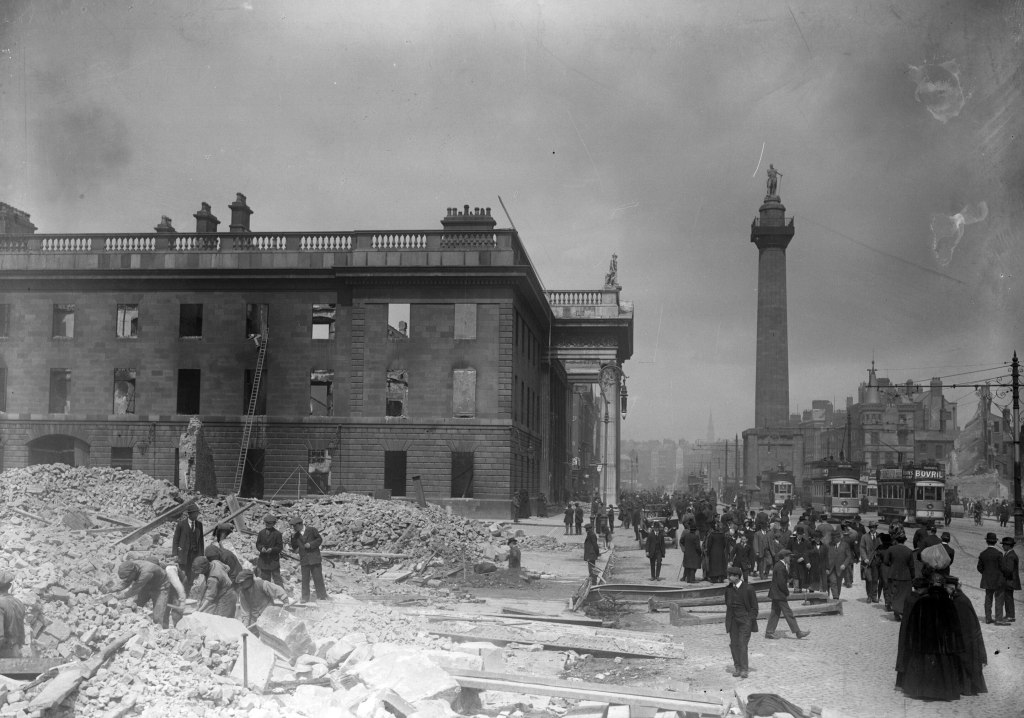
Historical Note: On Easter Monday, April 24, 1916, a group of Irish nationalists proclaimed the establishment of the Irish Republic and, along with some 1,600 followers, staged a rebellion against the British government in Ireland. The rebels seized prominent buildings in Dublin and clashed with British troops. Within a week, the insurrection had been suppressed and more than 2,000 people were dead or injured. The leaders of the rebellion soon were executed. Initially, there was little support from the Irish people for the Easter Rising; however, public opinion later shifted and the executed leaders were hailed as martyrs. In 1921, a treaty was signed that in 1922 established the Irish Free State, which eventually became the modern-day Republic of Ireland. To read more, click here.
For a discussion of Yeats’s poem, which some literary historians consider the best political poem ever written in the English language, click here.
~~~~
The poem is in the public domain, first published September 25, 1916. Included in Yeats’s collection Michael Robartes and the Dancer available for free through Wikisource.
Discover more from Vox Populi
Subscribe to get the latest posts sent to your email.

A very strong and beautiful poem, one I hadn’t read in a while. Thank you for publishing it here, this morning.
LikeLiked by 1 person
You are welcome. Yeats wrote it at the beginning of the Irish rebellion which was followed by the Irish civil war. I wonder whether we are at the beginning of a terrible beauty.
LikeLike
Thanks for reprinting the poem and commentary. One of the favorites of us all.–that poem. I recited it at a Cork poetry festival and remember so well how the Irish and we all appreciated the evocation of their poets and their connection of poetry to what is right.
LikeLike
Yes! Great poetry echoes through the generations.
LikeLike
And it was a tough poem for Yeats to write. Note that he had to praise the man who had, in his opinion, stolen the love of his life, Maud Gonne from him. The poem begins as comedy (of manner and errors), but the events of that Easter in Dublin, change comedy to tragedy, and the players take on a new look, the Green of Irish heroes.
As to whether the poem is the greatest public poem of the 20th century, it just may be. I would pair it, though, with Seamus Heaney’s poem The Tollund Man. Read together, they capture the ethos of that sometimes dark era, but also how it repeats previous dark eons. It hints at a major question of both poems: is there redemption in revolutionary martyrdom.
Heaney, an Irish Catholic, learns of the bog bodies unearthed in Denmark, from prehistoric times. Some obviously murdered. He ends the poem with these lines:
Out there in Jutland
In the old man-killing parishes
I will feel lost,
Unhappy and at home.
LikeLiked by 1 person
Lovely mini-essay, Jim. I’d like to see what you can do with a longer critical essay. I’m guessing your attempt would be brilliant.
LikeLike
“Unhappy and at home.”
LikeLike
I lived in Éire for a about a year in the 70s, when the IRA was still going strong, and WBY came up, of course. And the Easter uprising, and the English, and this poem… “And a terrible beauty was born” is probably the most haunting line I have ever read. Oh, Mr Yeats, you are indeed a master.
LikeLiked by 3 people
Yes, indeed. In 1974, I went to school in Dublin during the troubles. The department store down the street from the college I attended was blown up by terrorists, killing several people and injuring dozens. And yet, the next day, people went to work cleaning up the mess. Yeats, Joyce, Synge and the other giants of modern Irish literature were my heroes.
LikeLike
OMG, we were there together? It was in 1974… we were in Waterford and Bray, and passed through Dublin often.
LikeLike
Ahhh. Thank you. My lack of formal education in literature provides a different kind of relationship to poems I “should have read.” I read with a different eye than I would have in my more fiery youth, but I now welcome and embrace meeting what I missed then.
LikeLiked by 1 person
yes, my Irish professor described Yeats as the “sunken ship in the harbor all other Irish poets have to navigate around.” Being American, I’ve never had that burden.
LikeLiked by 1 person
I’d say Mr. Yeats could write a little. This poem makes me want to be a better poet and a better man. Thanks, VP, for jogging my conscience and my memory.
Charles ________________________________
LikeLiked by 3 people
yeah, old Billy Yeats knew a thing or two about poetry.
LikeLike
“Elegant craft” and a restraint that is Yeats alone, burdened with feeling that strikes so deep. Unparallelled.
LikeLiked by 4 people
exactly. thank you Noelle.
LikeLiked by 2 people
Yeats’s poem was called by my professor, the British literary critic James Mays, “the greatest public poem of the 20th century.” It was an important poem for me when I was young and living in Ireland because it combines elegant craft with a deep passion for a cause.
LikeLiked by 3 people