
Vox Populi
A curated webspace for Poetry, Politics, and Nature with over 6,000,000 visitors since 2014 and over 9,000 archived posts.
Majid Naficy: The Persian New Year
Let it fill you as if you were a sprout pot
And grow like fragrant watercress
Out of your hands.
The New Year will come,*
And you will sit
At the cloth of the “seven s’s”.
You will look in the mirror
And along with the red goldfish
You will be freed
From the confines of the fishbowl.
And you will pass
From the lonely ash tree,
The stately hyacinth,
The anxious garlic,
The drunken vinegar,
And the happy silver coin.
And along with the bard of Shiraz*
You will be filled with the sound of love.
And so, why be sad?
When the Thirteenth Day comes
You’ll go with the flowing water
And speak to the sky and the earth
Of the beautiful moments of love.
~~~
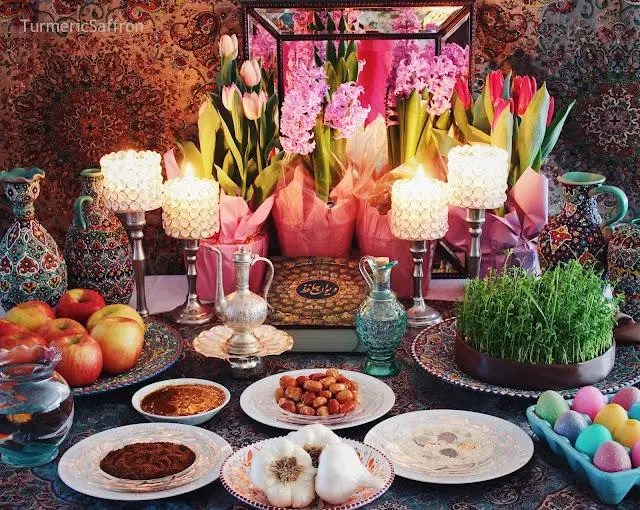
*- On Nowruz or the Persian New Year which coincides with the first day of spring, it is traditional to spread on a cloth seven items, the names of which all begin with the letter sin (“s”). These “seven s’s” are typically ash tree, hyacinth, garlic, vinegar, a coin, sprouts (wheat, watercress, or other), and sumac. Other items put on the cloth (not beginning with sin) are a goldfish (in a fishbowl), a mirror, and either a Koran or a copy of Hafez’s collected poems. Thirteen days later, people must go out for a picnic and cast their sprouts into a stream.
*- Hafez, the fourteenth century Persian lyricist.
~~~
نوروزانه
مجید نفیسی
بگذار تو را چون کوزهای پُر کند
و از دستهای تو
چون دانههای خوشبوی شاهی بردمد.
نوروز خواهد آمد
و تو بر سفرهی هفت سین خواهی نشست
در آینه نگاه خواهی کرد
و همراه با ماهی سرخ
از تَنگیي تُنگ آب خواهی رَست
و از انزوای سنجد،
وقار سنبل،
اضطراب سیر،
مستیي سرکه،
و شادیي سکه خواهی گذشت
و همراه خواجه شیراز
از صدای عشق پُر خواهی شد
و آنگاه، چه غم!
چون سیزده درآید
بر آبِ روان خواهی شد
و از زیبایی لحظههای عشق
با دشت و آسمان سخن خواهی گفت.
بیستوهشتم ژوئيه هزارونهصدونودوپنج
~~~
Copyright 2026 Majid Naficy
Majid Naficy is the author of many books in Persian and in English, including most recently The Story of a Love: A Sequence of Twelve Poems, Second Edition, Literature Club, Finland, 2025. He lives in Los Angeles, California.
Discover more from Vox Populi
Subscribe to get the latest posts sent to your email.

I was fortunate to visit Iran just before the revolution. Beautiful people cared for me as I got food poisoning on El Al. When I was a Bahai I loved celebrating Nawruz
LikeLiked by 2 people
You’ve traveled to so many wonderful places, Barbara.
LikeLiked by 1 person
Glad I did when I could. Hope to be able to again someday but probably won’t be able to do heights so glad I visited Andes and Himalayas before the plague.
LikeLiked by 1 person
Ah, yes! The Persian poets left us with poems like this—
From Rumi
*****
Out beyond the ideas of
wrongdoing and rightdoing
there is a field
I’ll meet you there
When the soul lies down
In that grass
the world is too full
to talk about
Ideas, language,
Even the phrase ‘each other’
doesn’t make any sense.
*****
What’s wrong with people?
LikeLiked by 4 people
What would happen if all schoolchildren were required to read and memorize poems like these –the Rumi you quite (thank you) and today’s beautiful poem by Majid Naficy ?
LikeLiked by 3 people
A wonderful idea, Jennifer.
LikeLiked by 1 person
Ah, if only.
My kids, and me before them, were barely even exposed to poetry at shcool
LikeLike
My first exposure to contemporary poetry was in the 7th grade.* Watermelon Pickle*, an anthology that included Wm. Stafford and other poets I came to love.
LikeLike
That sounds wonderful! We did a poetry unit in Middle School, which mostly consisted of following the teacher’s instructions on writing with an abab rhyme scheme, creating shape poems and learning 5-7-5 haiku. If we read and discussed poems written by “real poetsI have no memory of it. It did do the trick of teaching us about syllables and rhyme — and then.read a long handout with different instructions. I did like the teacher, don’t mean to fault her — maybe it’s more a reflection of our culture. Which circles back to the beginning comment….
LikeLiked by 1 person
Also sprach Zarathustra. Happy Nowruz! The original is a delicate painting/poem all in itself, and the translation is pure music and wonder.
LikeLiked by 3 people
Happy, bountiful and — please — a Peaceful Nowruz!
LikeLiked by 4 people
oh yes!
LikeLiked by 1 person
Indeed. Anything that’s good and wholesome, including Zoroastrianism, which, I can almost guarantee, neither of those philistines have ever heard off. But I don’t think they’ll succeed. In fact, I’m sure of it. It’s the oldest religion on the planet, for one, and has survived despite (and in rare cases, because of), Buddhism, Christianity, and Islam, at least three (that I know of) conquering empires, Persian, Greek, and Ottoman, and is still rich in culture and literature despite the heavy hands of the mullahs. Two modern examples include “Persepolis” and “Reading Lolita in Tehran,” not to mention the above. Happy Nowruz.
LikeLiked by 3 people
Spot on, Matt.
LikeLiked by 2 people
Thanks Matt, for mentioning Persepolis, by Marjane Satrapi. It was my introduction to both a look at girlhood in Iran around revolutionary 1979, and to graphic novels. I found that the genre, as Satrapi used it, was her work of genius, and should be sought out these days as we learn more about the place, and how one young woman survived there for awhile. Her sequel, set as an emigre in Paris, is also well worth a visit.
LikeLiked by 3 people
Thanks. Both Peresepolis I and II are great. I still teach excerpts from it, but I also teach Shah of Shahs by by Ryszard Kapuscinski. Also excellent, and a quick read.
LikeLiked by 3 people
I’ll check out Shah of Shahs.
LikeLiked by 2 people
Persepolis is a great book.
LikeLiked by 3 people
Trump and Hegseth are not just punishing their enemy. They are destroying an ancient and beautiful culture.
LikeLiked by 2 people
*My above comment was meant to be posted here, as a reply to yours, MS. Please adjust your perceptions accordingly.
LikeLiked by 2 people