
Vox Populi
A curated webspace for Poetry, Politics, and Nature with over 6,000,000 visitors since 2014 and over 9,000 archived posts.
Eman Abu Zayed: With Gaza’s Libraries in Ruins, Palestinians Fight to Preserve Historical Memory
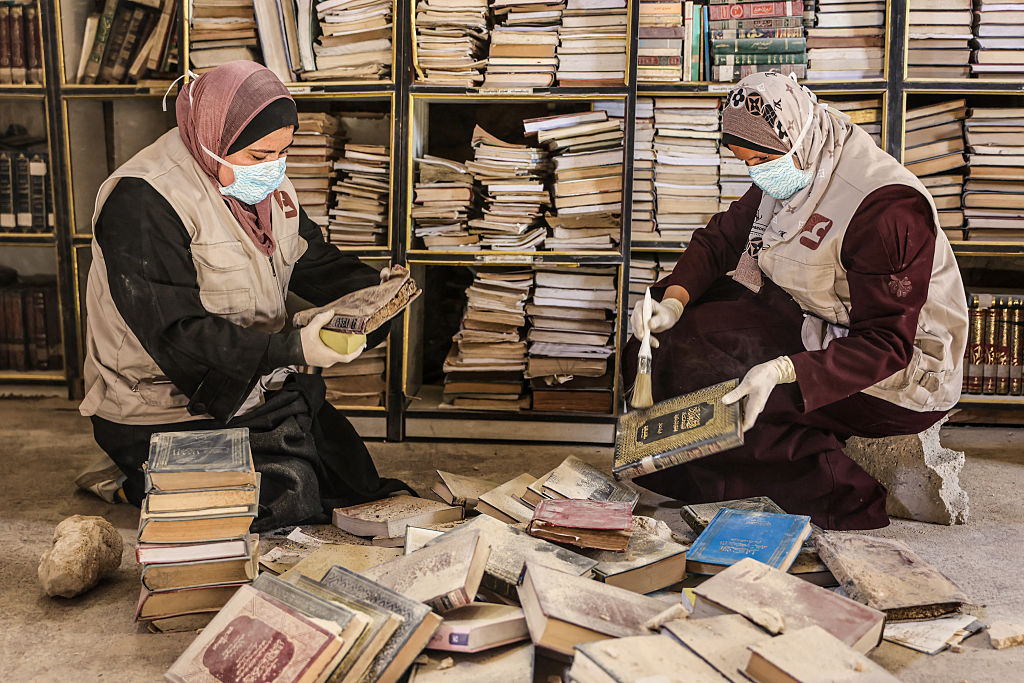
More than 87 public libraries and archives in Gaza have been partially or completely destroyed by Israel’s genocide.
Since the outbreak of Israel’s war on the Gaza Strip in 2023, the destruction has not been limited to homes and public infrastructure. It has also extended to cultural and intellectual heritage, as libraries and archives across the enclave have endured major attacks and significant losses. Reports from human rights and academic organizations indicate that more than 87 public libraries and archives in Gaza have been partially or completely destroyed, resulting in the loss of hundreds of thousands of books, documents, and rare manuscripts that form an essential part of Palestinian cultural and historical memory.
Meanwhile, library visitors gradually disappeared from public spaces. Reading habits shifted to homes, displacement shelters, and digital platforms, as people attempted to preserve their cultural practices amid a war that has devastated the territory and disrupted everyday life.
The Islamic University of Gaza: 1.5 Million Books Bombed
Standing before the remains of the Islamic University of Gaza, researcher Riyad Al-Saawi looks at what is left of a 50-year-old institution — one of the oldest and largest universities in Gaza. Since its establishment, the university’s libraries had served as some of the most important cultural and academic repositories in the Strip, housing more than 1.5 million books covering a wide range of disciplines, from literature, history, and philosophy to science and technology. They also contained academic journals, rare documents, and historical manuscripts that reflected the depth of Palestinian intellectual heritage. The long rows of shelves and the quiet atmosphere of study once made the library a haven for researchers and students, who spent hours reading references, consulting studies, and writing their work in silence.
Al-Saawi gazes at the empty space where the shelves once stood and reflects on the magnitude of the loss.
Al-Saawi gazes at the empty space where the shelves once stood and reflects on the magnitude of the loss. “I came today looking for the library where I spent years writing my research,” he says, his voice carrying both shock and sorrow. “It once held more than 1.5 million books, but I found no trace of it.” Every corner of the library had once witnessed moments of discovery and learning; every shelf carried knowledge that had accumulated over decades. Today, it has been replaced by silence and emptiness — an absence that reflects both destruction and resilience.
~
Salvaging a Personal Library From the Rubble
Elsewhere in the same landscape of loss, Noaman Al-Hilu, a man approaching 60, sits among the rubble of his destroyed home. Slowly bending over the debris, he sifts through the dust and broken concrete in search of something different from the surrounding wreckage: his books.
Over the course of nearly four decades, Al-Hilu had built a small personal library in his home, collecting titles one by one from bookstores, book fairs, and second-hand markets. For him, they were not simply books but a personal archive that accompanied him through years of reading and learning.
Pulling a dust-covered volume from beneath the rubble, he carefully brushes it off. In a voice marked by both sadness and determination, he explains that what remains today are only fragments of the private library he spent years assembling. Together with his family, he says, he is trying to salvage whatever books can still be recovered from the ruins — not only to keep them, but to pass some of them on to his grandchildren as a memory of a time when books once filled the house.
On the surface, the scene appears simple: an elderly man in the ruins of a home. Yet in its full context, it feels as though time itself is digging through the stones in search of its lost memory.
Cordoba Library: Selling Books Amid Displacement and War
In the Al-Nasr neighborhood in northern Gaza, a young man named Ramzi had run a small bookstore known as Cordoba Library for more than 20 years. The shop was a modest place that offered religious, cultural, and historical works alongside novels and children’s books.
When the war began in October 2023 and waves of displacement spread across the Gaza Strip, Ramzi was forced to move his bookstore several times. He relocated from northern Gaza to Deir al-Balah, and later to Rafah, carrying the books with him each time in order to preserve what remained of his collection and continue his work.
Despite the war and the siege, Ramzi continued selling books online, responding to readers who kept ordering titles even under extremely difficult conditions. For him, the work was not merely a source of income but also an effort to preserve the presence of books in people’s lives during a time of displacement and destruction.
Samir Mansour Library: The Loss of a Major Cultural Landmark
Samir Mansour Library has long been considered one of Gaza’s most prominent cultural institutions. Founded by Professor Samir Mansour, the library expanded over the years into several branches across the Strip, becoming a key destination for students, researchers, and readers.
Its branch located near the Islamic University of Gaza was particularly well-known among university students, who frequently visited it to purchase academic and literary works. The shelves contained a wide range of titles covering literature, philosophy, politics, history, and translated works.
The war, however, did not spare this cultural institution. The library suffered extensive damage, and thousands of books that had been collected over many years were destroyed. Mansour explains that the loss was not only financial but also cultural, as many of the books that burned were rare editions or titles that readers had long waited to obtain.
Amid fuel shortages and an intensifying blockade, some residents at times resorted to burning books simply to light fires for cooking — an image that reflects the depth of the humanitarian crisis in the Strip. Still, Mansour insists that the idea of the library itself cannot be destroyed, and that Gaza’s literary and scholarly culture will endure despite the devastation of the region’s cultural institutions.
Reading as an Act of Resilience
The story of Gaza’s libraries is not merely a passing detail of wartime. It reflects a deep relationship between people and books in a society that has long valued knowledge. Before and during the war, university students, young people, and even children regularly visited libraries to borrow books and read, demonstrating the strength of reading culture in Gaza.
In Gaza, a book has never been just another item on a shelf — it is a window to the wider world in a city under blockade.
During long periods when the internet was cut off amid the war, many people returned to books as a way to pass time and reclaim a sense of normal life despite the surrounding hardship.
In Gaza, a book has never been just another item on a shelf — it is a window to the wider world in a city under blockade. As some displaced families carried their books with them, and others tried to rescue them from beneath the rubble, reading continued to be an act of cultural resilience. In a city exhausted by war, reopening a bookstore or reading a book may appear simple. Yet for many in Gaza, it remains proof that cultural life has not disappeared, and that the relationship between people and books continues despite everything the Strip has endured.
First published in Truthout. Licensed under Creative Commons (CC BY-NC-ND 4.0). You are free to share and republish under the terms of the license.

EMAN ABU ZAYED is a writer and journalist from Gaza who believes in the power of words to change reality.
Discover more from Vox Populi
Subscribe to get the latest posts sent to your email.

The destruction of people is one kind of pain, paticularly when one’s own government is responsible. The destruction of books, heritage, history is another but they’re inexorably linked. I have been so focused on the death of women and children, demonstrating in Israel with photographs of children killed in Gaza that I never thought of libraries. So painful. And nothing seems even close to ending.
Thank God for groups like Standing Together, The Villages Group, and others engaged in the West Bank – we are still able to enter and visit, bear witness and help. In Gaza we can’t so there’s a lot we don’t hear about – like more than 87 libraries, a million books – destroyed in the bombing. Part of the heart of a people. Thank you Eman Abu Zayed – for your courage, your insistence on telling us about the libraries and books of Gaza. We have to know. And as always Michael, thank you for publishing this knowledge. As an Israeli, I don’t ever want to be in the position of saying I didn’t know.
LikeLike
Thank you, Noelle. You give me hope that compassionate people will prevail eventually.
>
LikeLike
Destroying libraries in Gaza and banning books in other places are all part of the same plan: make people forget their past, forget any semblance of critical thinking, anything resembling beauty and they will take what crumbs capitalism has to offer. I donated many children’s books to Gaza and they, like the children who read them, are now basically dust and rubble. And yet the world remains silent, as if told who to support is the right thing to do. Let’s collect good books, classics especially, but also modern science and tech books, and send them to various people and sites which will get them into Gaza. How long shall we wait to do something, anything? Come up with ideas, all of us, to stop this carnage, to stop the destruction of innocent people and the knowledge they need to read in order to empower themselves.
LikeLike
Thanks, Mandy. Didn’t you live on the West Bank at one time? I remember poems of yours that take place in that part of the world.
LikeLike
I lived for two years in Gaza (1989-1991). Thanks for remembering.
LikeLike
The need to destroy words, stories, history…Again and again. George Orwell warned us. Tyrants here, there, and everywhere.
LikeLike
Colonizers must always endeavor to destroy indigenous remembrances and history in the hopes that future generations of those colonized and the rest of the world will believe the history written by the colonizers alone. It is all genocide.
LikeLiked by 1 person
sadly, yes, we’ve seen this before. The burning of books, the bombing of libraries, the arrests of poets and writers. Every occupying army follows the same playbook.
LikeLike
I can’t even begin to comment. I just hurts too much.
LikeLiked by 3 people
yes. It hurts, but we must not turn away.
LikeLiked by 1 person
Bradbury’s Fahrenheit 451 comes up in my thoughts often now. I just re-homed 7000 books and there is an emptiness. I once was glad that a people had found a homeland without being totally understanding and aware of who was displaced from theirs. Now I think of the battered child growing up to become the one to batter others—a cycle of hate where a scholarly people now destroy knowledge. No, I don’t blame all of a people, I blame leaders who fan flames and do evil to distract and those who follow blindly because it is easier to follow than to react with responsibility and reason. After all, am I not a part of a country that is killing children? I will be at the No Kings rally- a small one where I can sit and hold a sign, look around at other protesters, and remember not all humans are evil.
LikeLiked by 1 person
Yes, I blame the leaders.
LikeLiked by 1 person
Meanwhile at San Francisco International Airport, bystanders captured on their phones a woman being placed in handcuffs by plain-clothed federal agents who refused to identify themselves—while a young girl in braids stood nearby, crying. America has become like fascist Germany in the 1930s. People are arrested because of their ethnicity and lawmakers and the news media do nothing to stop it.
LikeLiked by 1 person
Erasing the culture to erase the people is a time honored Israeli practice. From the theft of the oldest libraries chronicled in “The Great Book Robbery” https://www.youtube.com/watch?v=GdtCrCsKlw0 to the destruction of The Edward Said Library, Gaza’s first English language library championed by Mosab Abu Toha, Israel attempts to make true “a land with no people for a people with no land.”
LikeLiked by 2 people
Thank you, E. I love the epigram at the bottom of your emails:
Do not be daunted by the enormity of the world’s grief.
Do justly, now.
Love mercy, now.
Walk humbly, now.
You are not obligated to complete the work, but neither are you free to abandon it.
– the Talmud
LikeLiked by 4 people