
Vox Populi
A curated webspace for Poetry, Politics, and Nature with over 6,000,000 visitors since 2014 and over 9,000 archived posts.
H.C. Palmer: An Old Kansas Farm Boy’s Take on Gary Snyder’s “Hay for the Horses” or Why I Became a Poet
What one must always comprehend of poetry is that it is an experience the reader must relive.
—John Ciardi
~~
I fell in love with poetry when I heard Gary Snyder read his poem “Hay for the Horses.” That was thirty-one summers ago on a big porch surrounded by Ponderosa and Jeffery pines at a Squaw Valley literary conference. The last day featured readings by the faculty. I was a wannabe fiction writer and had brought along stories about cattle ranching in the Kansas Flint Hills, fly fishing and my take on the American War in Vietnam. I had never considered writing a poem until I heard Snyder read. I knew how hay was harvested because I’d done the work and I was amazed that his poem told the story so beautifully and so big in such a short space of time.
There was a social gathering after the readings where I overheard a group of young writers commenting. “I guess it was a good poem,” one said, “but nothing I can relate to.” And “I really could care less about barns and hay bales and sweaty boys.” This, while I was wondering what it was that could turn putting-up hay into poetry! Years later I ran across John Ciardi’s book How Does a Poem Mean? His quote, the epigraph for this essay, explained my immediate comprehension and love for “Hay for the Horses.” I had lived every word and nuance.
In the early 1950s I worked summers as a part of a team of 4 high school football players bucking bales of alfalfa hay for a local rancher in Southeast Kansas. We moved over 1,000 bales from his hay meadow to the loft in his barn each cutting. Left in the field, the baled hay would rot and mold. Barring a drought, we put up 3 crops every summer.
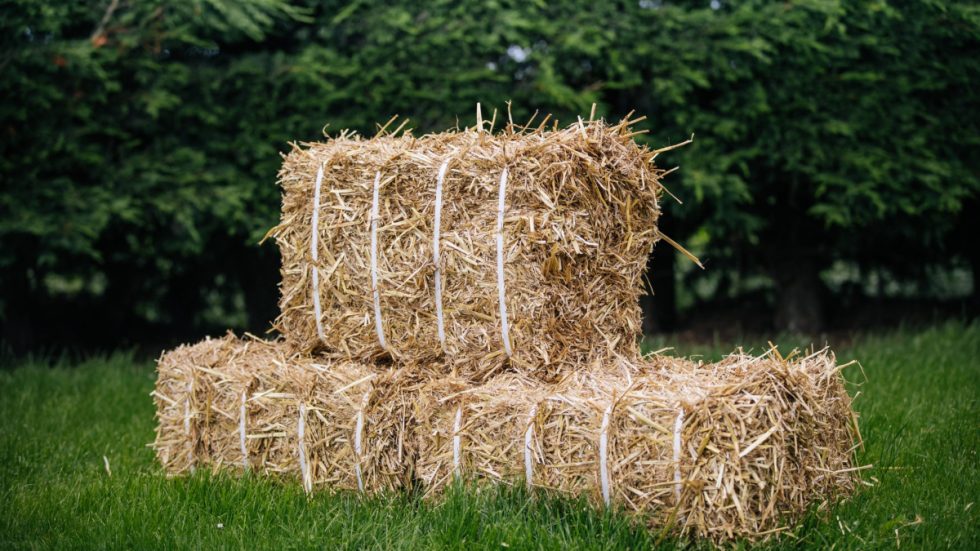
Making the bales was a process completed before we arrived. The rancher had cut the alfalfa with a mechanical scythe attached to a tractor. After a day or two in the sun and with the aroma from its violet and purple flowers still sweet, he’d raked the cuttings into windrows. The next day a baling machine scooped up and fed the windrows through a chute where the alfalfa was compacted, secured tightly with baling wire, then dumped to the ground in rows ready for bucking. Imagine, big green loaves of bread, 18 inches square and 3 and one-half feet long that weigh 90 to 100 pounds. Picking up and loading those bales required strength and attention.
We arrived at the ranch a little after dawn. The rancher had hitched his hay-wagon behind the tractor, ready for us to ride the empty flatbed to the field. There, he drove slowly alongside each row while two of us grabbed bales by the wires then bucked them aboard. The other two stood on the bed where they stacked them 5 layers high, the first layer side-ways and the second lengthwise—a weave of sorts—alternating each layer to secure the load for the ride to the barn. At the barn, the rancher parked the wagon below the loft’s big door. The boys stacking bales waited on the wagon while the boys on the ground climbed a ladder into the loft. Then, as Snyder says succinctly, “With winch and ropes and hooks,” the wagon boys hoisted the bales up to where, like 2 Captain Hooks from Barrie’s “Peter Pan,” the others gripped their hay hooks, ready to stab the bales and pull them inside.
The farmer’s wife made lemonade-runs mornings and afternoons. She brought lunch too. The first day, all the peanut butter and jelly sandwiches we could eat. The second, we feasted on fried chicken. We’d come to expect her chicken which the rancher had promised before we signed on. It was included in our verbal contract for the nickel-a-bale the four of us would divide equally as wages.
I remember my first harvest that first summer. After two days—daylight to dark—we had loaded, off-loaded and stacked in the loft, 1,280 bales. That is 1,280 bales x 5 cents a bale = $64, divided four ways = $16 a piece. Bucking hay was itchy, sweaty, and gritty hard work that left us bone-weary, but we could see what was accomplished at the end of each day—the art of it, the pattern, shape and beauty of a job well done. As a bonus, all those days haying, helped us get in shape for football.
In the 1970’s, I hired my own hay-bucker boys. Then, 5 years into the registered Hereford business, my ranch manager convinced me we could save 3 week’s work every summer if we had a round-baler. He explained the new baler scoops up windrows, wrapping the hay layer over layer, from inside to out, to make a waterproof bale weighing about 1,200 pounds. When a bale is proper size, the machine secures it with baler twine and drops it onto the meadow where it stays, without rot or mold, until needed. When it’s time, the bale is picked-up by a forklift-like contraption attached to the back of the tractor, moved to a manger, and dropped inside—a process of harvesting and feeding hay untouched by human hands.
I remember my first season of round-baling, standing high-up in that empty loft, leaning against the big door frame, and watching the new machine doing the old work. I was believing I had made a major contribution to what Snyder might call, The lost art of bucking hay. Yes, the round baler was efficient and quick, but it didn’t feel right without my high school boys. What had I done?
The young writers at Squaw Valley who didn’t know the work of bucking hay might have tried to imagine “. . . flecks of alfalfa / Whirling through shingle cracks of light.” Or, Snyder might have explained before he read. It is a conundrum. Will poems about people working at their craft be consigned to history books? Snyder, in another poem, “Axe Handles” quotes Pound, “When making an axe handle, the pattern is not far off.” Poems done well preserve knowledge and show the way. The axe handles metaphor works for a lot of things—like what is in plain sight. This is something Ciardi would encourage the poet to write—poems the reader can live in.
Hay For the Horses
Gary Snyder
He had driven half the night
From far down San Joaquin
Through Mariposa, up the
Dangerous Mountain roads,
And pulled in at eight a.m.
With his big truckload of hay
behind the barn.
With winch and ropes and hooks
We stacked the bales up clean
To splintery redwood rafters
High in the dark, flecks of alfalfa
Whirling through shingle-cracks of light,
Itch of hay dust in the
sweaty shirt and shoes.
At lunchtime under Black oak
Out in the hot corral,
—The old mare nosing lunchpails,
Grasshoppers crackling in the weeds—
“I’m sixty-eight” he said,
“I first bucked hay when I was seventeen.
I thought that day I started,
I sure would hate to do this all my life.
And dammit, that’s just what
I’ve gone and done.
~~~~~
Copyright 2025 H.C. Palmer
“Hay for the Horses” by Gary Snyder is included in this essay under the “fair use” copyright statute.
Discover more from Vox Populi
Subscribe to get the latest posts sent to your email.

Saturday! A perfect day for this prose, this poem in the month of March drawing to a close and we’ve been getting a little rain almost every day and have come to that feeling about things as would a man with a barn full of stacked Alfalfa, or a field of round bales, facing the remainder of a hard season. It’s a moment worry can rest, something sublime as this telling, the wonderful Snyder poem. I’m so grateful this day has come—wished, even hoped for yet unseen. And the equinox! The first day of Spring! We’ve crossed a wilderness to arrive in this place we’ve stood all along. What a world .
LikeLiked by 1 person