
Vox Populi
A curated webspace for Poetry, Politics, and Nature with over 6,000,000 visitors since 2014 and over 9,000 archived posts.
Robert Cording: Ghost Forest
Humpback Whale
I never saw the whale, yet cannot remove it
from my sight. In the story I read, it was evening,
the day had settled. A biologist, who was notified
of the beached whale, moves towards
the darkening outline of its startling enormity.
The whale is not just dead. Someone has
hacked off its flukes. Someone thought it would be
funny to stuff a cigar butt in its blowhole.
And there’s a heart with a couple’s initials
carved into its barnacled flanks to declare their love.
Sometimes I pretend I am that man walking
the length of the whale to measure what was.
And sometimes I remember the humpback breaching
near my grandfather’s boat on Long Island Sound,
the sound its fifty-foot body made as it slapped
down against the water over and over,
and the splash it sent up like I did as a child
discovering the play of my body. But mostly I think
of how the biologist must have known there is
no refuge from the unbearable he must bear home.
~~~
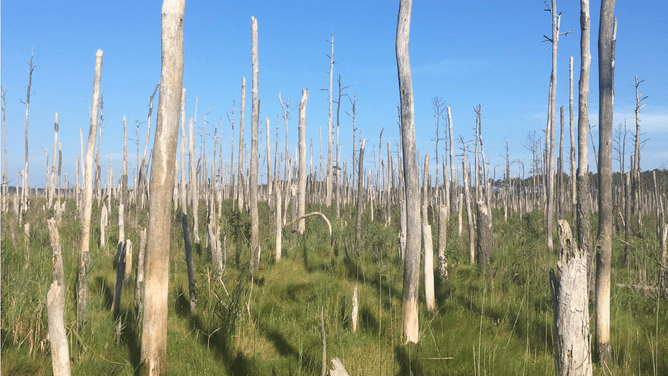
Ghost Forest, Marco Island, Florida
Some said it was a once-in-a century storm,
others the new normal of global warming,
but Ian’s fifteen-foot surge struck
the final blow after years of flooding,
the full moon high tides of rising sea levels
bringing the first deposits of salt into the forest.
Now, their roots blackened, the trees
bleached-out, the forest is nothing more
than gray pillars or skeletal trunks with branches
thrown up like arms in desperation
when people drown. A forest of memory,
the trees are apparitions when the moon
haunts the ghostly ruins at night.
When I take my grandchildren to see it,
they ask, What happened here? My answer is
not an answer: sometimes people don’t believe
what is taking place even when they can see it
with their own eyes. Tonight, I’m not here
to pretend this place that has been lost,
can be saved, but simply to stand here,
at the edge of what once was
and remember the sound of wind in the pines—
not that ocean sound, but something thinner,
quieter, older, ancestral whispers moving
through the spikey tops of the trees.
Or how, looking into a darkness
I could not penetrate, I’d see glowing eyes
and flitting shadows and hear sounds
I could not identify, though I could sense
how much life was going on beyond me.
~~~~
Poems copyright 2026 Robert Cording
Robert Cording’s many poetry collections include In the Unwalled City and Finding the World’s Fullness, both published by Slant Books.
Discover more from Vox Populi
Subscribe to get the latest posts sent to your email.

Beyond sad. Oh.
LikeLiked by 1 person
It seems, as your poems directs us, that everything is connected for better or worse. Haunting image.
LikeLike
The truth hurts, even when expressed so beautifully in both these poems—the first poem directly….the human ignorance and therefore our stupidity—and the second from our almost unified effort to extinct (is that a verb now?) ourselves.
LikeLiked by 1 person
Thank you everyone for your kind and heartfelt responses. We live in a world that delights us many times a day, and that more than warrants or care and love.
LikeLiked by 1 person
No redemption. Such distress. The cruelty and ignorance of humans. The Humpback Whale is a sad as anything I’ve every read.
LikeLiked by 3 people
Such ache in these poems, such profound sorrow in a voice given to what can no longer be. How difficult it must have been to write these seamless, beautiful, important, poignant poems, Robert! I stood — & still stand — with you on the beach, mourning the whale, aghast at its desecration, stood with you by the “gray pillars or skeletal trunks with branches thrown up like arms in desperation.” My heart is heavy, yet grateful for these poems: they urge me to pay attention to, & love what is still alive and beauty-full around me. These poems stir such awe in me…
LikeLiked by 3 people
Beautiful, Laure-Anne!
LikeLiked by 1 person
What stunning poems. I will now carry forward with me – ‘no refuge from the unbearable he must bear home’; the memory of the sound of wind in the pines, ‘a forest of memory’. So grateful there are poets to put such moving words to these haunting losses. Ever thanks to Robert Cording and to Michael.
LikeLiked by 1 person
Thank YOU, Jan.
LikeLiked by 1 person
Yes, Michael, poetry, politics, nature, the purposeful disregard for beauty, individual and global, the poet’s cry and our echoed sorrow.
LikeLike
perfectly said, Barb, thank you.
LikeLiked by 1 person
Oh, the mournfulness in our poems these days, with the cruelty and ignorance that surrounds us. And yet, Robert Cording stands with the tree skeletons, ancestral whispers, the dignity of the once thriving. He won’t let their beauty pass by without singing of them and the dialogue some people still share in their presence. Heartfelt thanks.
awestruck weeping is my response, like other commenters. If I was religious, I’d say pray for those slaughtered beings, with their denuded limbs akimbo, their flukes hacked away. Also, pray for us.
LikeLiked by 3 people
your comment is a beautiful elegy in itself, Jim. Thank you.
LikeLiked by 2 people
Almost exactly what I would have said. Robert Cording’s poems have been showing up everywhere for me lately. Here, yes the “mournfulness” and the urge to pray not only for what is lost, but for what is missing in our kind for this destruction, cruelty to happen. Thanks Michael for posting.
LikeLiked by 2 people
Thanks, Kathleen. I love these poems by Bob because they are beautiful elegies in themselves, and also they weave together poetry, politics and nature.
LikeLiked by 1 person
It gives me chills, the description of the casual lack of regard, of reverence, for that whale. And these wonderful lines:
“Tonight, I’m not here
to pretend this place that has been lost,
can be saved, but simply to stand here,
at the edge of what once was
and remember…”
LikeLiked by 5 people
Thanks, Jennifer!
M
>
LikeLiked by 1 person
Yes, I love these beautiful elegies and join the poet in grieving for our lost world.
LikeLiked by 4 people
We have already long prepared a Lexicon of loss for our speech beyond the Garden. I am amazed how much is gone, just from and during my days, and how I have to find ways to love what remains. There is still beauty, somehow enduring, and we have poetry to make and speak, like this—so masterfully done—and in so doing still lay claim to this ever diminishing world.
LikeLiked by 5 people
Beautifully said, Sean. Thank you.
>
LikeLiked by 1 person
Two of the saddest poems I’ve ever read. They make me weep.
LikeLiked by 7 people
Yes. And there is so much to weep for now, “there is
no refuge from the unbearable he must bear home.” Precisely this. I weep with you Susan.
LikeLiked by 5 people