
Vox Populi
A curated webspace for Poetry, Politics, and Nature with over 6,000,000 visitors since 2014 and over 9,000 archived posts.
Allen Ginsberg: The Velocity of Money
For Lee Breton
I’m delighted by the velocity of money as it whistles through the windows of
Lower East Side
Delighted by skyscrapers rise grungy apartments fall on 84th Street’s pavement
Delighted this year’s inflation drives me out on the street
with double digit interest rates in Capitalist worlds
I’m delighted by double digit interest rates in the Capitalist world
I always was a communist, now we’ll win
an usury makes the walls thinner, books thicker & dumber
Usury makes my poetry more valuable
Manuscripts worth their weight in useless gold—
The velocity’s what counts as the National Debt gets trillions higher
Everybody running after the rising dollar
Crowds of joggers down broadway past City Hall on the way to the Fed
Nobody reads Dostoyevsky books anymore so they’ll have to give
passing ear
to my fragmented ravings in between President’s speeches
Nothing’s happening but the collapse of the Economy
so I can go back to sleep till the landlord wins his eviction suit in court.
~~~~
From Collected Poems 1947-1997 (Harper Perennial, 2006). Included in Vox Populi for noncommercial educational purposes only.
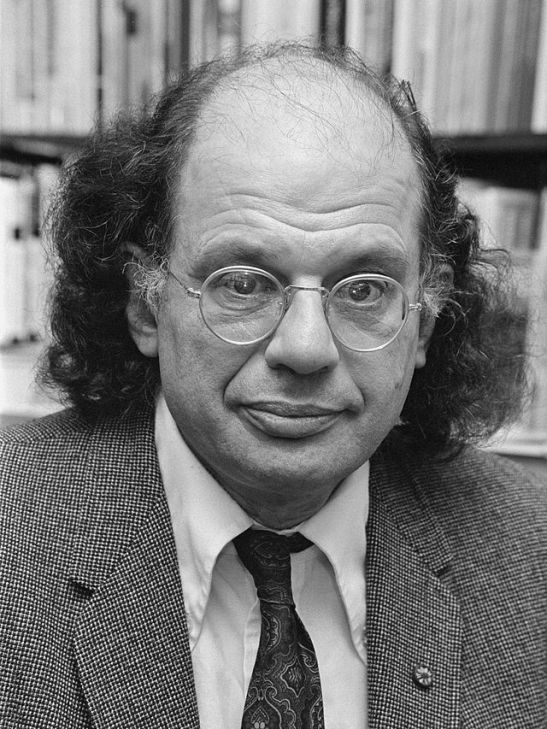
Irwin Allen Ginsberg (1926 – 1997) was an American poet. As a student at Columbia University in the 1940s, he began friendships with Lucien Carr, William S. Burroughs and Jack Kerouac, forming the core of the Beat Generation. He vigorously opposed militarism, economic materialism and sexual repression and he embodied various aspects of this counterculture with his views on drugs, sex, multiculturalism, hostility to bureaucracy and openness to Eastern religions.
Best known for his poem “Howl“, Ginsberg denounced what he saw as the destructive forces of capitalism and conformityin the United States. San Francisco police and US Customs seized copies of “Howl” in 1956 and a subsequent obscenity trial in 1957 attracted widespread publicity due to the poem’s language and descriptions of heterosexual and homosexual sex at a time when sodomy laws made male homosexual acts a crime in every state. The poem reflected Ginsberg’s own sexuality and his relationships with a number of men, including Peter Orlovsky, his lifelong partner. Judge Clayton W. Horn ruled that “Howl” was not obscene, asking: “Would there be any freedom of press or speech if one must reduce his vocabulary to vapid innocuous euphemisms?”
Ginsberg was a Buddhist who extensively studied Eastern religious disciplines. He lived modestly, buying his clothing in second-hand stores and residing in apartments in New York City’s East Village. One of his most influential teachers was Tibetan Buddhist Chögyam Trungpa, the founder of the Naropa Institute in Boulder, Colorado. In 1979 at Trungpa’s urging, Ginsberg and poet Anne Waldman started The Jack Kerouac School of Disembodied Poetics in Boulder.
For decades, Ginsberg was active in political protests across a range of issues from the Vietnam War to the war on drugs. His poem “September on Jessore Road” drew attention to refugees fleeing the 1971 Bangladeshi genocide, exemplifying what literary critic Helen Vendler described as Ginsberg’s persistent opposition to “imperial politics” and the “persecution of the powerless”. His collection The Fall of America shared the annual National Book Award for Poetry in 1974. In 1979, he received the National Arts Club gold medal and was inducted into the American Academy of Arts and Letters.
Discover more from Vox Populi
Subscribe to get the latest posts sent to your email.

I was lucky enough (with no credentials to speak of) to be a colleague of Allen’s at the first Naropa in 1974. Our poems were and are extremely different, but he said something crucial to me in my novice years: “You’re too worried about ‘poetry.’ It’s just a word; it’ll take care of itself.” He also taught me to lighten up as a teacher, to generate conversations rather than impose precepts… and that it was okay, if a student answered a question I couldn’t answer, to say, as he did, “I don’t know the answer, but I’ll find out if I remember.” And the earth didn’t yawn? Wow. We faded out of touch, but I’ll forevermore be grateful to him.
LikeLike
Ginsberg saw it all so clearly.
LikeLike
He really did.
LikeLike
The Bossman of American Counterculture. Diane Seuss speaks of him and his (and later her) “American Sentences,” in their poetry. How clearly we now see things from protest to the Art itself that were wildly radical during our upbringings now in clear focus, more reasonably intact than ever.
LikeLiked by 1 person
Thanks, Sean. Ginsberg was the pioneer for a new kind of poetry. Engaged, confrontational, unrestrained. I’ve learned so much from reading his work.
LikeLike
Go Ginsberg!
He always was a seer.
and yes he knew the sheeple would be our downfall. :((
LikeLiked by 1 person
Thanks, Margo. Ginsberg was one of the first poets whose work I fell in love with as a teenager. I loved his courage and his energy. Still do.
LikeLike