
Vox Populi
A curated webspace for Poetry, Politics, and Nature with over 6,000,000 visitors since 2014 and over 9,000 archived posts.
Sydney Lea: La Bella Vita
Every so often, but more now than in younger days, I’m inclined to rehearse moments that remind me how blessed I’ve been in marriage to my wife Robin. Some of the chief blessings, I think, involve times when we’ve discovered things as partners. This morning, for example, I somehow started to reflect things we learned on our honeymoon back in 1983. (We’d been cohabitating for a year, as her strait-laced grandmother believed, in sin.)
We’ve lived in Vermont since 1992, but in those days we lived across the Connecticut River in a small New Hampshire town. To that extent we oddly felt we’d come home when, having left behind the dreadful heat and crowds of Rome, we settled into a rented house in Umbria, a sturdy little structure built in 1434. Our village, Torre Gentile, consisted of 150 souls, according to Elsa Domenici, the town’s most prosperous native and, at 75, its unofficial mayor. Franco Doddi, to whom she leased the local bottega, suggested with a smile that the woman’s census must have included the local pigeons, turkeys and goats as well as “all the souls of the dead.”
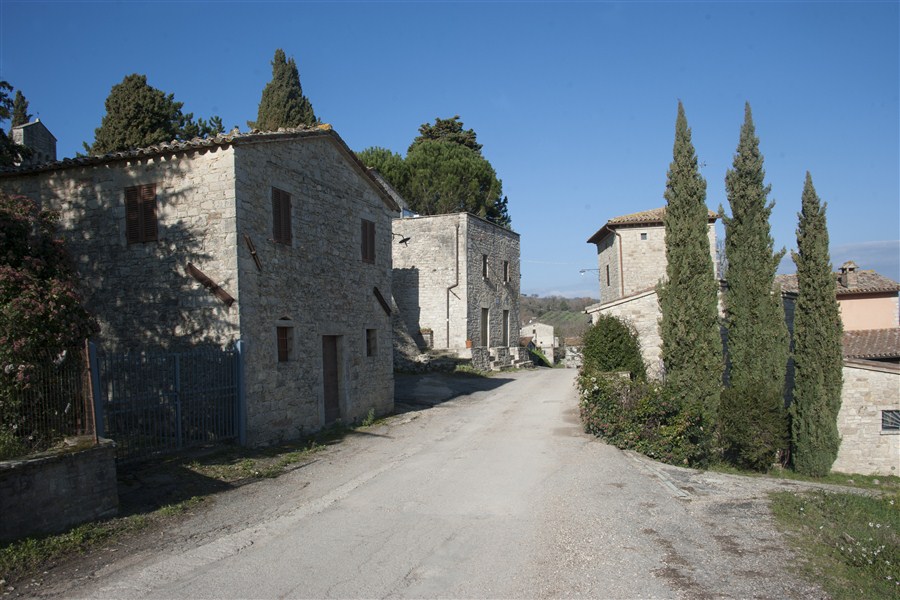
The actual number of citizens was around 50, we guessed, and for most– no matter the cars and motorbikes that coursed the gravel roads in the breakneck Italian manner– rural life had remained more or less the same for a long, long time. Farmers often did their summer fieldwork after dark in any year, and especially in that year’s especially torrid summer; we could hear their palaver well past midnight. When the day’s, or more properly the night’s labor ended, everyone not in diapers or in their final bed repaired to Franco’s shop for cool drinks, ices, and games.
La signora Domenici had assured us on our first day that in Torre Gentile, “c’è sempre calma, calma, calma.” But at one o’clock of that same morning, a dog began to bark in the self-hypnotized way to which some dogs are given: no breach of cadence or tone, merely a bow followed by a ceaseless series of wows.
I remember Robin’s saying, “Someone will do something about this soon.” And sure enough, we presently heard the shouts of a man who was calling his dog. Or so we surmised. But the shouts persisted for half an hour, in near sequence to the animal’s barks. There’d follow a lull of three minutes at most before everything started again. My ears were far better at 39 than at 83, and, listening carefully, I determined that the man shouted numbers, and that other men would now and then join in. At length, our exhaustion overcame curiosity and we drifted off.
In upper New England, at least four decades ago, it wouldn’t do for newcomers to stick their noses into local affairs too quickly. Things have changed by way of demographic, but five years was a good rule in our part of our state back then. How much longer, we figured, in a town five centuries older! So the next night, we simply stayed up chatting as the dog-and-man hue went on from 1 until 3 a.m. Quattro! Tre! Otto! Uno! Dieci! Sei! Sleep out of the question, we fantasized an explanation: a harmless madman in Torre Gentile habitually yelling numbers into the night, perhaps a senile oldster who recalled Mussolini’s militaristic bluster as a kind of poetry and called a befuddled marching cadence. Villagers, we supposed, not only tolerated but rather enjoyed this loony practice, because we heard frequent laughter in the hamlet’s square.
It wasn’t until our fourth day that we learned from Serena, the Doddis’ sweet ten-year-old daughter, who liked to visit with us, that what we were hearing was one of rustic Italy’s favorite games, Il moro, in which two players throw fingers and call out guesses at the total number.
Another enthusiasm in town was a card game about as simple as Go Fish, except that the loser of three hands in a row was required to suffer la penitenza. Signore Doddi, as arbiter, would the devise the victim’s penance. His ideas were ingenious, and his delight at inventing them was matched by the crowd’s delight in watching them play out.
In one case, he attached a cord to his 13-year-old son Valerio’s back belt loop and tied a spoon to the other end. Then he lit a candle and had the boy straddle it. Valerio had to waggle his hips until he’d put out the flame with the spoon. My wife, bolder than I by far, played the game and lost. Her first punishment was to fetch a small hard candy with her teeth from a box filled with flour, which she in time she did, her triumphant smile inversely Jolsonian. She played again, and her second penitenza particularly appealed to the male onlookers: Franco placed an egg just under the waistband of her jeans and challenged her do ten toe-touches without breaking it. She succeeded, thank God.
All this was great fun, but what struck us above all was the whole village’s participation. Elsa sat overhead on her balcony Franco, deferential, made sure of her approval. “Puoi Vedere, Signora?” he would ask her, can you see, to which she’d reply, “si, si, bene, bene,” braying her laughter whenever a particular punishment struck her fancy, or suggesting modifications otherwise. Knots of muscular teenaged boys stood here and there in the crowd. We admitted to one another at home that we’d expected the surliness at least, and maybe even the hint of U.S.-style macho hostility from these boys, but they seemed as much at ease and as entertained as the younger children with them.
Indeed, at least on our honeymoon, the sense that you could go anywhere at any time you wanted was tonic. We’d scarcely recognized how almost anywhere in America, we had at least a subtle worry about violence. In Italy, for a beautiful young woman like Robin, the principal threat came from the ubiquitous fanny-pinching hand of the Italian male.
It was scarcely that violence was a stranger even to this hyper-civilized land: the Fascists had been and in some quarters were still real enough, and the Red Brigade eerily inconspicuous that year, were the same. And we were always conscious of the carbinieri in important places, lead-vested and toting Uzis. But what we mainly encountered was a genial half-chaos, as in those village games.
Or in certain odd incongruities. In Perugia, for example, Communist headquarters occupied the second story of a building whose ground level housed a high-end jewelry store. On the highway, fearsome Maseratis and Ferraris flew along with bicycles, mopeds, scooters, small, three-wheeled trucks, and swarms of Fiats, all driven at maximum speed but with rarer instances of catastrophe than at home and almost no demonstrations of ill temper among the drivers.
It was all impossible… and yet it seemed mostly to work. Just as the church did. In The Dyer’s Hand, W.H. Auden’s Utopian religion would be, he says, “Roman Catholic, but in an easygoing, Mediterranean sort of way.” And indeed, we were impressed by how churchgoing in Torre Gentile was above all a social matter. Was it the strange coincidence of Italian anti-clericalism and Catholic piety that accounted for the scene we beheld when we attended services? The laity seemed often to ignore the liturgy, moving around to visit and chat with one another without reprimand from anyone, including the priest. Prayer appeared to be largely a private matter, individual worshippers, women mostly, veering off into side alcoves, their missals closed. Yes, like the precious games in the tiny piazza, church was above all a communal thing.
Yet how powerful, how far from “easygoing,” how passionate were Italy’s artistic monuments, so many of which we found, precisely, in church and cathedral. I made this observation one evening at dinner with distinguished company, hosted by an American couple with a vacation home just outside the village. She was an internationally renowned sculptor and he an esteemed journalist and author. Our hostess contended that few of Italy’s great masters had been truly motivated by Christian belief, that they were “just doing their jobs.”
Conscious of knowing less on the subject than she did and of my own uncertain beliefs, still I argued otherwise, however briefly. (Lying in bed that night, I very charitably defended my uncertainty by claiming as Keats did that I had the poet’s natural inclination to see both sides of an issue with passion.) My challenge ignited a sophisticated discussion, part theological, part philosophical, part historical, of religion’s role in art. What could heaven or hell have meant to a Raphael or a Fra Angelico? It was as close, I rightly imagined, as we’d ever get to a genuine salon, and it was, to be sure, fascinating. Our hosts and their guests were more than merely “interesting.”
Yet right along, I’d felt, as I later discovered my wife had, that something was missing from all that high-minded discourse. We discovered what it was on the road back to Torre Gentile, where on a Saturday games would be well under way as early as 9 p.m. In the twilight, we saw Elsa trudging uphill toward us, carrying a clutch of flowers and a watering pail. It turned out to be her weekly visit to the grave of her husband, who’d died in a fire two summers before. Even as night came on, the air was steamy, and we offered to turn around and drive her to the cemetery. She accepted, and at one point she whispered, “come è brutta questa stradina.” How ugly it is, this little road. Once we reached the graveyard, we told her that we were in no hurry, that she should take whatever time she needed.
For some twenty minutes, we heard her prayers and lamentations from behind the walls. And it was impossible not to be moved. Suddenly, in a shower of dirt and gravel, a Fiat Ritmo arrived, from which emerged a fashionably attired woman who looked to be in her thirties, bearing her own little bouquet. Soon we heard conversation beyond the enclosure. It quickly escalated in pitch and good humor. The two women eventually came out and embraced beside the younger one’s car, which then sped away.
It turned out that the younger woman was a relative of Elsa’s dead husband who’d moved to Orvieto some time since but who would periodically come to deck the man’s headstone too. “I haven’t seen her for at least a year,” Elsa exclaimed through her tears. “Can you see how beautiful life can be?”
I thought back on the erudite talk we’d just heard at the dinner party. It would have been rude, not to mention sentimental, to dismiss that conversation as of little worth. By training and by inclination, I’d set a high value on the cultivated exchange of words, and yet the sight of La Signora Domenici, her smiles and tears equally radiant outside the tiny cemetery, seemed to suggest the limits (the heaven and the hell) of human experience better than any words might. And, we later agreed, what might transcend cultured dialogue could find eloquent expression in seeming banality: “This road is ugly” or “how beautiful the world can be.”
~~~~~
Copyright 2025 Sydney Lea
Discover more from Vox Populi
Subscribe to get the latest posts sent to your email.

Apologies for Nike rather than Mike! Happy ‘’26!Sent from my iPhone
LikeLike
I rather like being called Nike. The name locates me somewhere between a god and a shoe.
>
LikeLike
🤣Sent from my iPhone
LikeLike
Oh, how that takes me back. What a wonderful story, wonderfully told. I forgot how simple life could be and how enchanting the small things. Thank you, you made my day. Happy New Year to all. May we remember the ‘God of Small Things’. https://www.youtube.com/watch?v=O9GzqWngy1g
LikeLike
So glad I read this remembrance. So often we forget or belittle the importance of neighborhood. We simply forget or disregard others; we forget we are all in this pot of chaos together. I am so guilty myself. It also reminded me of the two words or phrases that make me cringe when I hear them, usually spoken on the media. The term expert is used all the time; experts say we should do this if….!@?:! experts! Also, the phrase “ordinary people” often spoken by the self proclaimed Elite, usually politicians…”we must make life better for ordinary people” belittles us poor non-expert, non-elites.
Ok, I feel better. Have a nice day.
LikeLike
I could not stop reading this lovely essay — you had me smiling so many times throughout the piece: what vivid details, what fun stories!
LikeLike
A wonderful essay, Syd. It will stay with me.
LikeLiked by 2 people
Thank you, Syd, for this vivid remembrance and the wise equipoise that brings it to a close.
LikeLiked by 2 people
What lovely discourse, what beautiful life. I returned from Cortona in 1992 after a brief visit, my first (and so far, only) to Italy, during the 500th anniversary of Piero della Francesca’s death. All of Tuscany had his paintings out, places open for them to be seen, and as we passed road signs, directing us to painting locations as roadsigns in America direct us to hospitals and airports, Spending my days, visiting the green grocer, buying (and drinking) the daily bottle(s) of wine, going to the bakery each morning and coming to know the citizens who dropped their cautionary facade soon as they understood my presence and warmed to it, I came to realize I was in one of the most agreeable circumstances of civil and cultural propriety of my lifetime. After even such brief decompression from America, I had culture shock returning to my own country, and truly had to get over the idea of having to live there. I still have that haunting notion we’re not living but rather killing ourselves here.
LikeLiked by 3 people
Lovely sketch, Sean. Thank you!
LikeLiked by 1 person
Thanks, as ever, Nike! And how perfect a photo!
A tiny glitch: paragraph eight has the word the where no word at all should be– ” would the devise the victim’s penance.
Happy 2026!
Syd
LikeLiked by 1 person