
Vox Populi
A curated webspace for Poetry, Politics, and Nature with over 6,000,000 visitors since 2014 and over 9,000 archived posts.
Terry Blackhawk: Legacy of Flames
i. Globe lightning
They say it could happen anywhere,
storm clouds piled high, swooped
in from across the plains, heavy air
split, not by a jagged bolt dropped
towards the ground, slamming
into the earth, but a plasmic build-up
of transient energy, a roiling, flaming
globe of ions and static—a blue one,
one July at 326 S. Douglas came swarming
up the walk, or so Uncle Don told me, then
just as it reached the porch, disappeared.
It was the late 1920s, two decades beyond
the riot of ‘08, whose whiff of death, like the weird
smells loosed by the orb, must’ve lingered…
ii. Tree as monument
For if they do these things in a green tree, what shall be done in the dry? Luke 23:31
…and lingers still. A forsaken tree—replica,
bronzed, from a Black-owned barbershop, lone
obelisk—pierces the heart, America.
A trunk without branches, accusing token,
the sculpture points skyward in mute memoriam
to the battering, the desecration
of a body let dangle from its limb
then gouged, sliced, and still the mob
craved more. For trophies, some climbed
the trunk, tore into bark, heartwood, chopped
chunks of wood, stand-ins for what I shudder
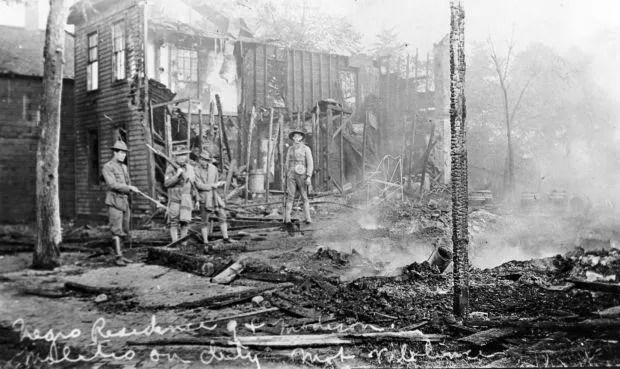
to name. In the post-riot photo, limbs lopped off,
the old elm stands near the burnt-out shop where
it once gave shade to its murdered owner.
iii. Tree as Souvenir
I think how Springfield’s “Old Elms” (per my father’s
poem) turned streets to Gothic aisles that cooled
his boyhood afternoons, and wonder what his father
must’ve seen that night (“witnessed,” my dad told
me) and what magnet of sickness and hate
sucked my grandfather into the mob’s soiled
maw. Years later, Grandpa Pete would berate
the TV for sending Sammy Davis, Jr.
or any brown-skinned star into his white
domain. So see, can we say he was fever-
gripped all his days, capable of turning even a tree
into other? And did he take as souvenir
a chunk of elm to dust and display beside tea
cups, glass goblets, crystal from Germany?
iv. Concerning the Car
In a town full of horse-drawn buggies, few
cars: mark of class, only up-and-comers
had them. Loper, a restauranteur, knew
the risk, or did he? A man of commerce,
clout, at ease with “Negroes,” he’d lend
the sheriff his car. Before things got worse,
they’d flee the swelling, murderous band,
spirit Richardson, accused of rape, into the next
county. Far from “heinous” headlines, the errand
saved his life while robbed of its prey, the mob vexed
to rage, torched Black houses, dragged from their homes,
lynched Burton, the barber, Dunnegan, a cobbler, wrecked
Loper’s in the burning after. It consumes,
looms over me now, this legacy of flames.
~~~~
~~~
Author’s Note: In 2024, President Joe Biden designated a national monument at the site of the 1908 Springfield IL Race Riot. Today, on the US Department of Interior website, where a page on the riot has been removed, contains this language: “Any previously issued diversity, equity, inclusion or gender-related guidance on this webpage should be considered rescinded.” The description of the bronze memorial tree (part ii) is taken from a video found on the Springfield IL NAACP website detailing plans for a monument. The monument has yet to be built.
Poem copyright 2026 Terry Blackhawk
Terry Blackhawk is a teacher and poet. Her many books include One Less River (Mayapple Press, 2019).
Discover more from Vox Populi
Subscribe to get the latest posts sent to your email.

What an amazing poetry and writer at the service of its true role in culture: To say the unspeakable. Life is everyone’s “controlled burn” run amuck. We all must ultimately share in the common shame of our humanness. We must read and write these poems.
LikeLike
Yes, thank you, Sean. You always find the right response.
LikeLike
Once again I will post of Facebook. If any of my friends are still there, please let me know if you can see it.
LikeLiked by 1 person
Such superb imagery and a tone of utter clarity and urgency — such a range of emotions. A haunting cadence and sounds. Such tension and ardor — what a poem!
LikeLiked by 3 people
These sonnets, the poetry form first associated with love, create a kind of formal irony, carrying the hate of racist America. And I hate what I read here and love that you write it. I too will be sharing these today. Thank you, Terry, for making poetry that needs to be heard.
LikeLiked by 4 people
Well-said, Mary. Thank you.
LikeLiked by 1 person
Terry, your sonnets sing the sad song that must be sung, that must be heard. Thank you for your sturdy voice.
LikeLiked by 4 people
This poem is such a powerful accusation of the ignorant, racist mindset. “capable of turning even a tree / into other?” I’ll share it on my FB page to expose it to more eyes and hearts.
LikeLiked by 3 people
Thanks, Rose Mary!
>
LikeLiked by 1 person
Brava, Terry Blackhawk, Brava! Thank you for writing this poem. To call it profound, important, vital feels like such an understatement. May your words, and their reverberations, travel far and wide.
LikeLiked by 3 people