
Vox Populi
A curated webspace for Poetry, Politics, and Nature with over 6,000,000 visitors since 2014 and over 9,000 archived posts.
The True Story of Thanksgiving
The Thanksgiving story you know probably goes like this:
English Pilgrims, seeking religious freedom, landed in Plymouth, Massachusetts, where they found a rich land full of animals and were greeted by a friendly Indian named Squanto, who taught them how to plant corn.
The true story is more complicated — and more interesting. According to historians, here’s what really happened:
In 1614, six years before the Pilgrims landed in modern-day Massachusetts, an Englishman named Thomas Hunt kidnapped Tisquantum (a.k.a. Squanto) from his village, Patuxet, which was part of a group of villages known as the Wampanoag confederation.
Hunt took Tisquantum and around two dozen other kidnapped Wampanoag to Spain, where he tried to sell them into slavery. But Tisquantum escaped with the help of Catholic friars, then somehow found his way to England.
He finally made it back to what is now Massachusetts in 1619. As far as historians can tell, Tisquantum was the only one of the kidnapped Wampanoags ever to return to North America. But while Tisquantum was in Europe, an epidemic had swept across New England.
There had been a shipwreck of French sailors that year on Cape Cod who had introduced an infectious disease, perhaps viral hepatitis, to the native peoples. The infection spread quickly, wiping out whole villages. When Tisquantum returned to Patuxet, he found that he was the village’s only survivor.
Into this disaster bumbled the Pilgrims. They showed up in New England a few weeks before winter and promptly began starving. Up until the Pilgrims, the pattern had been pretty clear. Europeans would visit the Wampanoags who would be interested in their trade goods, but were really uninterested in letting Europeans permanently occupy the land. Often, armed native people would force Europeans to leave if they attempted to stay too long. This time, the Europeans wanted to stay, and the disease that had decimated Patuxet ensured that they had a place to settle.
When the Pilgrims arrived in Patuxet, they found cleared land and the bones of what they assumed were savages. They called it Divine Providence, believing that God had killed these pagans so that Christians could live on their land. The graveyard of Tisquantum’s people became Plymouth Colony.
Meanwhile, Massasoit, a local Wampanoag leader, looked at Tisquantum and smelled trouble. Massasoit kept Tisquantum under what was essentially house arrest until the Pilgrims showed up hungry and clueless.
Patuxet wasn’t the only native village decimated by the plague. The entire Wampanoag confederation had been badly hit — as much as 75 percent of the Wampanoag population was wiped out. But the Narragansett, a rival neighboring group, basically weren’t affected by the disease at all. That put the Wampanoag in a precarious strategic position. But Massasoit had an idea to save his people. He would forge an alliance with the new settlers.
On March 22, 1621, Massasoit went to meet with the Pilgrims. He brought Tisquantum along to translate, but he didn’t trust him.
Let’s pause in our story long enough to note that Tisquantum was probably not the name he was given at birth, but sort of a nickname for a guy who had a talent for squeezing safely through disasters in which everyone else died. In that part of the Northeast, tisquantum referred to rage, especially the rage of manitou, the world-suffusing spiritual power at the heart of coastal Indians’ religious beliefs. So when Tisquantum approached first the Wampanoag and then the Pilgrims and identified himself by that sobriquet, it was as if he had stuck out his hand and said, “Hello, I’m the Wrath of God.”
Shortly into the conversation, Tisquantum, true to his name and reputation, tried to pit the Pilgrims against Massasoit, perhaps in an ill-advised coup attempt. But the plan didn’t work: Massasoit caught onto the plot and demanded that the Pilgrims hand Tisquantum over to be executed for treason.
However, the Pilgrims had their own plans for Tisquantum which involved him teaching them how to grow crops so they could survive the next winter. For Tisquantum, the choice between working as an agricultural consultant for the Pilgrims or being executed as a traitor by Massasoit was an easy one to make.
By their second autumn in the New World, the settlers’ situation was secure enough that they held a feast of thanksgiving. Massasoit showed up with about ninety men, most of them with weapons. The Pilgrim militia responded by marching around and firing their guns in the air in a manner intended to convey menace. Gratified, both sides sat down, ate a lot of food, and complained about their neighbors, the Narragansett.
And today, of course, the descendants of both the English and the Wampanoag are still around.
For further reading, see 1491: New Revelations of the Americas Before Columbus by Charles C. Mann. Second edition published 2006 by Vintage.
This historical account has been adapted by Michael Simms from an article by Nick Baumann published in the Huffington Post which was in turn based on interviews with Charles C. Mann and with Paula Peters, a member of the Mashpee Wampanoag tribe and an expert on Wampanoag history.
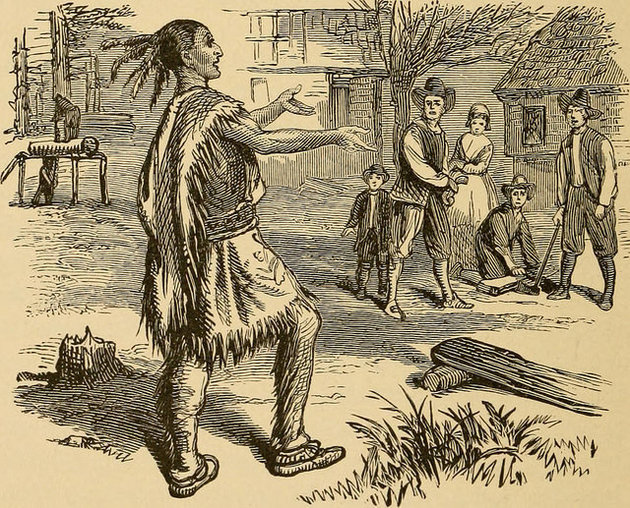
Illustration from a nineteenth century textbook (Library of Congress)
Discover more from Vox Populi
Subscribe to get the latest posts sent to your email.

“The Pilgrim militia responded by marching around and firing their guns in the air in a manner intended to convey menace. Gratified, both sides sat down, ate a lot of food, and complained about their neighbors, the Narragansett.” Seems that not much has changed. 🙂
Shared.
LikeLike
Yep. Same old posing and fighting.
>
LikeLike
Well, of course, it WOULD be the last time you ate dinner at anyone’s house. Maybe that’s why no one ever comes over for dinner?
LikeLiked by 3 people
hahahah. Yeah, I noticed that you and Emily don’t have your holiday parties anymore. Am I the last guest standing?
LikeLiked by 2 people
The much loved and missed annual holiday parties that involved sometimes hundreds of folks ceased when Covid hit. When we finally got over that lockdown, Emily and Mel just decided we couldn’t do it anymore. I’m 80, Emily’s a young 73, and believe me, as much as we loved keeping the tradition, it was a LOT of work. Now last year, we did do an Anniversary Party with Tony Buba and Jan McMannis at the Serbian Club in Southside with anyone and everyone invited and about 200 showed up. We will do that again in 2026 for our 40th Anniversary. We’ve already reserved the hall. So mark your calendars now. Oct 3, 2026, EVeryone is welcome. We’ll have some food, but it will be mostly potluck, it’s a cash bar (from which we do not benefit) and we have to clear the hall at midnite. Much easier, no cleanup, etc. We will probably make it some sort of benefit.
LikeLike
And when those friends are gone, dear Puritan, and you’ve stolen their land, for the next Thanksgiving you invite some witches.
LikeLike
I generally tell everyone a much simpler, but accurate version that I heard from some comedian long ago and can’t remember who for credit. If anyone asks me if I celebrate Thanksgiving in the traditional way, I always reply, “Yes, I have many of my friends over, feed them well, and after dinner I kill them all and steal their land.”
LikeLiked by 3 people
That’s the last time I eat dinner at your house, Mel.
>
LikeLiked by 4 people