
Vox Populi
A curated webspace for Poetry, Politics, and Nature with over 6,000,000 visitors since 2014 and over 9,000 archived posts.
Lao Yang: “Magnolia” by Michael Simms, translated into Chinese and recited 《玉兰》
《玉兰》
作者:(美国)迈克尔·西姆斯
中文朗诵:老杨
英文朗诵:老杨
配乐:小草
假设你把你所爱的紧紧地握在手里
你把它弄坏了
假设你让一些东西溜走了
你的眼睛在那一刻看向别处
玉兰的花瓣已经在落
随着每一阵微风
这是不可避免的,我推测
四季一直在起起落落
天空始终变幻不定
十四年没有听到你的声音了
我不知道你要说再见
~~~
Magnolia
Suppose you held what you love so tightly
you broke it
Suppose you let something slip away
Your eyes looking away at the very moment
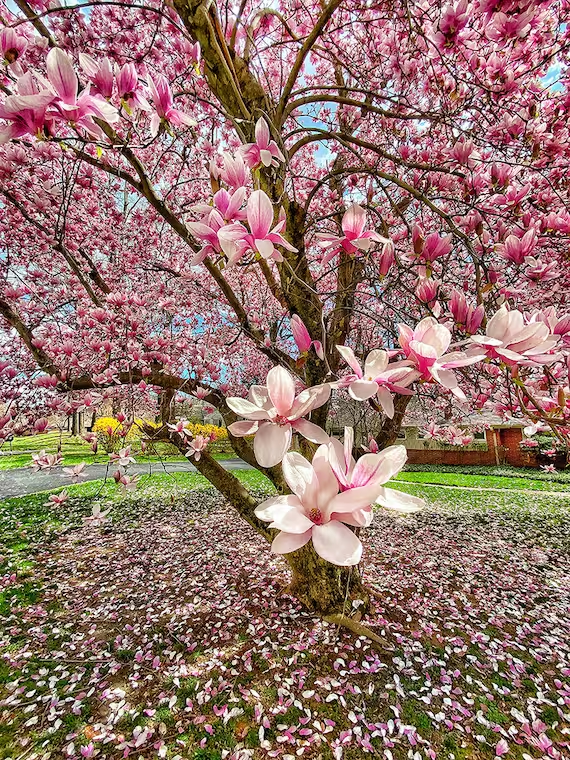
The magnolia tree already dropping its petals
with each breeze
It was inevitable, I suppose
the seasons rising and falling
the sky changing
Fourteen years since I’ve heard your voice
I didn’t know you were saying goodbye
~~~~
English version copyright 2025 Michael Simms. From Jubal Rising (Ragged Sky, 2025)
Chinese version copyright 2025 Lao Yang. This poem is part of an album to be released soon as Ten Love Poems Recited by Lao Yang.
Thanks to Ma Yongbo for facilitating this cultural exchange.
Lao Yang, originally from Henan, lives in Southern California. He majored in English as a student, worked as a teacher and in foreign trade, and is now retired.

Discover more from Vox Populi
Subscribe to get the latest posts sent to your email.

How truly wonderful! The poem and that it has been so lovingly translated.
LikeLiked by 1 person
I love the sound of the poem in Chinese.
When it was first published in English last year, a poet said it sounded very “Chinesey”
And now I know what he meant!
>
LikeLiked by 1 person
This poem is beautiful, Michael. What an honor to have it translated and spread widely in the world.
LikeLiked by 1 person
Thank you, Stephanie. Yes, it is an honor. Strange how things we think we deserve we don’t receive, but then something wonderful and completely unexpected appears in our lives.
>
LikeLiked by 2 people
Elise Kazanjian writes: What a glorious poem, Magnolia. I read it several times and loved it.
I listened to Lao Yang’s reciting in Chinese, and could almost understand all of it which pleased me.I’m used to the Beijing and Tianjin dialects, so Henan is not that far away. However, I have forgotten a great deal of the language and characters, but renew it whenever I eat at favorite Chinese restaurants here in SF.
I tried to add a comment on the poem page but was not successful. I’ll try again.
Many thanks for writing a poem that was a perfect Saturday morning gift.
LikeLiked by 1 person
nice poem. I loved the Chinese letters. Looks to me like beautiful tiny surreal inscription. Greetings to the poet and the translator, both.
i read lately Wei Huei. Earlier Three sisters by Feiyu. China is an alive nation.
LikeLiked by 1 person
Thank you, Saleh. Yes, China has many poets worth reading, both contemporary and classical.
>
LikeLiked by 2 people
great!I have shared the link to my FB and also sndt to Yao Jianxiong, the organizer of the album, asking him to pass it on to Lao Yang. I have no contact with Lao Yang, the reciter himself. yongbo
LikeLiked by 1 person
Thank you, Yongbo. I am very grateful for your help.
>
LikeLiked by 1 person
Congratulations, Michael. Absolutely beautiful. Linda Blaskey
LikeLiked by 1 person
Thank you, Linda! I love your poems as well!
>
LikeLiked by 1 person
Bravo of wind.
LikeLiked by 1 person
The bravo of you, Frank.
LikeLiked by 1 person
… bellezza dell’Arte (la tua)…
Bella esperienza artistica, evento multisensoriale di pace e bellezza. Grazie.
LikeLiked by 1 person
Grazie. You have a beautiful soul, my friend.
>
LikeLiked by 2 people
This is really lovely…simple language, deep feeling.
LikeLiked by 1 person
Thank you, Dion!
LikeLiked by 1 person
What extraordinary beauty and sorrow and this poem, and how wonderfully surprised I am to hear how clearly the Chinese picks up the tones. What a great experience. That melancholy tone not erased by the poem’s music and imagery, its grace, will be with me all day. Thank you and Lao Yang!
LikeLiked by 1 person
Thank you, Mary!
LikeLiked by 1 person
Listening to this went to my head in the most marvelous way, Michael. I will have to repeat the experience again and again. Thank you (both!) — for the writing and the reading. And I am particularly glad for the complete repudiation of that irksome claim that “poetry is what gets lost in translation.” So much gratitude to you and Lao Yang.
LikeLiked by 1 person
So much gratitude to YOU, Annie.
LikeLiked by 2 people
A gentle, moving, gorgeous, heartbreaking poem. So much packed into so few words. To hear it read in Chinese is fascinating and very, very beautiful. It’s as though your poem had been translated into music. Sharing it now.
LikeLiked by 1 person
Thank you, Rose Mary! Our online friendship means a great deal to me.
LikeLike
That’s mutual, Michael.
LikeLiked by 1 person
What a lovely poem about regret and disconnection, all on its own in written English.
Adding the magnolia photo, and the guitar’s accompaniment to both the readings in Chinese and the original, enhanced the final work of art for me. A collaboration on many levels, this one. You might try more of these in your mixology of the future…. The sound of the voice worked to cross a cultural gap, I think. And add a meditative feel to the whole.
LikeLiked by 2 people
I agree, Jim. This presentation goes beyond one poet’s words on the page and becomes a collaboration of artists.
LikeLiked by 2 people
heartbreakingly beautiful. Oh oh oh, this tender tragic human experience. Every hello could be the last goodbye. Thank you for this poem ❤
LikeLiked by 2 people
Yes, every hello could be the last goodbye. What a beautiful sentence, Moudi.
LikeLiked by 1 person
Wow. What a lovely poem, Michael, and what a stunning audio recording. Listening to the translation left me breathless.
LikeLiked by 3 people
Thank you so much, Christine!
LikeLiked by 1 person
How touching this is. How very very touching to hear those two languages talk together –blooming. How I loved listening to this!
LikeLiked by 5 people
Thank you, Laure-Anne. VP readers love your work! As do I.
LikeLiked by 4 people
It was a first time for me, hearing a poet read–in a language I do not know–his own translation into English of a poet whose work I do know.
I feel so clumsy and inadequate writing about the experience . . . but here I go:
I had cheated (is it really cheating?) by first reading your poem in English. And so I had been affected by its beauty: in nature (magnolia petals falling), and in the personal/universal intimation of loss. Then to hear the reading: Lao Yang’s using his own voice, his own language, as the beauty unfolds down the delicate (fleeting?)vlines.
Thank you, Michael.
LikeLiked by 5 people
Thank you, Maddie, for this brilliant response. I am honored.
LikeLiked by 3 people
oops. I meant to say “into Chinese”! Told you I felt clumsy! 😉
LikeLiked by 1 person
Michael: I wish I could explain the narcotic effect Chinese poetry has on me—as Hayden once said—carries me to distant Islands. Its almost cruel how you subject me to this on occasion…I’m not the same all day.
thankyou.
LikeLiked by 6 people
Oh, Sean, you are the William Blake of our time. Your praise means so much to me. Thank you.
>
LikeLiked by 3 people