
Vox Populi
A curated webspace for Poetry, Politics, and Nature with over 6,000,000 visitors since 2014 and over 9,000 archived posts.
Robert Cording: Dome Houses
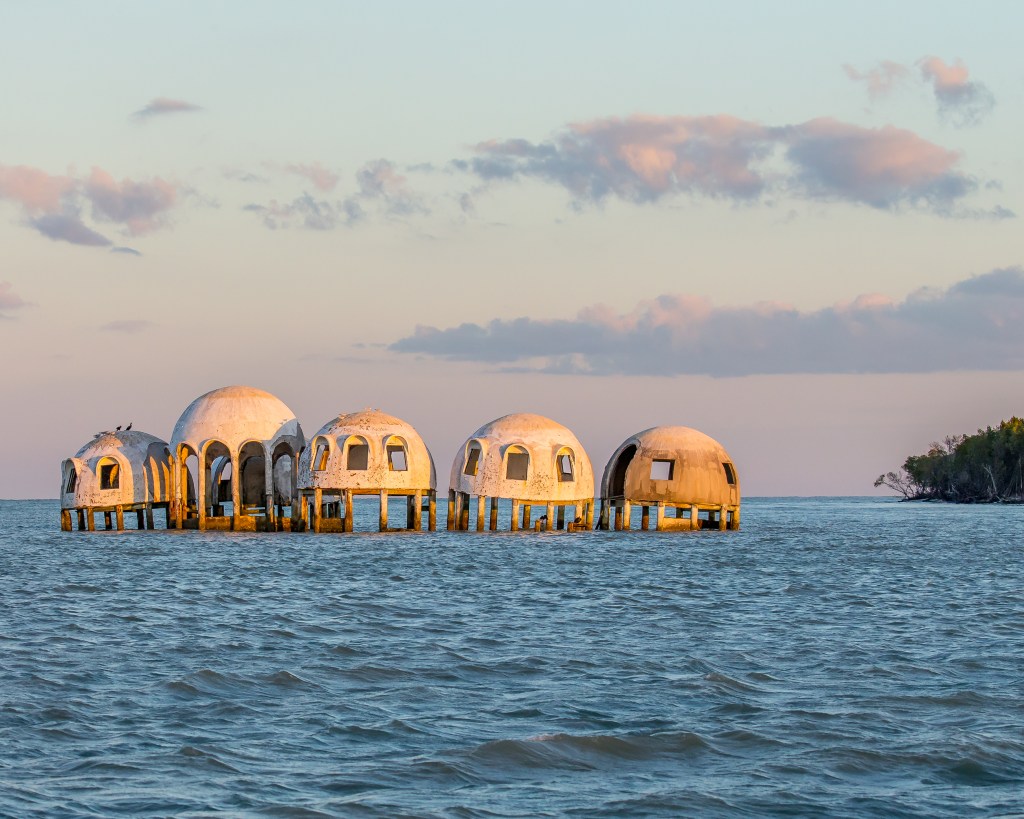
~
Dome Houses
Cape Romano, Florida
When erected, the domes must have looked
like something built to colonize Mars.
For a time, they were someone’s home,
six interconnected domes built on an old idea:
self-sustainability. Solar power, sun-heated
floors, gutters that collected rainwater
in a purifying tank. Chickens, turkeys, goats.
The builder loved inventing things;
and, most of all, just watching the weather,
his daughter said. The weather
did their family in, hurricanes that worsened
year by year as the water heated, eroding
the beach and leaving the domes tilted
in the rising Gulf, stranded for years,
then erased entirely by Hurricane Ian,
vanishing like a species of birds, or a future
no one wanted to preserve. Now, it’s a home
for the fish and rays that have taken up
residence. Snorkelers come. And boaters
and photographers who’ve charted
the domes’ slow disappearance.
When I last saw them, one dome was
already gone, the others a gathering place
for pelicans and graffiti. Flashes of sunlight
sped across the water. I imagined the father
smiling at the elegant rise and dip of dolphins.
Today, millions of shimmering, silvery baitfish
swirl in iridescent clouds above the ruins.
~~~~
Flaming in the Distance
When out-of-control wildfires
in the Texas panhandle,
wind-whipped at fifty miles
an hour, blazed towards Lubbock,
the home of an old friend,
I thought of his love for birds,
and making poems,
and for his daughter, Sophie,
a child when I saw her last,
but a teenager now who would need
to live in this world now much worse
than the one he and I were given.
He’s told me she likes to watch birds
with him and ride her horse,
and so I imagine her riding
towards a sun-stunned grassland
where the long necks of sandhill cranes
stick up out of the flatness.
I’d like to believe she recalls
what her father said in a poem once:
the cranes have been here
for two million years.
Perhaps she brings them closer
to her with binoculars, their red caps
flaming right before her eyes;
their neck feathers shimmer,
a silvery grey pearlescence
as she counts the shades
of earthy tans and sky greys
in the loose bundle of feathers
at the cranes’ back end. And maybe
she wishes she’d seen them fly in,
necks and legs making a line
against the hazy sky, and wonder
if seeing them is the sign of good luck
she’s heard about. When she turns
toward home, the sky to the north
is dark with the smoke of fires held off
for now by the lucky accident
of a cold front lodged just south of her.
~~~~
Copyright 2025 Robert Cording
Robert Cording’s many poetry collections include In the Unwalled City and Finding the World’s Fullness, both published by Slant Books.
Discover more from Vox Populi
Subscribe to get the latest posts sent to your email.

These poems are strong examples of how we as individuals, and as a species, are renters on this orb, always facing the chance of eviction for our acts. Those quasi-Martian domes also remind of Elon Musk’s dream to escape the earth to Mars to prolong his lease on a narcissistic life.
Long ago, a friend of mine from Nebraska stopped by on her way back home. I asked what she was going to do there, and she said, “sit by the Platte, to watch the sandhill cranes.” I asked her what they sound like, so she leaned her head back, and rattled the song of the sand hill crane. In the poem I wrote about it then, I said she was “in the ecstasy of her bird.” Renae is long gone from my life, but I think of that moment as a powerful reminder of how we sometimes interact to transcend the limitations of our species, and the rental of our time here. Peace to those who, like Robert Cording and Renae, help light our way.
LikeLike
Beautiful comment, Jim. I so look forward to reading your responses every morning.
LikeLike
Thank you. It’s a pleasure and honor to be part of the Vox Populi readership. Plus, the poems you post invigorate creativity for many of us readers.
LikeLike
Just back at home–thanks everyone for your careful attention to my work.
Bob
LikeLiked by 1 person
Thanks, Bob. I love the careful precision of your poems.
LikeLike
I love the sad whimsy of those dome houses. I’ve never seen them before or heard their story–a little metaphor for our own demise.
LikeLike
Exactly!
LikeLike
Ozymandius domes, and this perspective on Sophie and her loved plains and grasses and birds and the beautiful details of the cranes bodies. Fine poetry of loss and impending loss. Pre-elegies. I need to read more of Robert Cording. Thanks, Michael.
LikeLike
Bob Cording is great!
LikeLike
Beautiful poems, Robert Cording. (On a side note, I’ve never met Sophie, but I met her wonderful parents years ago when I gave a reading at Texas Tech.)
LikeLiked by 1 person
Such finely crafted and moving poems. Such precise language and imagery. Such deep emotional engagement — thank you for these necessary poems.
LikeLiked by 3 people
Poor, poor Gaia. We are killing her.
LikeLiked by 1 person
Gaia, though wounded, will survive. We are the ones who will die.
LikeLiked by 2 people
Yes. That’s right. We are the cancer. She will heal once our own avarice has killed us.
LikeLike
Bob Cording is a national treasure and Willi
LikeLiked by 1 person
How fond I’ve grown of Robert Cording’s eloquence, always at the service of some subject, apocryphal or ordinary, from his vision and experience. These are words that enlarge our world. I’m so pleased to have lived in his time.
LikeLiked by 3 people
I agree, Sean. Cording’s poems have a simple elegance that hides their depth of complexity. Also, I like contemporary poems that take seriously the environmental decay that is all around us.
LikeLiked by 3 people