
Vox Populi
A curated webspace for Poetry, Politics, and Nature with over 6,000,000 visitors since 2014 and over 9,000 archived posts.
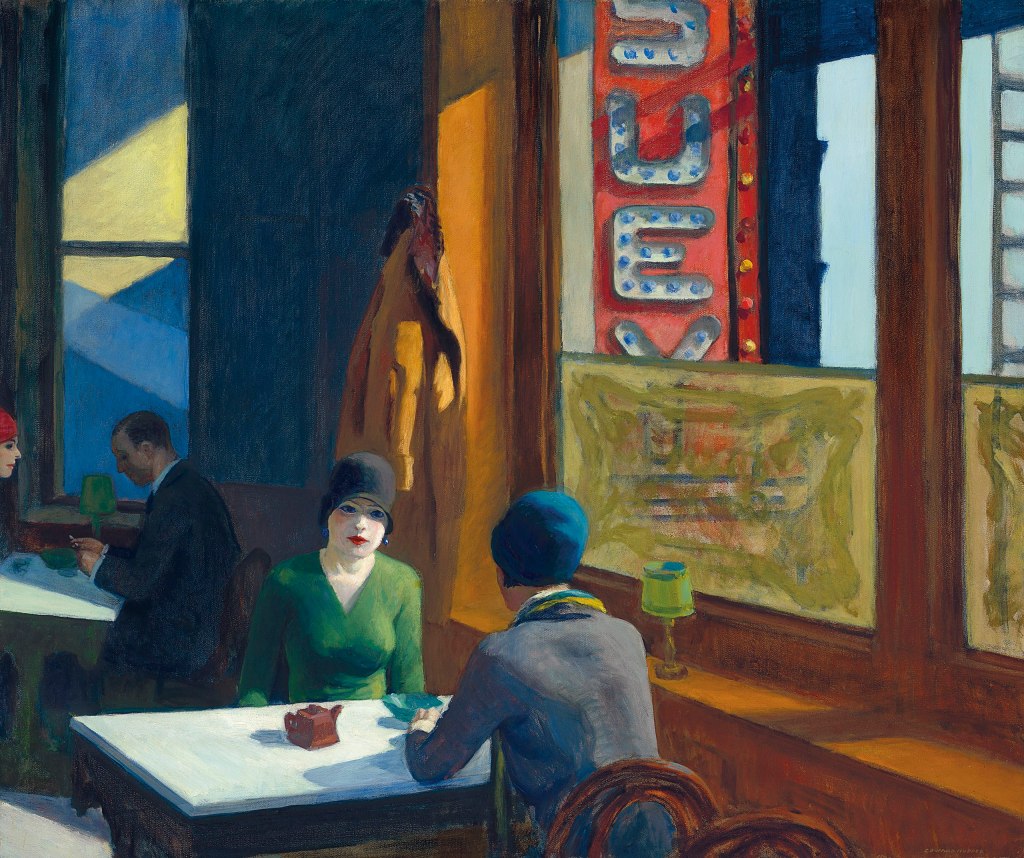
Christine Rhein: Chop Suey
—after the painting by Edward Hopper, and from the Cantonese
phrase, tsap sui, meaning “miscellaneous leftovers”
There are no plates, no food in this wide-windowed restaurant,
in the angled light and shadows. It is 1929. A man, in suit and tie,
holds a cigarette—not a cellphone—as he stares down at his hands,
ignoring the red hat, red lips of his companion. And no one takes
lunchtime pictures of themselves, although the two “office girls”
are all dolled-up—makeup, dresses, cloche hats that hide their heads—
the glamor their salaries afford them, the flair their bosses expect.
See how tired the one in green looks, how bored or sad she is,
listening to the other one sigh, how the exotic, clay teapot,
in the middle of their table, sits without steam, without cups.
A bright, spring coat hangs on a hook—Chop Suey customers
unaware Wall Street will crash, the country will plunge into war
upon war, torrents of technology. Yet already, in their face-to-face
hunger—no smiles, no laughter shatters the loneliness.
~~~~
Copyright 2025 Christine Rhein
Christine Rhein, a former auto engineer, is the author of Wild Flight (Texas Tech University Press). Her poems have appeared in The Gettysburg Review, Michigan Quarterly Review, The Southern Review, Poetry Daily and Verse Daily.
Discover more from Vox Populi
Subscribe to get the latest posts sent to your email.

Excellent as ekphrasis and even moreso as poem, period!
LikeLiked by 1 person
I agree, Syd!
>
LikeLike
Christine, I loved so many things about your poem! And what I love best is its tone — how I felt that — watching the painting, you were standing there, right next to me, and calmly sharing, with exquisite heart and intelligence, what you saw. L-o-v-e-l-y!
LikeLiked by 1 person
Laure-Anne, Thank you!
LikeLike
This poem helps me appreciate Hopper’s painting even more. Thank you. (Years ago, I saw Hopper’s “Cape Cod Morning” at the Smithsonian and felt transformed–I went to my hotel room and wrote a poem about it, which Yankee Magazine kindly published.)
LikeLiked by 2 people
Thanks, William!
>
LikeLike
This poem and Edward Hopper’s painting match perfectly.
LikeLiked by 3 people
Don’t they, though?
>
LikeLiked by 1 person
What a pleasant surprise. Back in 1994 I wrote a handful of poems musing on a few of Hopper’s paintings. People have always assumed an internal loneliness to his work, but I found the people in his art to be not really as alienated as some critics wanted to think. Though Christine makes the case for that alienation in Chop Suey, yet there seems no desperation in the blank faces. Maybe a self-centeredness as much as loneliness? If they are lonely, it also seems that in much of his work they remain in control of their presence.
My son John, who was four at the time, loved Hopper, too. He would place himself in Hopper’s terrain, as he flipped through the book, seemingly at random, like looking for his ace of spades in Hopper’s deck of shuffled cards. But John smiled and laughed, shattering any sense of loneliness. For him, Hopper was a wonderland of imagery, and bright squares of color and life. Though his favorite Hopper was the filling station with its three red gas pumps.
LikeLiked by 4 people
What a beautiful musing on Hopper, Jim. Thank you.
LikeLiked by 2 people
Michael:I want to send Christine my âAutomatâ (by Hopper) po
LikeLiked by 1 person
Sean, send me the poem and I’ll forward it to Christine, okay?
>
LikeLiked by 2 people
I’m out in the world presently, will send it when I get home.
LikeLiked by 1 person
Christine: I’ve been writing about “Automat” in the Des Moines Museum and its so intriguing to find parallels between the paintings and our words. Its a fine poem you’ve written, and all of this becomes an ultimate portrait of him—and—(did WC Williams say about another aspect of our culture?) the “pure products of America.”
LikeLiked by 3 people