
Vox Populi
A curated webspace for Poetry, Politics, and Nature with over 6,000,000 visitors since 2014 and over 9,000 archived posts.
Fred Shaw: Debunking the Right’s Obsession with Antifa
Rutgers University History Professor Mark Bray shares why he and his family fled the U.S. over safety concerns amid the Trump administration’s broad attacks on Antifa. He explains where the term originated from and why it’s being used as a “catch-all” phrase by government officials and those on the right.
~~~
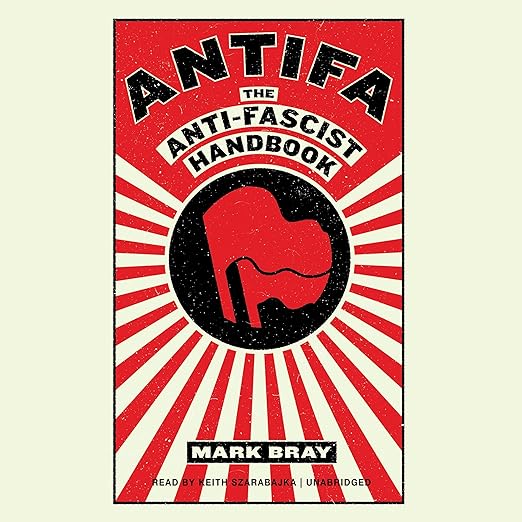
ANTIFA: THE ANTI
FASCIST HANDBOOK
By Mark Bray
Melville House ($16.99).
A Review by Fred Shaw
When teaching composition classes, I regularly ask college writers toexplain concepts of their choice, using definition as a starting point. In the aftermath of Charlottesville, where counter-protesters clashed with neo-Nazis, the term “Antifa” (short for anti-fascist) remains on the lips of both politicians and the media. Between President Donald Trump’s use of false equivalency between right-wing extremists and the “alt-left,” and the mainstream media’s rush to condemn both sides during growing protests, “Antifa” gets this critic’s vote for a term sorely needing clarification and nuance. Thankfully, Mark Bray’s “Antifa: The Anti-Fascist Handbook” arrives as a timely and thoroughly researched primer on the movement’s philosophy and tactics.
As a historian of human rights, terrorism and political radicalism who
lectures at Dartmouth College, not to mention an organizer of Occupy Wall
Street, Mr. Bray’s bona-fides are well-displayed here. He’s also no poseur
when it comes to understanding motives and tactics. While not a page
turner, “Antifa” skillfully argues “that militant anti-fascism is a reasonable,
historically informed response to the fascist threat that persisted after 1945
and that has become especially menacing in recent years.” The historical
aspects mined here seem especially relevant, giving readers needed
perspective on a decentralized movement that has been evolving worldwide
since Mussolini’s 1920s rise, priding itself on anonymity.
Early on, using historian Robert Paxton’s thorough definition of fascism, “a
form of political behavior marked by obsessive preoccupation with
community decline, humiliation, or victimhood … abandons democratic
liberties and pursues with redemptive violence and without ethical or legal
restraints goals of internal cleansing and external expansion,” Mr. Bray
properly frames the argument.
Anti-fascism, however, is more than just a rejection of fascism in the
aftermath of the Holocaust, relying on members who are “committed
themselves to fighting to the death the ability of organized Nazis to say
anything.” Mr. Bray further clarifies anti-fascism as “an illiberal politics of
social revolutionism applied to fighting the Far Right, not only literal
fascists.” While the subject might be edgy for many and disavowed by some
as extreme, the writing in “Antifa” is pointed with concise analysis provided
by an insider’s perspective.
Indeed, to most of its detractors (liberals included), Antifa remains
controversial not for what it stands for, but for how it achieves goals.
Populated by mostly socialists and anarchists who believe the state is
undesirable, unnecessary and harmful, Antifa look to defend the
“defenseless” (immigrants, transgender, people of color) by focusing on
disruption of fascist gatherings using tactics from doxing to violence
against the opposition. Utilizing historical analysis, quotes from current
Antifa and a talent for explaining motives, Mr. Bray clearly anticipates his
audience’s reservations.
When it comes to “no platforming” (not allowing people with unacceptable
views to speak publicly), Mr. Bray claims Antifa “value the free and open
exchange of ideas – they simply draw the line at those who use freedom to
promote genocide or question people’s humanity.” While Mr. Bray
concedes this might be a “slippery slope,” he counters by saying,
disagreements with fascism “grew out of the historical struggle, often
waged in self-defense … [by] Jews, people of color, Muslims, queer and
trans people, and others, to make sure that fascists do not grow powerful
enough to murder them.” He also makes the case that the government
“deprives elements of this freedom” to millions of the incarcerated.
With even Bill Maher bemoaning Ann Coulter and Milo Yiannopoulous
having their speeches canceled, and “pundits conclud(ing) that anti-fascism
is a greater threat to free speech than even fascism itself,” readers of
“Antifa” can be assured of gaining insight on an increasingly visible and
misunderstood group looking to keep the genocidal past from repeating.
~~~
Fred Shaw is a poet and critic who teaches creative writing at the
University of Pittsburgh.
First Published: November 5, 2017, in The Pittsburgh Post-Gazette
Discover more from Vox Populi
Subscribe to get the latest posts sent to your email.

Yes, lies, calls for the violent suppression of freedom and hate speech can’t be allowed. But that train has run away a long time ago with the dawn of social media. Now that the Right is baying for their skins (because), the ‘opposition’ can’t play by the old rules anymore or we will all lose. The bully has to get it on the nose or he won’t stop. I am so glad Mark Bray and family finally got away.
LikeLiked by 1 person
It’s a shame they had to flee.
LikeLiked by 1 person