
Vox Populi
A curated webspace for Poetry, Politics, and Nature with over 6,000,000 visitors since 2014 and over 9,000 archived posts.
Adam Patric Miller: A Chill in American Classrooms
When I first meet my classes of senior students, I bond with them by saying, “We have something in common: you’ve been doing this school thing long enough, you’re burnt out, and jaded, just like me.” Some laughter. “We’ll get along well!” I also talk about the two-way street of respect, and I read, verbatim, the following: Our classroom must be a place where everyone feels comfortable and respected in terms of race, ethnicity, sexual orientation, and political thought. We will not tolerate bigotry, bullying, racism, misogyny, or heterosexism in any form.
What a lie.
This is what I’ll report from the classroom of a suburban high school in mid-September of 2025: no one feels comfortable. I can feel it in the air and hear it in the unduly harsh sound of the new bell system. I can feel it in the deadly repetition of the lock down drill routine we had to go over, class after class, earlier this week. I also noted the reaction of an administrator when I shared what I thought was my humorous way of connecting with my seniors, about how they are as jaded as I am. “Jaded. That’s not good.” He was serious. The irony meter registered a zero.
I’m trying to be a good teacher, listening carefully to my students so I can make the ten-thousand micro-adjustments in what I’m presenting to them so they will feel how much I really want them to learn. One student says in a hushed voice she wants to write a personal essay for college that explores her growing awareness of the genocide in Gaza. I say I’m politically neutral on the topic (or I’ll lose my job) but she should write what she cares about. After Charlie Kirk was shot, I heard boys talking about it before the start of class. They asked, “Mr. Miller, did you hear about Charlie Kirk?” I did. But I didn’t elaborate. A colleague was upset because boys in her class asked mid-class if she knew about Charlie Kirk, and when she said she didn’t, they laughed with derision at her supposed ignorance. They are white and male and she isn’t.
I didn’t say to my students that one minute after Charlie Kirk was shot by a young white male, a sixteen-year-old white male opened fire with a revolver, critically injuring two fellow students before killing himself in Colorado. Nor did anyone else discuss that school shooting. We don’t talk about them. We don’t talk about who is most likely to commit the school shootings. We prepare, over and over, class after class, to do the four E’s: Educate, Evacuate, Evade, or Engage. Since I started teaching in 1992, I’ve been a fan of the first E. But instead of real education, I’ve become an expert at explaining to a class of twenty-three teenagers, many white and male, which way we’ll go if the intruder alarm goes off—like it did last year. A couple of kids made the mistake of jumping out of windows. A teacher had accidentally pushed the button on her device too many times. That triggered panic.
The class I teach to my seniors is called Social Issues in Literature. We learn about gentrification, how poor people are treated as though they are invisible, male toxicity, and we talk about issues of race, class, and identity. Students write about intersectionality—a college-level stretch if that is still taught in colleges. We study Stephanie Land’s book Maid. It’s written by a white woman who struggles as a single mother. She’s stigmatized for being poor and single—and our government seems to cause her and her child more harm than good. It’s a safe topic. We also study Dear America, Notes of an Undocumented Citizen by Jose Antonio Vargas. Immigration, these days, the plight of someone who looks like they might not “belong” here, is not a safe topic. I wonder if the book will be cut from the curriculum. I recommend the book to anyone who wants to understand how our country isn’t a place where everyone feels comfortable and respected. Whenever we discuss any of the issues in our class, I feel watched and censured. In 2025, there’s a chill in American classrooms.
We live in a country where a comedian can’t tell a bad joke about the President, especially when billions of dollars are at stake. As a teacher who thinks language matters along with matters of language—like free speech—I would normally talk about the incident with students because it’s happening and it’s important to their understanding of what our democracy should be or is in danger of not being. But I say nothing. It’s become part of my teacher life. Don’t talk; keep your job. I’ve completed my district-mandated training about antisemitism and Jewish identity courtesy of the ADL that came with a plea for a donation to the organization—even though I’m of Jewish heritage and my heart is in Palestine. And I watch students who don’t organize to protest a genocide, who go through shooter drills ad nauseam, who don’t question what the adults are doing to protect and educate them because no one has taught them that’s what they’re supposed to be doing.
Copyright 2025 Adam Patric Miller
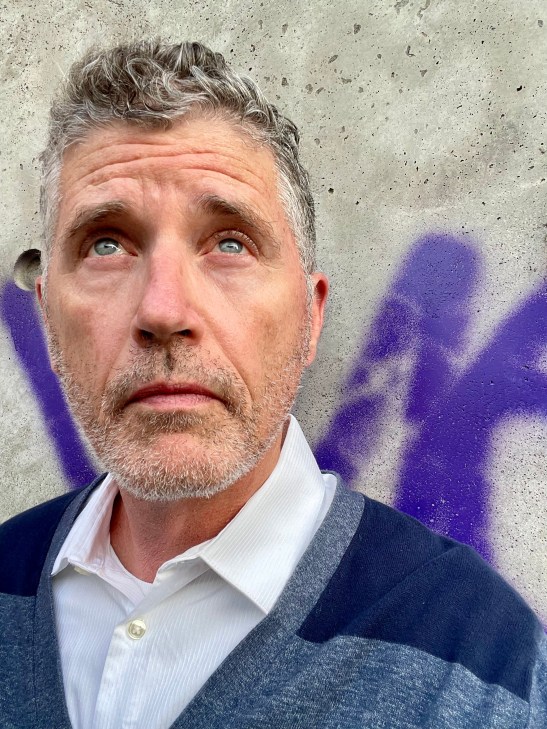
Adam Patric Miller has taught high school for 25 years in three states and currently teaches in St. Louis. He is the author of the book A Greater Monster, a collection of essays selected by Phillip Lopate to win the Autumn House Press Nonfiction Prize. He’s won a Pushcart Prize and a Notable Essay Selection in The Best American Essay Series. Miller’s work has appeared in Agni Magazine, The Florida Review, Diagram, The Brevity Blog, The Normal School, and Vox Populi. New poems are forthcoming from Divagations. His op-eds have appeared nationally in over 200 media outlets.
Discover more from Vox Populi
Subscribe to get the latest posts sent to your email.

“As a teacher who thinks language matters along with matters of language—like free speech—I would normally talk about the incident with students because it’s happening and it’s important to their understanding of what our democracy should be or is in danger of not being. But I say nothing.”
I teach university students. And it’s the same for me. 😦
LikeLike
Not even surprised. Makes me glad I decided to not teach in the US. For this type of stuff. Thanks for sharing.
LikeLike
The expression ‘nip it in the bud’ comes from the Roman poet Ovid’s work Remedia Amoris (Remedies for Love) and is originally ‘Principiis obsta’. In it, Ovid advised ending unhappy romantic relationships early on, before they become entrenched and turn into bigger problems. After the Second World War, this phrase became a symbolic keyword in connection with the Third Reich and the warning to stop dangerous political developments early on.
LikeLike
Thanks, Rose Mary. I didn’t know this….
>
LikeLike
Some 4th through 6th grade students I taught half a century ago are friends on Facebook. I can’t believe I got away with teaching them the songs of my generation ( The Cat Came Back was a favorite, complete with anti war lyrics)
They say they still remember those songs and though I know my politics are different from some of theirs we still have the ability to not be hateful. If I taught today, I would lose my job on day
LikeLike
I admire teachers today. They have to put up with a lot more from legislators than we did.
>
LikeLiked by 1 person
What brilliance in the telling, and sadness in the doing. I’m reminded of what my favorite poet Seamus Heaney wrote about his experience of the civil war in Northern Ireland: Whatever You Say Say Nothing. He wasn’t encouraging it, just saying it had become a central survival tactic. Have we come to that point too?
In our new rules for lack of engagement in public schools, we turn both teachers and students into bystanders.
LikeLiked by 2 people
Well-said, Jim. Thank you.
>
LikeLiked by 1 person
A heartbreaking essay. Thank you, Adam Patric Miller, for writing it. I hope it travels far and wide.
LikeLiked by 1 person
What a beautifully written but sad and depressing commentary on our current educational system. How can such a strange environment really be educational? With such censorship, no wonder we have so many essentially uneducated people in power.
LikeLiked by 3 people