
Vox Populi
A curated webspace for Poetry, Politics, and Nature with over 6,000,000 visitors since 2014 and over 9,000 archived posts.
Jane Mead: Passing a Truck Full of Chickens/at Night on Highway Eighty
Some were pulled by the wind from moving
to the ends of the stacked cages,
some had their heads blown through the bars—
and could not get them in again.
Some hung there like that—dead—
their own feathers blowing, clotting
in their faces. Then
I saw the one that made me slow some—
I lingered there beside her for five miles.
She had pushed her head through the space
between bars—to get a better view.
She had the look of a dog in the back
of a pickup, that eager look of a dog
who knows she’s being taken along.
She craned her neck.
She looked around, watched me, then
strained to see over the car—strained
to see what happened beyond.
That is the chicken I want to be.
~~~~
Poem copyright ©2015 by Autumn House Press, “Passing a Truck Full of Chickens/at Night on Highway Eighty,” (Autumn House Anthology of Contemporary American Poetry, second edition, edited by Michael Simms). Poem reprinted by permission of Autumn House Press.
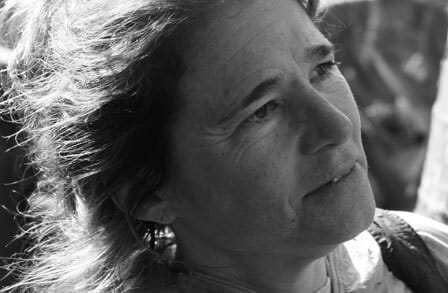
Jane Mead (1958-2019) was the author of five collections of poetry: The Lord and the General Din of the World (1996), The House of Poured-Out Waters (2001), The Usable Field (2008), Money Money Money Water Water Water (2014), World of Mad and Unmade (2016), and To the Wren: Collected and New Poems (2019). Her later work engaged the Western landscape, ecology, and the debts of ancestry: she managed her family’s farm in Northern California, where she grew zinfandel and cabernet wine grapes. In his review of Money Money Money Water Water Water, Jeff Hamilton noted, “Mead’s poetic compass, then, leads her not in circles, but toward a horizon of tragic speech,” adding that she “writes georgics in a confessional mode.”
Mead earned a BA at Vassar College, an MA at Syracuse University, and an MFA at the University of Iowa. She received awards and fellowships from the Lannan, Whiting, and Guggenheim foundations. She taught at Colby College, Washington University, the Iowa Writers’ Workshop, the Drew University Low-Residency MFA program, and was for many years poet-in-residence at Wake Forest University. (bio adapted from the Poetry Foundation)
Discover more from Vox Populi
Subscribe to get the latest posts sent to your email.

the beautiful Jane Mead.
LikeLiked by 2 people
Oh, yes!
LikeLiked by 2 people
I’m so happy to find Jane’s poem on VP today: for decades, this is the first poem I always taught at the beginning of each new class & I still teach it now to my new workshops or students. There’s such humanity, attention, curiosity, metaphorical wealth & attention to craft — and talk about mastering change of tone! I remember “discovering” that poem in her book The Lord and the General Din of the World as I was riding the T in Cambridge, MA & gasping in awe, with the rather ‘reserved’ T crowd raising , every so slightly, an eyebrow to my obvious delight from that book! It’s such a good book — I highly recommend it. Thanks Michael…
LikeLiked by 1 person
Great story about discovering the poem on the T, Laure-Anne. I gasp in awe every time I read this poem.
LikeLiked by 1 person
Brilliant, just brilliant!
LikeLiked by 2 people
Indeed!
LikeLiked by 1 person
The grief, the resilience, the joy, the inspiration to continue on no matter the conditions. All in one poem.
LikeLiked by 3 people
We are all chickens on the way to the slaughterhouse, but a few of us are alert and aware.
LikeLiked by 5 people
Thank you! You summed up Jane’s poem. The chicken is wildly alert and defiantly aware.
LikeLike
I believe I read and admired this poem before, perhaps in a class, so not quite one I read again for the first time. So much said in so few words. I love poetry.
LikeLiked by 4 people
Me too, Barbara. A compact experience of waking up!
LikeLiked by 1 person
I read and reread this poem—it reminds me of Elizabeth Bishop and Ellen Bass in her attention and empathy to these other creatures, but oh, how ironic the end. Yes, the hen was exceptional, a creature to emulate, but she was doomed, anyway.
LikeLiked by 5 people
Hunting for a small empathy in a doomed environment. I too thought of Bishop in her poems like the Fish., the Armadillo (great to read side by side with this one), and a favorite poem: The Moose.
LikeLiked by 3 people
That was how son John chose our cat. It was the one in a huge litter who paid attention, explored, wanderlusted. 20 years of Luna’s inspired life proved it would have been the cat I’d have wanted to be.
I like how Jane Mead’s poem begins as an ecopoetic description of our misuse or disregard of animals, but ends with a hopeful meeting. Mead’s slowing for a five minute bond is almost mystical in such circumstances. She paid attention. Thanks for nurturing the poem, Vox Populi.
LikeLiked by 4 people
My mom had a cat named Luna who lived to be something like 24 years.
LikeLiked by 1 person
Bet your Mom’s Luna wasn’t named for an Anime character. Or was a male cat. I just read Ellen Bass’s devastating poem Birdsong from my Patio, and thought of your deck – the birdsong you attract to that spot of hope. May your prayer flags there live long, and the hummingbirds find sweet nectar.
LikeLiked by 2 people
I’ve published and performed this poem many times through the years. It’s like an old friend, but it always reminds me that Jane herself has passed. She was that chicken!
LikeLiked by 2 people
Thanks, Sean. I admire Jane’s poems because she was always true to her vision. She inherited a vineyard in California which burned down in a wildfire.
LikeLiked by 4 people
An amazing poem! My first read of her and I trust there is a long road to travel with this life-deepened and seasoned voice. I waken in a new poetry world every day in Vox Populi and am so grateful!
LikeLiked by 4 people
Like you, Sean, she was a farmer and a poet. She grew wine grapes in Napa, and I have a few bottles of her zinfandel. Sadly, she left us a few years ago, but her poems are remarkable, as is this one.
LikeLiked by 5 people