
Vox Populi
A curated webspace for Poetry, Politics, and Nature with over 6,000,000 visitors since 2014 and over 9,000 archived posts.
John Ashbery: A Worldly Country
Not the smoothness, not the insane clocks on the square,
the scent of manure in the municipal parterre,
not the fabrics, the sullen mockery of Tweety Bird,
not the fresh troops that needed freshening up. If it occurred
in real time, it was OK, and if it was time in a novel
that was OK too. From palace and hovel
the great parade flooded avenue and byway
and turnip fields became just another highway.
Leftover bonbons were thrown to the chickens
and geese, who squawked like the very dickens.
There was no peace in the bathroom, none in the china closet
or the banks, where no one came to make a deposit.
In short all hell broke loose that wide afternoon.
By evening all was calm again. A crescent moon
hung in the sky like a parrot on its perch.
Departing guests smiled and called, “See you in church!’
For night, as usual, knew what it was doing,
providing sleep to offset the great ungluing
that tomorrow again would surely bring.
As I gazed at the quiet rubble, one thing
puzzled me: What had happened, and why?
One minute we were up to our necks in rebelliousness,
and the next, peace had subdued the ranks of hellishness.
So often it happens that the time we turn around in
soon becomes the shoal our pathetic skiff will run aground in.
And just as waves are anchored to the bottom of the sea,
we must reach the shallows before God cuts us free.
~~~~
Copyright 2007 John Ashbery. From A Worldly Country (Carcanet Press).
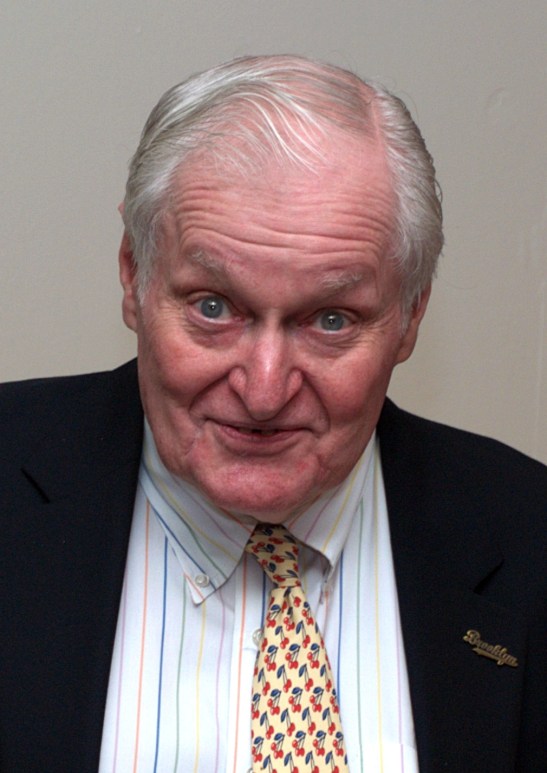
John Ashbery (1927-2017) published more than 20 volumes of poetry. Among other awards, he received the Pulitzer Prize, National Book Award and National Book Critics Circle Award for his collection Self-Portrait in a Convex Mirror (1975). Ashbery is widely considered the most influential American poet of his time. Stephanie Burt compared Ashbery to T. S. Eliot, calling Ashbery “the last figure whom half the English-language poets alive thought a great model, and the other half thought incomprehensible”.
Discover more from Vox Populi
Subscribe to get the latest posts sent to your email.

It’s a marvelous poem!
LikeLike
It really is!
>
LikeLike
This is one of John’s satiric poems, the satire reinforced by the rhyming couplets. I laugh when I read it, but I can’t rank it with his best work, the “Self-Portrait in a Convex Mirror” mentioned above (which he once told he, personally, didn’t much like–but so what?) and other lyrics like “Soonest Mended” or the magisterial “Three Poems” (written in prose). It will take many more decades before a full and comprehensive understanding of his very diverse oeuvre is attained.
LikeLiked by 1 person
Thanks, Alfred.
LikeLiked by 1 person
great poet & good poem.
LikeLiked by 1 person
Thank you, Saleh.
LikeLike
A lot of peop
LikeLike
I’m one of those who’s had trouble “getting” Ashbery (he’s a tough one if you are self-taught in poetry and poetics, as is also much of Wallace Stevens, or the Language Poets). However, this poem forges an a ha bond between Ashbury and my poetry-reading sensibilities. I guess a wise strategy with Ashbery (and Stevens) is to read selected poems, not their entire often puzzling oeuvre. Thoughts?
LikeLiked by 1 person
Oh, yeah. Ashbery has a lot of incoherent messy frustrating poems in his ouvre. But buried in that messy pile are more than a few works of genius, including in my opinion A Worldly Country.
>
LikeLiked by 1 person
It nails our situation, and does it with poetic power.
maybe with some of his poems like this, Ashbury uses his style and creativity to build an intricate word house to inspire readers, while in others he is just showing off with funhouse mirrors.
LikeLiked by 1 person
You may be right about Ashbery’s intentions. I think he was in a constant process of intuitive invention without a lot of concern as to what the reader would think.
>
LikeLiked by 1 person
Ashbury is ‘devil may care’, I am not restricted by anyone’s rules, and that makes him so unique. IMHO.
LikeLiked by 2 people
I’m in love with the music. Thank you!!
LikeLiked by 1 person
The poem is held together by the music of the language.
LikeLiked by 1 person
what a wonderful poem! I became a fan after I found and bought and read a used volume of the “poem of Parmagianino” at Powells City of Books in Portland one morning. Later it became even more wonderful to me when I listened to him read it. A door swung wide and I’ve held affection for this great man and his devotion to our metier ever since.
LikeLiked by 2 people
At 22, I read Self-Portrait in a Convex Mirror, and it changed my life. The rhythms of the lines and the leaps and glides between subjects opened my mind to the possibilities of language. I’ve never been able to replicate his way of using language, but the freedom he assumed for himself was extraordinary.
LikeLiked by 2 people
I so agree—I’ve tempted myself more than once to write such a thing of that subject, and wrestle with, if not befriend the fact I’m also in the actual role of the painter.
I also have the painting to accompany, although its grand in scale (6’ x 7’) finished in 01’ in an attempt to get into a millennium show, but the year passed and I was still painting.
LikeLiked by 2 people
So few of us can master one art, yet you have mastered two!
LikeLiked by 1 person
love the language and — surprisingly — the rhymes.
something’s you seldom see in good poems.
LikeLiked by 2 people
The poem is held together by the music of the language.
LikeLiked by 2 people