
Vox Populi
A curated webspace for Poetry, Politics, and Nature with over 6,000,000 visitors since 2014 and over 9,000 archived posts.
Rachel Hadas: Two Poems
Breath on the Pane
Two poems crossed my screen the other day –
poems by students, I was going to say,
but they were both my age. All three of us
were drawn to themes of memory and loss.
So it was not coincidentally
that their poems shared both imagery
and a perspective, taking the long view
of episodes, detached but poignant too,
recollected in tranquillity,
as Wordsworth put it. More specifically,
both poets seemed to peer as through a pane
of glass. Though feelings cool, details remain.
One describes how he stood looking out
from a high window at a parking lot,
empty, at night. The other can recall
a certain beer (years since he drank at all),
and sees with startling clarity the brown
glass of that bottle. Broken, the shards shine.
Transparent and impersonal and cold,
the trope of glass conveys what can’t be told,
but lets us intimate the larger scene.
New York: a wife walked out. Vermont: the sun
rose on a snowy day. Regret and waste;
the brand of beer he still can all but taste –
memories evoking desolation
softened by years. Is time a consolation?
The answer, we three seventy-somethings know,
has to be Janus-faced: both yes and no.
Standing back and shaping into verse
what once felt raw and merciless, or worse,
we breathe warm steam on the cold glass of grief
and writing in that mist is our relief,
even if the sharp edge of what we then
felt is renewed enough to cut again.
We’ve achieved distance, not immunity
from what the poems make us feel again, and see.
~~~~
Drawing Lessons
Images, words: the mind’s incessant flow,
still moving, now more hesitant and slow,
river into delta, a broad plain
where everything is spread out to be seen.
But we can only see things one by one.
Always distraction is the difficulty.
But since it’s where we live, then try to face
the ambient chaos, welcome its embrace,
then dive into the chaos that we choose,
or that chose us. We have nothing to lose.
One sight that sticks with me is the tail
of a blue phoenix soaring on a tile
from fifteenth-century Turkey. I couldn’t draw it
worth a damn, but gazed until I knew it.
I used the pencil in my hand to see.
~~~~
Copyright 2025 Rachel Hadas. These poems first appeared in Fortnightly Review. They are included in Vox Populi by permission of the author.
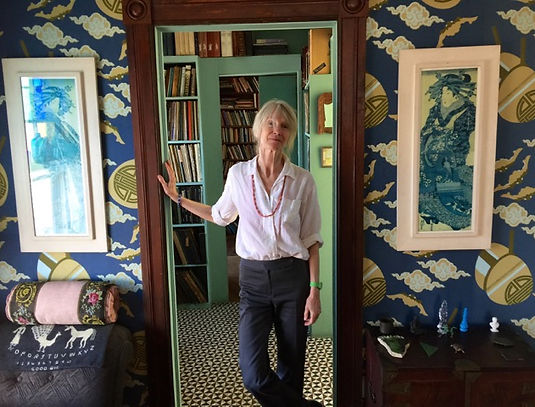
Rachel Hadas at the Merrill House in Stonington, Ct.
Poet, essayist, and translator Rachel Hadas is the author of many books of poetry, including, most recently, Ghost Guest (2023) and Pandemic Almanac(2022), both from Ragged Sky Press. A selection of her essays and criticism, Piece by Piece, was published by Paul Dry Books in 2021. Her newest collection of poems, Forty-four Pastorals is forthcoming from Measure Press later this year, and a prosimetrum (alternating poetry and prose) entitled From Which We Start Awake, is due out in 2025 from Able Muse Press. Her poem “Voyage” is included in the 2024 edition of The Best American Poetry anthology, edited by Mary Jo Salter.
Hadas is one of some forty translators of the Dionysiaca of Nonnus, an epic from late antiquity published by the University Press of Michigan in 2022 as Tales of Dionysus; she has also translated three plays by Euripides. As an editor and critic, she is particularly interested in medical humanities and translations from the classics in addition to poetry; she currently serves as Original English Verse Editor for Classical Outlook.
Hadas taught English at Rutgers University-Newark from 1981 to 2023, and was named a Board of Governors Professor in 2001. She has also taught courses in literature and writing at Columbia and Princeton Universities, the Ninety-second Street Y, the Sewanee Writers’ Conference, the West Chester Poetry Conference, and the Hudson Valley Writers’ Center.
Hadas’s honors include a Guggenheim Fellowship in Poetry, an Ingram Merrill Foundation grant in poetry, and an award in literature from the Academy-Institute of Arts and Letters. She is a recipient of the O.B. Hardison Poetry Prize from the Folger Shakespeare Library and has been a Fellow at the Cullman Center for Scholars and Writers at the New York Public Library. A member of the American Academy of Arts and Sciences, she has been a resident of the MacDowell Colony, Yaddo, and the Virginia Center for the Creative Arts.
Rachel Hadas lives in New York City and in Danville, Vermont. With her husband, visual artist and filmmaker Shalom Gorewitz, she has been collaborating on poetry and video.
Discover more from Vox Populi
Subscribe to get the latest posts sent to your email.

Two super fine poems. I mean, wow.
LikeLike
Rachel wears her learning like a loosely fitting garment.
>
LikeLike
Rachel: These are very fine renderings of time into verse. They answer experience with correlatives of recollection, both artful and vivid. I’m grateful to have gone—so fine to read this beginning morning of the week.
LikeLike
Two wonderful poems that join formality and warmth, self-consciousness and self-understanding, and are just wonderfully human.
LikeLiked by 2 people
I agree, Bob. Rachel is one of our most skilled and endearing poets. A national treasure.
LikeLiked by 1 person
Am especially engaged by Drawing Lessons. I like the double meaning Hadas uses for the title. She deftly assembles a metaphor for our final spreading out and slowing near the end of a rushing cerebral life of interesting flotsam and jetsam. Oh, and that blue phoenix as antidote to distraction. Where will each of us draw ours?
LikeLiked by 2 people
Great poem!
>
LikeLiked by 2 people
I love the flow, the rhythm, the rhyme that pulls me into the picture and the time, the beer and the memories, mine melding with no one I know, but somehow know well. I must explore more by this wonderful poet. It is as if my brain in caught in a current I had been waiting to catch.
LikeLiked by 2 people
Rachel is one of my favorite poets. Her understated elegance and her background as a classics scholar speak to me.
>
LikeLiked by 2 people
What book do you recommend?
LikeLiked by 1 person
Rachel has many beautiful books. Two of my favorites are the poetry collections Pandemic Almanac and Love and Dread. Her translations of classical authors are beautiful as well.
LikeLiked by 2 people
Thank you
LikeLiked by 1 person
Rachel Hadas’s poems display an easy elegance, a grace that moves us without insisting.
LikeLiked by 2 people
Bravo! You’ve put into words and lines in Poem 1 how that works. Thank you. I’m leaving a space before I read Poem 2. Don’t want to jumble them up while 1st one is still resonating.
LikeLiked by 3 people