
Vox Populi
A curated webspace for Poetry, Politics, and Nature with over 6,000,000 visitors since 2014 and over 9,000 archived posts.
William Trowbridge: Polio Days
Our neighborhood was blue collar, on the western side of Omaha: lots of tidy one-story homes, one-car garages, elm trees, lawns maintained with push mowers. We lived on 58th street. The city ended then at 72nd. It was 1949 and I was seven, as were my pals. The first television western, Hopalong Cassidy, had been aired that spring.
We spent summers mostly outdoors. But I’d usually start Saturday by watching kids’ shows on our marvelous new round-screen Zenith. My favorite was “Smilin’ Ed’s Gang,”starring Froggie the Gremlin, Midnight the Cat, and Squeaky the Mouse. After that and right after breakfast on weekdays, I’d join my pals outside. We’d ride our bikes around the neighborhood for a while and then find something to fill the rest of the day. Sometimes we’d play softball in the intersection by my house. The street corners were bases and the pitcher’s mound was the manhole cover in the middle. It wasn’t a busy street, but when a car approached, the lookout call was “water in the bucket.” There was a pecking order, based on who could beat up whom, usually settled by a wrestling match. The only guy in our group who could beat me up was Steve Moran. Held back a year in school, he was bigger than the rest of us. The only guy who could beat him up was my pal Roger’s big brother Gary, who kept aloof from us younger kids. Our only dread was getting grounded for riding our bikes on busy 60th Street or not coming home when it was dinner time. To us, polio might have been something you spread on your morning toast.
July of 1949 was especially hot in Omaha, but the polio epidemic got most of the news coverage. Across the country, hospitals were filling up. Polio was also called “infantile paralysis” because it affected mostly children. Life magazine showed victims, some of whom were confined in “iron lungs,” which were large metal cylinders containing those who had bulbar (lung) or spinal bulbar (spine and lung) polio. Spinal polio didn’t require one. The iron lung was for patients who could no longer breathe on their own. They were laid out on their backs, with only their heads protruding. A mirror was attached at an angle above, so they could look at something other than the ceiling. Some victims would require extended, even lifetime use due to paralyzed chest muscles, though modern ventilators have helped ease the burden. I’m still amazed that I thought iron lungs looked cool, like space ships from Flash Gordon. I wondered how it would feel to be inside one.
In those days, Old Dutch Cleanser was a popular brand. On its label, a bonneted Dutch vrouw in clogs was clomping after dirt and germs, club raised for the kill. That was my mother after she heard polio was contagious. She began scrubbing nearly everything, even our fruits and vegetables, which began to taste a little like Fab. And I sometimes felt she was hovering over me.
One Saturday afternoon that summer, my pals and I were playing kick the can when I started to feel exhausted enough that I walked home and flopped down on the couch. My mother, who’d never seen me do that in the afternoon and who was already on red alert, took my temperature. It was 103, so she called our doctor. Doctor O’Neil, one of the few who still made house calls, showed up around an hour later. After retaking my temperature and checking my breathing, he asked me to sit up and touch my toes. I couldn’t. Then he asked me to touch my chin to my chest. When I couldn’t, he put his stethoscope back in his bag and had a conversation in the kitchen with my mother, who came back looking more distraught than I’d ever seen her. I then found myself on the way to the hospital emergency room. I was to have something called a “spinal tap.” It involved removing a small amount of spinal fluid with a needle to test for polio. The process was a blur to me, but the test showed I had the spinal kind.
All of Omaha’s polio wards were full, so I wound up in a makeshift one in the basement of the county hospital. The rollaway beds were crowded together, and I remember seeing furnace pipes above our heads. Boys and girls were separated, and I guess the iron lung patients were in another area, maybe even another hospital. We were bedridden, with no radio or TV, only a frayed supply of magazines and comic books. If you needed help from a nurse, you had to yell “Nurse!” And they were very busy and in short supply. The kid a bed over from me yelled for one a lot. When she would finally come, I could see he was just used to getting lots of attention. I think we had to use bedpans all the time instead of toilets. I don’t remember any accessible restrooms. Sometimes, due to the nurse shortage, getting the bedpan in time could be a race against humiliation. I lost a couple of times, which some of the other kids enjoyed announcing. There were no showers or bathtubs, but we did get a sponge baths once a week.
For some mistaken reason, we received three shots of penicillin a day, not a good practice since polio is a virus. The spoiled kid kicked and screamed each time the needle arrived. After a day or two of that, the rest of us managed to ignore him. I think his daily fits helped many of us resist having our own. Nobody wanted to be seen acting like that kid. What I couldn’t ignore was a voice from across the ward, moaning and crying after the lights went out. The sounds were chilling. Someone said the kid had been hit by a car. I didn’t know. Maybe hospitals had gotten so crowded, they had to put him with us. The sounds ceased after the first few days.
I managed to make friends with a couple of other kids, which helped pass the hours. Bernie, in the bed next to me, was my main one. We talked about our homes and played guessing games. Sometimes we told jokes and made faces to get each other laughing. We also made up names for each other. I was Woody (Woodpecker), because of my red hair, and, because of his freckles, he was Howdy (Doody). Throughout my hospital stay, I retained the childish faith that doctors could heal me of this or any other disease and that I’d be brought home immediately afterwards. So I had no fear of the potentially ruinous outcome. I suspect this was also the attitude of most of my ward-mates. There were lots of complaints, but I don’t recall any talk of the frightening possibilities. We didn’t seem to get it.
Twice a week, nurses gave us the Sister Kenny Treatment., which everybody dreaded. The spoiled kid threw a fit during these times, too. The nurses would wheel in blankets soaking an insulated glass tub of very hot (seemed like boiling) water. They’d then wrap each of us in one to loosen our joints and improve circulation. The blankets were painfully hot at first. Afterwards, they’d manipulate our legs and arms in hopes of reducing the stiffness and improving circulation. Because of the partial paralysis, that was also painful. Finally they’d try to get us to at least take a few steps—or, if we couldn’t, to crawl. This treatment, though initially disparaged by the medical establishment, turned out to be more effective than earlier ones requiring immobilization. But there were no Sister Kenny fans in our group.
No visitors were allowed. So my mother took her nurse’s aid uniform from World War II out of mothballs and got on the volunteer staff in hopes of visiting me now and then. But she was restricted to the main part of the hospital. Once, though, she did manage to wave at me from a basement door. I remember she seemed to be trying hard to look cheerful. Despite her Dutch Cleanser efforts at home, I’d been the only one in our neighborhood to get polio. Still, the thought of ending up paralyzed never occurred to me. I was safe inside the bubble of innocence.
After two often-dismal weeks and a bruised butt from all the shots, I was thought to be recovering enough to be sent home, thanks mainly to my immune system and the Kenny treatments rather than the penicillin. Also, the hospital had to keep making room for more patients. One morning, they wheeled me out to where my parents waited in the car. It was good to see and feel sunlight again. Mother and Dad seemed happier than I was. He was beaming, she was crying.
My eighteen-year-old sister lavished my bedroom with crepe paper streamers, balloons, trinkets, and posters. Mother was giddy with relief. Dad, as usual, was busy at work. I was permitted my preferred diet of pasta, cake, cookies, popsicles, and grape soda. And I could sometimes go to the living room and watch TV from the couch, though the weekday shows were mostly for adults. And my pals came by my bedroom window to visit. It’s remarkable how children can adapt so quickly to change, good or bad. The polio ward became a remote memory. But I also had to spend most of the next three weeks lying down, something doctors today would disapprove of.
All and all, I was getting spoiled from the coddling and restless from the boredom. I actually got tired of my beloved grape soda. So I was glad when the summer ended and I had to go back to school, though a little disappointed I didn’t get to try out one of those iron lungs. I couldn’t appreciate it then, but I was among the lucky few who had a relatively mild case of the disease and suffered no after effects. Nevertheless, I contributed dutifully to the March of Dimes campaign for relief of polio victims, filling the pockets in the slotted mail-in cards with dimes from my allowance till the polio epidemic was well past.
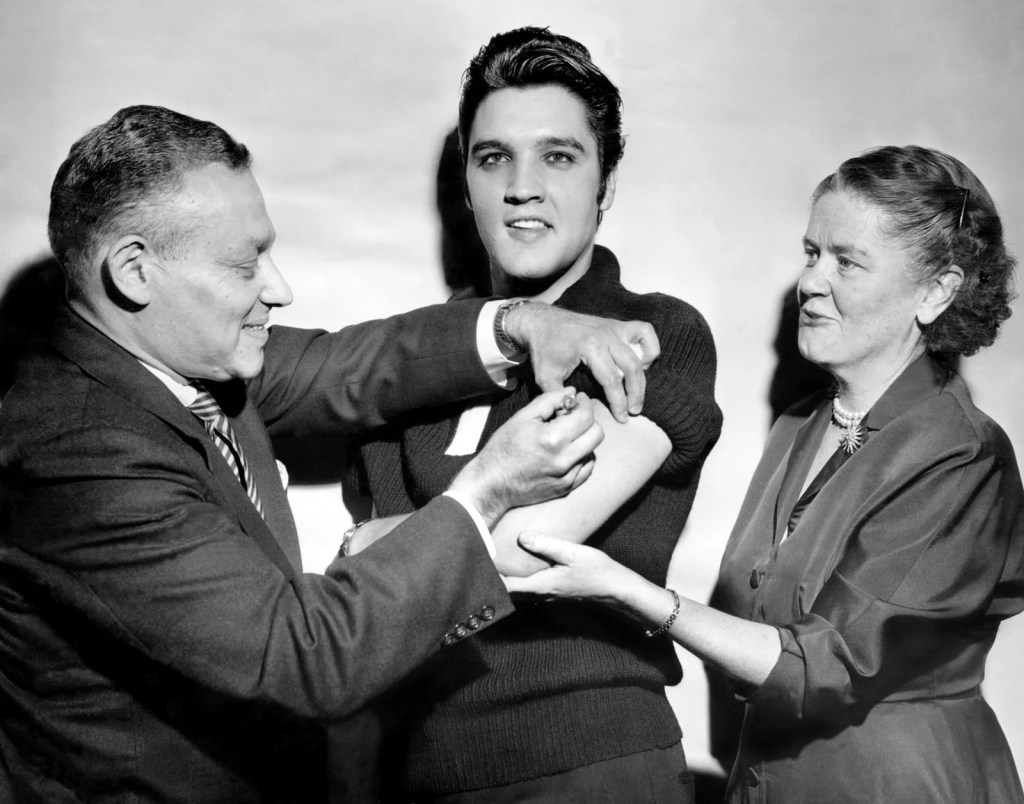
With the introduction of the Salk vaccine in 1955 and the more effective Sabin one in 1960, polio was virtually eradicated. The world was then spared an affliction thought to have originated as far back as 1500 B.C. FDR caught polio in 1921, and my father’s best friend’s got it the next year. Dad’s friend was wrongly put in a body cast, which wound up insuring lifelong paralysis from the waist down. FDR wasn’t put in a cast, but he fared no better.
The defeat of Polio was brought about by medical scientists, and Doctors Salk and Sabin were rightly hailed as heroes. But today there’s an assault on science, caused by its frequent contradiction of political dogmas and paranoid fantasies In medicine, we’re veering back toward the days of misinformation and malpractice, heralded by the Newspeak slogan “Make America Healthy Again.”
Robert F Kennedy, Jr., who has neither a medical degree nor expertise in the field, is now Secretary of Health and Human Services. Though he claims to support use of the polio vaccine, he’s also said, ignoring all the credible scientific evidence, that efficacy of the polio vaccine is “mythology,” that it may have caused more deaths than it’s prevented. Moreover, his lawyer has filed petitions to revoke or suspend federal approval of the standalone inactivated polio vaccine (IPOL) for infants and children. Kennedy has also replaced the members of the Advisory Committee on Immunization with a group that includes known anti-vaxers. At the same time, polio is on the rise in some third world countries, due primarily to low vaccination rates. And the polio virus likes to immigrate. We should be doing more to secure our borders from it instead of rounding up people who simply want a life free from poverty, repression, and violence. Otherwise, polio days will be here again.
Essay copyright 2025 William Trowbridge
William Trowbridge is a Distinguished University Professor Emeritus at Northwest Missouri State University, where he was an editor of The Laurel Review/GreenTower Press from 1986 to 2004. His many books include Call Me Fool(Red Hen Press, 2022).
Discover more from Vox Populi
Subscribe to get the latest posts sent to your email.

Beth Peyton says, “…a powerful essay, and brought back memories of my many summers in Omaha (although I got the sugar cube). I forwarded to my Uncle Dave Shadle, who knew Bill as a kid (which I didn’t know). They grew up together in west Omaha. My uncle said “Thanks so much for sharing this with me! Bill was a good friend as was Barry MacEnilly. You would rarely see one without the other.”
LikeLike
Thanks, Bill, for this. I can relate. I’m recalling my mother’s fight against the spread of polio…very much the enemy of all school children when I was in grade school, 1942-48 and Junior High from’49-51 and High School from 52-55. My mother had her own notions about how polio spread, and that was that it was carried by house flys. We had two fly swatters in every room of our home and Mom gave my sister and I a nickel for each fly we swatted. Also, there were rumors that polio was spread in city swimming pools which my mother poo-poo’ed, mostly because she was a Red Cross Water Safety instructor and believed drowning was a bigger risk than polio. Good piece at a time we are in need of eradication of risks worse all of the infectious diseases. We can only hope the perpetrators in the MAHA “movement” will be the first to suffer from their ignorance and hate—which is more dangerous than all of the infectious diseases put together.
LikeLike
Thank you for this, Dr. Palmer.
>
LikeLike
A chilling end to a very good essay. Robert F. Kennedy, Jr. is an idiot in a powerful position. Yikes.
LikeLiked by 1 person
Yikes. An ignoble end to an illustrious family’s contribution to American politics.
>
LikeLiked by 2 people
I remember the dread and fear my parents had when I got a stiff neck. I remember that we weren’t to swim in public pools. Two of my classmates got polio, at different times, relatively mild cases. One now has post-polio syndrome.
LikeLiked by 1 person
Thanks, Arlene. The disease coming back.
>
LikeLiked by 1 person
There were two kids in my class with some strange contraptions around their legs – one the left, the other the right. Polio, they said. We didn’t bully them. Then we got anti-polio drops on spoonfuls of sugar. Too late for those two, but what a difference this made from then on to all of us who hadn’t been touched by that terrible illness yet.
LikeLiked by 1 person
Thanks, Rosemary. I remember standing in line with my father at the local school auditorium to get our sugar cubes. I had no idea what it was all about until many years later.
>
LikeLiked by 1 person
I remember my friend Jaques who was always studying plants and animals and whose mother was in an iron lung. And I remember sugar cubes and a week of penicillin shots in my behind when I had a viral flu. I remember Bobby Kennedy who asked dad to be his PR person ( not sure why dad said no) and I remember a little boy who lost his dad who has grown up to espouse weird theories that will lead to more death. The world has turned upside down.
LikeLike
Thanks, Barbara. Lots of memories…
>
LikeLiked by 1 person
Cicero: “Experto credite.” — Trust the one who has had the experience. (Especially one who writes as powerfully and beautifully as Trowbridge.) Thanks for this fine essay.
LikeLiked by 3 people
Thanks, Richard. The polio epidemic happened so long ago, there’s little cultural memory of it. I’m grateful to Bill for reminding us. Forgetting such things will lead to horrible consequences.
>
LikeLiked by 2 people
Thank you, Bill Trowbridge, for writing this essay. I hope your words and the alarm bells they sound travel far and wide.
LikeLiked by 4 people