
Vox Populi
A curated webspace for Poetry, Politics, and Nature with over 6,000,000 visitors since 2014 and over 9,000 archived posts.
Ahmad Shamlou: Excerpts from Elegies of the Earth
Translated from Persian by Niloufar Talebi
Nocturnal (A Bit of Evil in Your Soul)
A bit of evil in your soul
A bit in mine
A bit in us all…
—and the eternal curse befalls humankind.
A tiny latrine in every home, even in the sanctuary of love,
is enough to drag
an entire city
into filth.
~~~
If Only
If only the burden of bread
would let me,
I’d speak volumes
of your warm hands—
two toddlers tangled in my arms.
□
Songs fold into songs—
O mother of Christ, O sun!
I’d write songs
of your boundless heart
strumming its endless harp
if only the burden of bread
would let me.
□
Colors blur into colors—
I’d paint patterns
of your springtime rainbow,
pitched like a canopy
over the fall-stricken garden
if only the burden of bread
would let me.
□
You are a wellspring in the heart,
a waterfall in my hands
a sun in my eyes,
an angel in disguise.
I’d tell tales
of the human that you are
if only the burden of bread
would let me.
~~~
In the Moment
I caress you and discover the world
I think of you
and touch time,
suspended and boundless,
naked.
I blow, I rain, I shine.
I am the sky
the stars and the earth
and the fragrant wheat that sprouts,
dancing
within its green soul.
□
I pass through you
as thunder through the night—
I glow
and implode.
~~~
I Love You Without…
I love you without wanting you.
□
Is it old age
to coil inward like a cloud
and thunder without rain?
Is it old age
to want her
without clasping her?
Is it old age
to want her,
ache for her in every vein
without even
a single plea?
Is this the pinnacle of love,
the promise of union beyond the body?
~~~~
These poems are from Elegies of the Earth: Selected Poems by Ahmad Shamlou (World Poetry Books, November 2025) Edited and translated from the Persian by Niloufar Talebi.
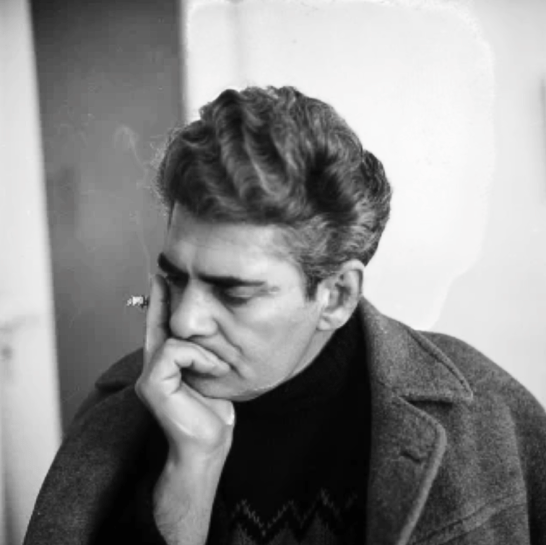
Note from the translator: Ahmad Shamlou (1925–2000) was born into an itinerant military family. He dropped out of school early but became one of the most influential literary figures of the 20th century, leaving behind over 70 books and a living encyclopedia of Iranian folklore.
Coming of age in 1940s Iran, a time of dictatorship, foreign interference, and cultural upheaval, he became politically engaged and taught himself to write and read world literature. For a thousand years, Persian poetry had followed strict, rhymed forms like the ghazal, often cloaked in metaphor (moths, candles, lady wine-bearers) with Rumi and Hafez among its globally revered greats. His early mentor, Nima, began breaking with these traditions, introducing modern imagery despite fierce criticism. Shamlou soon went further: rejecting rhyme altogether and writing bold free verse on current subjects, birthing a poetry of urgency. He became the vanguard of Iranian Modernism, alongside poets like Forough Farrokhzad (now translated into English).
By translating dozens of writers including Éluard, Lorca, Neruda, and Langston Hughes, and works like Gilgamesh, The Little Prince, and Song of Solomon, Shamlou grafted international ideas—like French surrealism and symbolism—onto Persian poetry. As Ezra Pound reshaped English modernism by introducing Chinese forms, Shamlou blended East and West, myth and street, and high and low, to democratize literature without simplifying it. He championed the “everyman,” the struggle for freedom, and all who stood up to tyranny. His poems are recited by intellectuals and laborers alike. He left behind many recordings in his signature bass voice. Because his work was in conversation with world literature, it belongs to it. Translating Shamlou into English closes a long loop of influence—returning his voice to the global chorus that shaped him, and that he helped shape.
Fiercely independent, he opposed both the Shah’s regime (enduring multiple imprisonments) and the Islamic Republic. His radicalism even frustrated peers, as he challenged nationalism and refused ideological compromise. His style ranged from spare, declarative verse to lush lyricism, always grounded in moral clarity and emotional force. He also wrote essays, journalism, and scripts, building a body of work that bridged art and activism. Known to his people as the “Master Poet of Liberty,” Shamlou is celebrated in Elegies of the Earth—a sweeping centennial collection and the first major English introduction to this Nobel-nominated poet.
~~~~
Niloufar Talebi is an author, translator, and multidisciplinary creator. Ahmad Shamlou, who attended her parents’ secret literary salons in post-1979 Tehran, has been a lasting inspiration for her work—including an opera, literary biography, and a TEDx Talk. A Fulbright U.S. Scholar and recipient of translation prizes, including a NEA Translation Fellowship for her translations of Shamlou’s poetry, she teaches Creative Writing and Creativity at Stanford Continuing Studies.
Discover more from Vox Populi
Subscribe to get the latest posts sent to your email.

If mainstream media were making room for poetry, as well as for dissident voices, I could retire and go back to gardening. In the meantime, I’m glad to have such fine company on the barricades.
LikeLiked by 1 person
Iran has been in pain for a long, long time. These poems are gorgeous.
LikeLiked by 1 person
Yes, they are gorgeous!
>
LikeLiked by 1 person
Thank you for sharing your new discovery. I was in Iran just before the revolution, but his poems feel current.
LikeLiked by 1 person
They really do!
>
LikeLiked by 1 person
Amazing poems.
LikeLiked by 2 people
Thanks, Doug. Shamlou is new to me, a lovely discovery of an important poet.
>
LikeLiked by 2 people
Love especially the lines about age.
LikeLiked by 1 person
Yes, also the originality of the poems. It’s not often you see the word latrine used as a metaphor.
>
LikeLiked by 1 person