
Vox Populi
A curated webspace for Poetry, Politics, and Nature with over 6,000,000 visitors since 2014 and over 9,000 archived posts.
Charles Harper Webb: Appetite
The crowds seem endless, tramping past
the Hunger Artist’s straw-filled cage to see
the panther’s glinting teeth and lethal stride.
Then one night, as the moon spills milky light,
the big cat coughs, and its heart stops as if pierced
by an antelope’s spiral horn. The stillness,
once the cat has thumped onto the concrete floor,
grabs the Artist and shakes just as he too is merging
with death’s murmuring stream. Absence
leaps from the cat’s cage, as when a basement light,
left on for days, burns out and, in the house above,
dark grabs a sleeper, who wakens in fright.
A tickle grips the Artist’s nose, and drags him
toward the bloody meat that still awaits
the panther’s fangs. Always before, that scent
would make him retch. Now it seems sweet.
He reaches through the bars and eats,
then shoves out of his cage, and stalks back
to his childhood home. Elke next door,
who tortured him, tattling and whining
until he would play daddy to her dolls—Elke,
once thin and small, waves from her window,
her breasts white as whipped cream,
nipples like ripe raspberries in the chill.
.
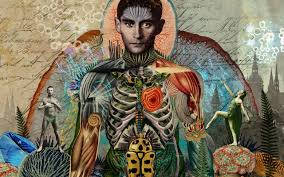
To read Franz Kafka’s short story A Hunger Artist, click here.
Ed. Note: Hunger artists or starvation artists were performers, common in Europe and America in the 18th, 19th and early 20th centuries, who starved themselves for extended periods of time, for the amusement of paying audiences. The phenomenon first appeared in the 17th century and saw its heyday in the 1880s. Hunger artists were almost always male, traveled from city to city and performed widely advertised fasts of up to 40 days. Several hunger artists were found to have cheated during their performances. The phenomenon has been relayed to modern audiences through Franz Kafka’s 1922 short story “A Hunger Artist”, contained in the collection of the same name. (source: Wiki).
~~~~
Poem copyright 2025 Charles Harper Webb
A former professional rock singer/guitarist and licensed psychotherapist, Charles Harper Webb is Professor of English at California State University, Long Beach. His collections of poetry include Sidebend World (Pitt, 2018).
Discover more from Vox Populi
Subscribe to get the latest posts sent to your email.

What a fascinating poem, with its tightly crafted tercets and intriguing narrative! Funny I was just admiring a couple of Charles’ poems in GLIMPSE and now this. Often he makes me laugh, but this time there is a menace and dangerous allure to this poem. Bravo! I just adore his work.
LikeLike
I do too, Meg.
>
LikeLike
This is oddly apropos, given our passing through customs in Miami this morning, trepidation over my wife’s newly-minted green card and enough of an officious delay to miss our connection, leaving us now stuck in LA until tonight, but thankfully having skated over the ICE, and my first of two back-to-back short fiction classes beginning on Monday, replete with Kafka’s “An Imperial Message” and “Give it Up,” along with “Vanka,” short fiction by Chekhov, another writer, like Kafka, lost at a young age to Tuberculosis even as the tumors in my own lungs are held in check. For now. But thankful, too, to have spent a month in Colombia, off the grid, mas o menos, and thus free of the palpable smog of grift, graft, and imperious gringos. Our return a reminder, however, of the stakes, a dark grabbing the sleeper[s] when we disembark in Harvey Milk Terminal in short order.
LikeLike
Welcome back to 1935 Germany, Matt…
>
LikeLiked by 1 person
From what I could glean:
The intention of communication in Franz Kafka’s short story “A Hunger Artist” is layered and complex, but at its core, the hunger artist seeks to express his misunderstood inner truth and gain authentic recognition for his art and suffering.
Key Intentions Behind His Communication:
The hunger artist wants people to recognize his fasting not as a stunt, but as a form of deep spiritual or artistic expression. He fasts not for fame or money, but because he claims he has never found food he liked — a metaphor for his alienation and existential dissatisfaction.
His communication — through his silence, fasting, and presence in a cage — is meant to symbolize an ideal: striving for purity, self-denial, or mastery over the body. He wants to communicate a philosophical or metaphysical pursuit beyond mere spectacle.
Much of the hunger artist’s frustration stems from the fact that his audience misunderstands his intentions. They see entertainment; he wants them to see the profound truth of his condition — his suffering, discipline, and rejection of the material world.
The hunger artist also seems to fast in order to affirm his own identity. His art is the only thing that gives his life meaning, and his communication — though often unspoken — is a way to assert: I exist, I suffer, and this suffering means something.
LikeLiked by 3 people
I’m not sure what sort of response to this poem would be useful for the poet or his audience. Others might be better able to connect with hunger artistry or explain the mystery of its uncaging. It almost reads like an allegory of an eating disorder, but am I reading it with too much of a slant?
LikeLiked by 2 people
Hunger artists were performers, common in Europe and America in the 18th, 19th and early 20th centuries, who starved themselves for extended periods of time for the amusement of paying audiences. Kafka’s 1922 short story “A Hunger Artist” develops this idea as a metaphor for all artists. Charles Harper is telling a tale of his own that echoes Kafka’s story.
LikeLiked by 2 people