
Vox Populi
A curated webspace for Poetry, Politics, and Nature with over 6,000,000 visitors since 2014 and over 9,000 archived posts.
Baron Wormser: Groovy
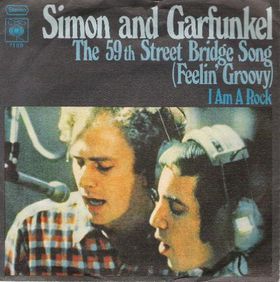
Once upon a time, which is to say 1966 or thereabouts, Paul Simon wrote a song called “The 59th Street Bridge Song (Feelin’ Groovy).” The song begins with these words: “Slow down, you move too fast / You got to make the morning last” and ends with these words: “Life, I love you / All is groovy.” In-between – as a tuneful, lyric burst since it’s a short song – the narrator salutes the beauty of crossing a bridge one marvelous morning that can be any morning. The song lilts in a perfect way, each note vibrant and buoyant. As human beings, we, too, have felt such 59th Street mornings, when the poetry of sheer being is palpable and we feel at liberty to enjoy that poetry. The hurry of purpose is recognized but suspended. Time is precious. So is the enormity of feeling that issues in the word “groovy.” Elemental and open-ended, the song doesn’t reach beyond its keen moment. Wonder of wonders – everything is in place already.
It’s fair to say that “groovy” has passed out of daily parlance. As words go, it was a bit silly, a bit mystic, a bit glib, a bit droll, a bit low-brow, a bit artless, and a bit wonderful. It spoke to an era and seemed, accordingly, germane to that era and almost sensible in its glad frankness. It’s a different word from “happy” and Simon’s song captures that difference. “Happy” is possessive and inevitably speaks to individual circumstances and that dogged pursuit (also known as the anxious treadmill of wanting) that shadows (and mars) American society. We may say, “I am happy” but we are unlikely to say, “I am groovy” because the latter adjective speaks to a state of existence that is much larger than the individual. The sheer presences – morning, weather, walking, looking around, being a body – are all part of the word that nods to those presences yet indicates more, a sense of embodied harmony. For testimony, ask the flowers that are part of that harmony – in Simon’s words “Let the morning drop its petals on me.” Yes, he is the rhymin’ Simon whose chiming words are part of the great congruence we experience each day.
The adjective’s guileless simplicity invites mockery. Among the lessons that repression teaches – at home, in school, among peers – is wariness. To declare feelings is to make ourselves vulnerable. Groovy – to hearken to Simon’s word – may be dismissed as little more than callowness and self-satisfaction. That would be wrong but in an age typified by an angry sneer, anyone can understand such wariness. Sadly, it’s more compelling to deliver a put-down than a sincere compliment. Indeed, sincerity is suspect since it has nothing to offer beyond sheer feeling. No deal is being made. No one is being hectored. No one is asserting some dubious egotistical certainty. The narrator in Simon’s song is at one with life without making any newsworthy statements or efforts. In its upbeat way, the song takes the air out of the poses that go with each political day, the drone of fixing human affairs according to one more cock-eyed notion. What about the sun rising and the sky and those flowers? Are they beneath the considerable contempt that is broadcast each and every hour? Are we so totally the prisoners of those notions that the sheer glorious morning no longer exists? We need not answer: Our self-importance props us up and gives us our anthropomorphic swagger.
More than one thinker has told us that societies cannot exist without repression, that any group that does not have strict margins is going to go off the tracks and dissolve into the violence of each person against each person. Since capitalist competition quietly and not-so-quietly exemplifies such workaday violence, we may immediately question such a premise yet we know good reasons exist for the constabulary. The extent of that constabulary’s reach is another matter, as the phrase “homeland security,” to say nothing of “national security,” indicates. Those phrases are supposed to tell us how repression is good for us and that whatever nasty apparatus we dream up to buttress those phrases is not to be challenged. Nuclear weapons are good for us. Wars that incite “regime change” are good for us. Endless economic “progress” and taking endless profits are good for us. Destruction of environments is good for us. We must fall in step, otherwise as nonbelievers we are not fit to be members of the society. Once upon a free-spirit time, such people were designated as hippies, men and women who dropped out, in part to appreciate those flowers Simon calls attention to. “Flower power” may have seemed an idle slogan but its talent for appreciation was not idle at all. Why else are we here but to relish the encompassing earthly spectacle? To complain? To make it “better”?
As the present moment instructs us, scorn comes easy and many people are eager to get their piece of it, however vicariously. Elevated by one dismissal of charity and decency after another, they stand a little taller. Given the scorn’s desperately vehement tenor, it’s not hard to perceive what is percolating not far underneath: a big unhappiness, a big witlessness, a big emptiness that insists it is everything but unhappy, witless, and empty, that proclaims the word “great” as if repetition somehow made it real. It goes without saying that Simon’s song has no statements to make about the destiny, venal or otherwise, of the nation. In his spritely way, Simon is pointing to what is much larger than the nation, a largeness that humbles those who improvidently consider the fate of the United States to be mankind’s fate and who have been opposed to that largeness since that song was written. Repression believes that “groovy,” in all its forms – natural this and natural that, be it food, yoga, cannabis, meditation, sex, fabrics, and music – is inimical to the society’s functioning according to the ways of capital and the machines that have made capital go. Repression believes that the artificial, since it is the result of manipulations, is preferable to the natural, hence the irony of the machine “intelligence” that has come to pass and that we are told to applaud.
“Believes,” however, is too mild. Loathing for the natural is closer to the mark, a loathing that Trump eagerly manifests, although he is only one in a long line of so-called “leaders” who has made it plain that the straight and narrow of armed force and more armed force aided by technology is the surest political path. Thus, a closed mind, as the recent purging of books from the Naval Academy library shows, is preferable to an open mind. A closed mind is certain and doesn’t have to listen to anything, beginning with the day that presents itself to each person and doesn’t ask the person for an agenda or goal or some screwed-up ambition and that puts life in a perspective beyond the news cycle.
I can only assume that deep shame accompanies this refusal to be open to the day which, after all, is not air-conditioned or wireless or busy deporting people, a shame about mortal bodies, a shame that waves the brusque flag of Realpolitik, as if that cynical combativeness were the last word in human affairs, as if to say, “It’s a bad world and we can make it worse.” In that dark light, life at-large seems a self-fulfilling prophecy, insufficiency parading as wisdom. Letting in more air, more of the feeling that “groovy” signifies and on which no price can be put, can only cause harm to the brusque engines that the ever-sneering Nazis captured so well in their motto above the gates of Auschwitz: Arbeit Macht Frei. Those steps across the 59th Street Bridge savor of the first freedom, a spirit in touch with the majesty and joy that are present in each earthly moment, whether we are attentive or not. Apparently, we have other things to do. We are told life is not a song. But it is.
Copyright 2025 Baron Wormser
For twenty-five years Baron Wormser worked as a librarian in Madison, Maine. Also he taught poetry writing at the University of Maine at Farmington. From 1975 to 1998 he lived with his family in Mercer, Maine, in an off-the-grid house on forty-eight acres. His memoir, The Road Washes Out in Spring: A Poet’s Memoir of Living Off the Grid concerns that experience.
Discover more from Vox Populi
Subscribe to get the latest posts sent to your email.

I came to the ‘groove’ late in life (was a bit older than the groovies) but treasured the sentiment to this day, “Indeed, sincerity is suspect since it has nothing to offer beyond sheer feeling. No deal is being made. No one is being hectored. No one is asserting some dubious egotistical certainty.” That’s what makes me so sad for my kids. But perhaps, we parents don’t quite ‘get it’, they have found their own, in their way. I sometimes suspect it. Poor He Who Shall Not Be Named had no choice but ‘manifest that loathing’. It’s all he is. The scary thing is that he has found the creepy-crawlies that lived under the stones he so happily upturned. Terrific essay. As always.
LikeLiked by 2 people
Well-said. Thanks Rose Mary.
>
LikeLiked by 1 person
I was recently thinking about the phrase: you’re in the groove (Barbara H used the phrase in her comment here too). Wormser certainly is. As with most of his postings on Vox, they stay in my groove for future re-reading, though not all make me feel groovy in Paul Simon’s sense.
As for levity, I believe Baron makes the case for it, unlike many other barons of our time. So haha narcissists.
LikeLiked by 1 person
Thanks, Jim!
>
LikeLiked by 1 person
This is a song I sought out on days when I could almost remember how it felt to be in the groove or when the world felt like that deep scratch that wouldn’t let me move on. It’s been awhile. I will go out in the garden, sit in the center of the labyrinth and see if it still works.
LikeLike
It still works for me!
>
LikeLiked by 1 person
Another outstanding essay by Baron Wormser. Among other things, “feeling groovy” made me think about the recent “No Kings” rally in my conservative-leaning town. There was a huge turnout, with everyone smiling at each other. It felt (echoing the metaphor) like we were all filled with the same beautiful song.
LikeLiked by 2 people
Yes, Eva and I attended the NO KINGS rally in Pittsburgh. It felt very 60’s.
M.
>
LikeLiked by 1 person
Those of us who grew up on 45 and 33 rpm records know about the groove. The digital generation missed out. Now that the Nazis are back, we need to get our diamond needle mojo workin’.
LikeLiked by 3 people
Thanks, Doug, for this reminder of the importance of my mojo which is in dire need of a tune-up.
>
LikeLiked by 1 person