
Vox Populi
A curated webspace for Poetry, Politics, and Nature with over 6,000,000 visitors since 2014 and over 9,000 archived posts.
Video: Margie Soudek’s Salt and Pepper Shakers
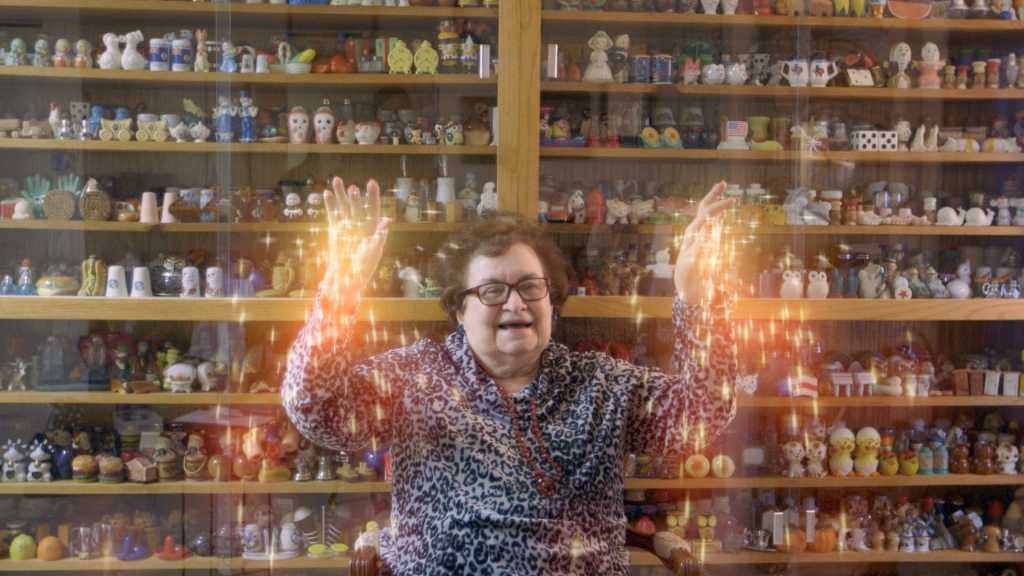
Using special FX, the director Meredith Moore surrounds her grandmother with explosions, rainbows, and sparkling lights as she shares her extensive collection of salt and pepper shakers.
Director Meredith Moore
Produced by The New Yorker
Running time: 12 minutes
Margie Soudek came into her first set of salt and pepper shakers—a pair of ducks “dressed like ladies”—around 1946. Throughout the next seven decades, Soudek’s collection expanded to fill a wall-to-wall and floor-to-ceiling set of shelves. She amassed more than two thousand sets. “Once she started collecting, everybody just gave them to her,” her granddaughter, the filmmaker Meredith Moore, said. “It took on a life of its own.”
Touching the salt and pepper shakers had been off-limits for Moore and her cousins when they were growing up. In her thirties, she finally got permission to open the cabinet. In 2018, Moore travelled from her home in Baltimore, Maryland, where she was teaching visual effects at the Maryland Institute College of Art, to Soudek’s assisted-living facility, in Oklahoma, and began filming the collection. That summer, Moore filmed around five hundred shakers. What does it mean to film inanimate objects? She wasn’t sure what she wanted to do with the footage. “I started thinking more about my own obsessions with digital effects,” Moore said. “I got really excited about weaving those two worlds together.”
In the resulting film, “Margie Soudek’s Salt and Pepper Shakers,” Moore combines old family videos, visual effects, and screen recordings of her own computer to explore the ways that art-making and obsessiveness enhance our realities. “Objects bear witness to our lives,” a note on her desktop reads. “When does an obsession take hold?” posits another. In one fantastical scene, Soudek appears to zoom through a lush green landscape, her wheelchair aflame, while human-size salt and pepper shakers spin past her.
Click here to read the story behind the film.
Discover more from Vox Populi
Subscribe to get the latest posts sent to your email.

Moore’s film demonstrates in a bittersweet way, how what some would consider hoarding, can be glorious. It also reinforces the joys of love between family over the generations. Folk art can contain thousands: there’s beauty everywhere in this masterpiece. Margie sets the objects of possibility, Meredith Moore transforms them and the scene with her digital magic. And the result is oh so bright with kitschy wonder. It turns salt and pepper into a near miracle.
But it also can help set loose the viewer’s imagination into learning new technology to incorporate into their own art. Wow squared. With this film (thank you to Margie, too) a whole new way of doing art shows its possibilities. A deep bow of gratitude.
LikeLiked by 1 person
Lovely, Jim. I’ve never seen the boundary between collecting and hoarding. Perhaps the difference is the neatness of the collection? A yard sale is much like a museum devoted someone’s castoffs, it seems to me.
>
LikeLiked by 2 people
I had a stamp collecting buddy named Jean-Nickolaus Tretter who collected stamps even after he went blind. A unique collector. After he died, we also discovered to our surprise that he had also collected many thousands of LGBTQ memorabilia. In fact, so much material, that it now has become the Jean-Nickolaus Tretter Collection at the University of Minnesota, and the largest such collection in the upper Midwest. I salute the man I knew as a collector for what he accomplished by his focused hoarding. You can google his name and read a fascinating account of his life.
LikeLike
Thanks, Jim!
>
LikeLike