
Vox Populi
A curated webspace for Poetry, Politics, and Nature with over 6,000,000 visitors since 2014 and over 9,000 archived posts.
Matthew J. Parker: Cancer Dancers
I did not plan a trip to Colombia last winter. First time since 2007. Nor again this summer. Before 2024, I’ve made biannual trips to that splendid country to spend time with first my girlfriend, then my fiancée, and finally my wife; during those years I went from grad student to adjunct instructor to construction worker to lecturer. Of those 17 plus years, or 884 weeks, we were together maybe 50 of those weeks. Maybe.
By comparison, my longest prison sentence was 2.5 years. Meted out to me three times. My shortest 2 years. Twice. That’s 11.5 years on paper; served in both Arizona State and federal prisons. Take a few years off for good behavior and add a couple on for county time and that’s roughly a decade I’ve served behind bars, a revolving-door dance with four presidents – Reagan to GWB – and all leading with the drug war jitterbug.
That’s seven years less, by the way, than our LDR. So much for 90-day fiancés.
I met Gerenith in 2006. Found her on a dating website that featured women from Cali, Colombia, aka the Salsa Capital of the World. I recall being enchanted by her photos, one in particular sporting a wide, red-lipped smile on an oval, smattering-of-freckled face. But when I saw the age difference – I’m 13 years her elder – I reluctantly scrolled away to photos of other women from Cali, aka Caleñas, eventually purchasing the emails of three closer in age. But checkout informed me that there was a buy-three-get-one-free deal. I was almost woozy with relief when I added Gerenith’s email to my pending ten-dollar purchase, and this seemingly innocuous smidgen of luck doled out by an electronic sister of fate turned out to be, by far, the greatest event of my life.
One of the worst was being in jail or prison and dreaming of being out, only to wake up to the reality of sickly-yellow concrete and cold-rolled steel. But the dreams took on nastier proportions when, several years after meeting Gerenith, I’d have this recurring nightmare about being locked up again with no way to contact her. A teary-eyed image of mi Caleña believing I’d abandoned her was by far the worst pain I’ve ever felt. That odd decade in prison and even longer as a street junkie tiny blips on the agony radar by compare.
The nightmare was made even more acute due to her seemingly imperturbable constitution. In 18-plus years, I’ve seen her cry only twice. The first was in June of 2021, in Cali, a few days after we were married. It was the height of the pandemic, and on the day before my flight home I returned to our hotel room to have her fall into my arms, weeping irrepressibly; “Mi papa esta muerto. Mi papa esta muerto.” A hospital had contacted her mom to say that her dad had died from the corona virus.
I consoled her as best I could, then left again to get my mandatory Covid test for reentry into the USA. When I returned this time, however, she was dancing with joy. The hospital had made a mistake. Her father was very much alive.
“Seguro?” I asked, as she pulled me in to dance with her.
“Sí sí sí,” she said, her smile doing a foxtrot of its own. I love that joy on her face. To me there is no greater sight on the planet.
This memory somewhat mirrors our LDR holding pattern. Beginning in the winter of 2007, with rare exceptions, we saw each other twice a year, usually a week each in winter and summer augmented with biweekly phone calls. Although nothing like losing a loved one, there was definite sadness between trips similar to that drawn-out element accompanying grief – where days and even hours seem unbearably long. The difference is that ours was followed by a quick week of dancing joy just after Christmas and another around the 4th of July; weeks that flew by, as if Einstein himself piloted the planes that took me to and from her.
And yet, just like in prison, time between visits sauntered along, was indeed relative to our movement through it, which to me seemed interminable. But even through her continuous chiding me with “Paciencia,” I knew that we were lucky to have found each other. During our unnaturally extended LDR I watched both friends and family struggle to find even a fragment of the love we salsa danced with so blithely; saw relationships come and go; attended happy weddings only to witness the bliss fizzle in a scant five years. Yes, both the time and the distance between us sucked, but we loved each other and knew it, and that was enough. Everything else, even the maddening infrequency of physical contact, not to mention the bureaucracy that perpetuated it, was secondary.
Nor do we ever fight. Or hardly ever. Our last fight was over ten years ago. I know because I was smoking as we argued, and I smoked my last cigarette in 2013.
Our first fight occurred in Barrio Granada in northern Cali soon after we met. It began in a mall and ended up on the streets, where I lost my temper and yelled at her. She stopped then, flung hands on hips, looked me dead in the eye, and said, “No me Grites. Nunca.”
I tried to interject, but she stamped a foot and said it again, this time slowly, enunciating each syllable as she wagged a finger in my face, No…may…gree-tahs. Noon-kah. No may goo-sta.” She then pirouetted away from me and marched up the street like Helen heading alone back to Troy.
I fell in love with her right there.
We were both students at the time. Once I’d kicked heroin my return to college was both obligatory and, when compared with being a junkie, ridiculously easy. The problem was that, after earning my MFA at Columbia in 2012, I couldn’t find work in any of the Five Boros. What I discovered was that New York City loves its ex-cons, it just doesn’t have much use for us.
Upon returning to Arizona, I taught as an adjunct for five years and drove a cab on weekends. But when it became clear no full-time teaching positions would ever be offered, I went back to construction. It was more money, for one, to where I could finally finance an immigration attorney.
Then, in the winter of 2021, UC Berkeley hired me as a full-time lecturer. It’s a union job that pays fairly well, even for the Bay Area. And although initially nobody would rent to an ex-con with a bankruptcy in his jacket, I tended toward preposterous happiness and was and am almost pathetically eager to please. At first, many didn’t get why I’m so nice and so genuinely appreciative of even the smallest gratuity, but the world I came from and the horrors I’ve been through both dictate a near-Victorian congeniality stripped of snobbery.
Gerenith, however, does get it. Got it after a year or two. She hates my prison tatts, for instance, but recognized very quicky their skin-deep superficiality.
“They look Satanic,” she’s often said, about the skulls and the dragons and the ridiculously obnoxious pentagram orbiting my belly button.
Gerenith is a good Catholic girl who was both repulsed by the pentagram – put there, btw, in defiance of an ADOC official who told me that I could not claim pagan as my official religion because, in her words, there was no such thing – but also able to recognize that, whatever it represented (in this instance radical atheism), it was no longer who I was, but rather a scar from an injurious past; put there, perhaps, as a reminder of how ugly life can be even amid, especially amid, it’s inherent beauty.
Like cancer.
Gerenith arrived here on January 11, 2024. We took a selfie at Miami international, just after she cleared customs. Her smile in that photo is real enough, although tinged perhaps with a tad of trepidation – in her 50 years she’s never been out of Colombia – while mine mirrors sheer relief.
Then, less than two months after her arrival, I was diagnosed with throat cancer.
Her initial reaction was denial; “The doctors are wrong,” she said, her eyes filling but holding firm, which shattered my heart. Finally, we were together forever, but our forever had just been canceled. I felt guilty for bringing her here, but when I mentioned this to a friend, he said, “Crap. She arrived just in time.”
The next day she was back, and I attribute this to her steady Catholicism. Her faith would not allow her to be sad, or at least not in front of me. We are indeed overjoyed all the time and moreover accent this with laughter-lubed intimacy – I can make her giggle constantly with sexual innuendos that poke light fun at her strictly vanilla appetite. She also loves to be snuggled, especially in the mornings – damp and chilly San Francisco is a far cry from the tropics of Colombia – and we still hold hands to this day on walks.
But she lost it when, in preparation for treatment, they pulled out six teeth, including all of my molars. Throughout the cancer treatment I was often in pain; a stabbing throb in my throat and exterior radiation burns were accompanied by an earache and a mouthful of sores. But when the Novocain wore off after the extractions, her helplessness in the depths of my agony released the flood, and I witnessed her tears for the second time. The feebleness we all feel in the wake of a loved one weeping is like an ant swept away by the flood. Some ants, however, are lithe enough to dance on the crest of the wave until the flood passes, and strong enough to trudge the long road home.
It was opioids that, ironically, got me through treatment. People who know me were very concerned about my steady supply of prescribed Oxycontin. But I was a hype. It was the intravenous aspect as well as, to a certain extent, the lifestyle that I was addicted to. Moreover, I’ve been clean for 23 years, but even were it less so, my addiction to Gerenith far surpasses any craving I’ve ever had for heroin. She is my morning fix; my awakening dream as opposed to those long-ago-put-to-sleep nightmares.
Of course, amidst the bliss, the dread of cancer has reared its contorted visage – inopportune and damnably uncomfortable. During and after both radiation and chemo I was sick for three months. The treatment worked, however, the throat cancer eliminated, but it has since metastasized to my lungs, which is a much direr diagnosis; one that confronts me with the possible reality that my wife has arrived just in time to hold my hand while I die.
And it’s under such straits the age gap has waltzed back in to haunt me. If the cancer and/or treatment shortens my life or, God forbid, kills me now, that would be horribly unfair to her. But the die of love has been cast, its randomness and lack of surety inherent in the game – a love that flared up almost two decades ago and today burns inside us with such intensity it would give a pulsar pause.
So despite such a grim prognosis, we are happy; insanely so. Gerenith rarely allows herself to show sadness in front of me lest it undermine the positive energy she firmly believes I need to heal, and she’d sooner go toe-to-toe with a jaguar in the jungles of her homeland before admitting that cancer could come between us. Her stoicism in turn gives me both the hope and strength to maintain an even keel even as we both bob and tread lightly around the issue until, quite recently, we were thrown a lifeline – thin and barely visible, but a possible preserver, nonetheless: Immunotherapy, kindly provided by the killer (no pun intended) health insurance my job at Berkeley provides, so killer that I have a cadre of doctors at my beck and call.
The treatment is called Keytruda, a drug with minimal side effects, so minimal I’m able to work, although we’re still not sure of its efficacy. I’ve gathered still more optimism, however, from the article, “Still kicking: Metastatic cancer ‘thrivers’ give patients like me hope,” in which author Drea Cornejo, after being diagnosed in her mid-twenties with Stage 4 lung cancer similar to mine, states that, “survivors, or ‘cancer thrivers’ as some of us prefer to say, helped show me that recent advancements in medicine have drastically changed what it means to live with late-stage cancer.”
Live, of course, being the operative word, along with its derivative, living, as in Gerenith and I living together and still being wildly in love, especially in the face of so many obstacles, the greatest of which has moved in and put its rank feet up on the coffee table. And live with them we must. The trick is to give them, pope-like, a good washing, and then teach them how to dance, preferably a three-way salsa.
Copyright 2025 Matthew J. Parker
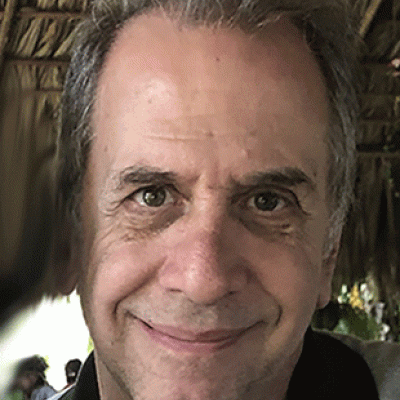
Matthew J. Parker is a lecturer at UCLA Berkeley.
Discover more from Vox Populi
Subscribe to get the latest posts sent to your email.

What a beautiful essay of love, life, and resilience! Power on, Matthew!
LikeLike
Matt’s journey has been extraordinary.
>
LikeLiked by 1 person
I hope you can dance for a long time, and keep writing as life carries you along with its love and its rains, too. Rain can wash Gerenith and you, while it replenishes rivers. Your words touch me with their tender, realistic resolve. Words and music made my own grief an easier burden.
LikeLiked by 2 people
Such a wonderful, honest, optimistic account of being human and being fortunate. Thank you. I wish you well with all my heart, Matthew J. Parker.
LikeLiked by 2 people
You are most welcome, Rose Mary. Thank you for the well wishes, and, of course, like Barbara above–not to mention MS and so many others featured on this particular venue–your poetry.
LikeLike
Wow! First of all, I am thankful for found love and new life. I guess as we read anything, the parallels to our own lives color and extend. I think of my son, a devout Christian ( I’m more of an agnostic Buddhist?) and the lives he saves carrying Narcan in his inner city neighborhood. Then I think of my own stage 3 breast cancer that now appears to be gone after the keytruda and surgery and radiation. Then my thoughts wander back to my son, his frequent visits to jails, hospitals, gang funerals. The photo he took of cops’ guns pointed at the car they stopped in front of his house, but the angle such that they also pointed at him through the window. The baby left for a hour in the stopped car, luckily a/c left on. Everyone ultimately released but their phones confiscated. Stopped only because of the funeral they had just attended. I think good writing does this to the brain and allows us to work on our own fears. Thank you. I didn’t plan to write a lengthy response when I started this.
LikeLiked by 3 people
Thanks for this, Barb!
>
LikeLiked by 2 people
A wise professor one told me “If you touch one person with your writing you did a great job.” Thanks for this. You encourage me.
LikeLiked by 2 people
Always hope for a last dance.
LikeLiked by 2 people
Read this with interest and appreciation.
LikeLiked by 3 people
Thanks, Christine!
>
LikeLiked by 1 person