
Vox Populi
A curated webspace for Poetry, Politics, and Nature with over 6,000,000 visitors since 2014 and over 9,000 archived posts.
Jerry Paul Sheppard: Trump’s policies are more than dumb — they’re stupid, according to stupidity researchers
Before he stepped down as Canadian prime minister, Justin Trudeau called Donald Trump’s tariff policies “very dumb.” This might be an accurate description of many Trump administration policies — but the more objectively correct word is “stupid.”
In fact, Québec’s largest newspaper, Le Journal de Montréal, published a front-page photo of Trump in early February with the word “stupid” in 350-point type. Some may call this an opinion, but the science of stupidity tells us that it’s more of a definition.
Recent research has produced a succinct label for the poorly calculated actions of decision-makers: stupidity.
This is not simple name-calling, but a phenomenon that comprises loss and features a set of actions that are either outright recognizably dysfunctional, or appear so at odds with any sensible course of action that it seems a hidden agendacould be involved.
Stupidity that causes everyone to lose
According to the seminal and transactional view of human stupidity by Carlo Cipolla, the late Italian economic historian, interactions fall into four categories:
- Intelligent interactions that are beneficial to all – a positive-sum game like Scottish philosopher Adam Smith’s notion of wealth through specialization and trade;
- Helpless interactions that result in a loss in a zero-sum game;
- Bandit interactions that result in a gain in zero-sum game;
- Stupid interactions that cause all parties to suffer a loss.
Free trade is based on an intelligent positive-sum interaction. Trump’s transactional zero-sum view is that for every winner there is a loser.
.
He apparently doesn’t understand that tariffs are only successful if other countries don’t retaliate. But other countries do retaliate, and as the world is now witnessing, the resulting trade war can decimate the global economy.
Trump’s protectionist measures aimed at boosting the U.S. economy can therefore be considered “stupid” interactions that risk deepening and lengthening an economic depression.
Stupidity as recognizable actions
Modern-day researchers have also identified three recognizable sets of actions embodying stupidity:
Confident ignorance that involves people taking risks without having the necessary skills to deal with them. It’s not just being ignorant of one’s ignorance — explained by the Dunning-Kruger effect — but being self-assured despite contrary evidence.
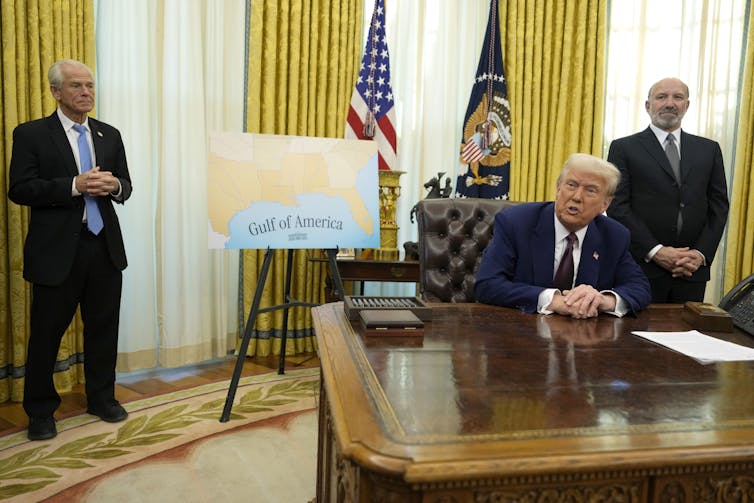
Trump may know what he does not know, so he delegated many tasks to Tesla founder Elon Musk and trade tariff architect Pete Navarro, both of whom seem to possess no such awareness.
Absent-minded failure means people knew the right thing to do but were not paying sufficient attention to avoid doing something stupid. Organizations create agendas, but if issues don’t reach a point where they seriously impact the organization’s objectives, they are ignored.
An example is the recent U.S. strikes against Yemeni Houthis. U.S. officials ignored critical security components by sharing information about their plans over unsecure connections and with a member of the media.
Lack of control means that autocratic decision-makers compromise their organizations by failing to accept objections from those charged with implementing the leader’s preconceived plans.
Such autocratic decision-makers may select biased information to support their proposals. Those working under these leaders either buy into efforts to selectively use information, limit alternatives and execute these preconceived plans or they leave the organization (either voluntarily or not).
In the U.S., witness the firing of Justice Department pardon attorney Elizabeth Oyer. She failed to support restoring gun rights to actor Mel Gibson, who had been convicted of domestic violence in 2011. Gibson’s pardon was reportedly based on his personal relationship with the president.
Types of stupidity
Organizational researchers have used the term functional stupidity to describe those who refuse to use their intellectual capacities when making decisions and then avoid justification for their actions. This allows group members to quickly execute routine functions without much thought.
Dysfunctional stupidity is a lack of organizationally supported reflection, reasoning and justification. Organizations fail to use intellectual resources to process knowledge or question norms or claims of knowledge when confronted with new or non-routine decisions. By blocking communications, muffling criticism and squelching doubts, organizations ensure adherence to superiors’ edicts.
One Trump administration example is the unquestioning permission given to allow the Department of Government Efficiency (DOGE), headed by Musk, to access to a wide array of government data.
It can take the combined efforts of organizational officials on multiple levels to maintain stupidity.
Individually, stupidity is reinforced by ignoring crucial information because of a need for a rapid response.
Consequently, quick decisions and shortcuts made by individuals result in negative outcomes. An example would be the Trump administration’s apparent need to appear to find cost savings quickly to allow for tax cuts, overriding a more logical approach to find ways to achieve those savings without gutting legally mandated services.
Organizationally, stupidity is reinforced because organizations limit acceptable alternative behaviours when they cannot process all available information. Data is restricted, controls are tightened and organization officials fall back to using previously well-learned responses in their comfort zones. Inexperienced decision-makers fall back on uninformed assumptions, or no assumptions at all.
Witness Trump’s “reciprocal” trade tariffs that battered financial markets worldwide, finally causing him to hit the pause button. No tariffs were calculated using current tariff rates, while others were based on American trade deficits with other countries. Other tariffs seem to be based on no rationale at all.
Stupidity as a hidden agenda?
Some actions that appear stupid may simply hide a hidden agenda. When the Trump administration erroneously detains and deports anyone under the Alien Enemies Act, is it an accident or a way to instill fear in everyone that authorities can detain, mistreat and deport them without due process at any point?
Many of the actions being taken by the Trump administration appear stupid. Tariffs, for example, represent a loss — a transactionally negative sum game.
Trump’s decisions exhibit confident ignorance, absent-minded failure and lack of control. They also show dysfunctional stupidity as Trump officials seemingly refuse to use their full intellectual resources. Stupidity is also being reinforced through unfounded assumptions. Is this all hiding a secret agenda?
“You can’t fix stupid,” so the saying goes. But having capable administrators in place while other branches of government exercise their constitutionally mandated oversight role might dampen some of the Trump administration’s stupidity.
First published in The Conversation. Included in Vox Populi with permission.
Jerry Paul Sheppard is Associate Professor of Business Administration, Simon Fraser University.
Discover more from Vox Populi
Subscribe to get the latest posts sent to your email.

“confident ignorance”–yes.
LikeLike
Dear Jim,
You do understand that even suggesting a course in Stupidity Studies, puts you firmly in the company of the pointy-headed who support the I in DEI, right?
PS I hope you have a sense of humor.
LikeLike
Hahahaha
>
LikeLike
The article ends with ““You can’t fix stupid,” so the saying goes. But having capable administrators in place while other branches of government exercise their constitutionally mandated oversight role might dampen some of the Trump administration’s stupidity.” That was still true during his first term. Now he has replaced all those who might ‘dampen some of the […] stupidity’ with Fox anchors or somesuch. No more ‘dampening’, unless the judiciary takes the baton and runs with it (not dawdles with it).
LikeLike
Trump calls it his Weave, as in the boxing maneuver of bobbing and weaving to confuse your opponent. Mohammed Ali called something similar Rope a Dope, suckering your opponent by appearing weak as an act of subterfuge to set up the knockout. For Narcissist Trump, the dope will always be someone else, no matter the outcome.
As a former academic, I can see the need for some university to start an MA in Stupidity Studies. oh the irony.
I was once fired as a grad assistant by my boss, under orders from her boss, because I was lazy and stupid. The command was to Fire Jim. As I was leaving I happened to see the terminator-in-chief who was all smiles. Then I was frantically called back. She’d had my name confused with Ken’s, another grad assistant, and my exasperated supervisor reinstated me, firing Ken. Never an apology from the Head Cheese. My own supervisor was overcome with horror. And Ken deserved his fate.
LikeLiked by 1 person
Great story, Jim. I wonder what became of Ken.
>
LikeLike