
Vox Populi
A curated webspace for Poetry, Politics, and Nature with over 6,000,000 visitors since 2014 and over 9,000 archived posts.
Adam Patric Miller: A Teacher’s Mini-Observation
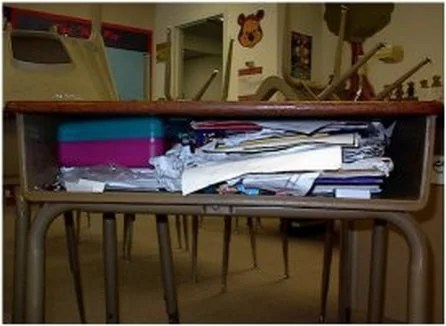
It’s near the end of April, so my teacher’s desk is a mess. Unshelved books, half-empty jars of tea leaves. I’ve scribbled on every scrap of paper. My officemate says to a student, “You’re paper is now at about a B+.” The bells have been ringing or not ringing because we’re giving state tests. The state is checking to see how my sophomores read and write in comparison to the other sophomores around the state. Giving the test, some of the headphones don’t work. One student can’t submit her work because she’s been locked out by technology. My seniors are revving up for the prom this weekend with AP testing around the corner. Many will spend their last week in high school taking those expensive tests. The College Board earns billions. I signed my contract to teach another year. It may be my last because I’m angry about a pop-in mini-observation where the administrator focused on how kids were sneaking a look at cellphones by the window, one student used his laptop to check in on the Masters golf tournament, and another dozed while sitting straight up in his seat. The administrator wrote, “…many of your students are missing out on good teaching as they are disengaged, either with phones, video or heads down (some appear to be dozing off).” Before I say more about how American education is failing—and so, clearly, am I—let me add the mini-observation occurred during the last class on a Friday.
But no excuses. I should have been whirling around the class snatching iPhones. Better yet, I should have had rules in place for iPhones from day one. Actually, I did. After a few months, students and I gave up on placing phones in a plastic holder by the door. In fact, we don’t know what happened to the plastic phone holder. It’s gone. My student who was watching video of the Masters, I’d talked to him about that three times before the administrator arrived and I should have confiscated his laptop…again. My student with the headphones on in the front of the room—a special arrangement for only Fridays if he doesn’t have them on during class all week and they’re not even playing music because it’s more a coping mechanism for reasons I won’t get into here—yes, he put his head down. I nudged him but also knew he was working on Willy Wonka for the school show and wasn’t getting sleep. Strike that, reverse it. I haven’t been getting much sleep because tornadic winds blew most of the roof off of our home and the insurance adjuster said they would cover $8,500 in damages and the first estimate to fix the roof was $25,000. There was another student with headphones on—I often catch him playing chess during class. I should threaten him and his grade but he’s a top student and I kind of enjoy trying to catch him. He speaks fluent French and shakes his head when I share my college French with the class.
What was the lesson the day of the mini-observation? The curriculum tells me I must teach “the Bible as/in Literature.” I’ve learned to like teaching the stories from the Bible as they relate to the literature we’ve studied. That was the set-up the administrator missed. Holden Caulfield’s favorite character in the Bible is Legion who cuts himself with stones because he’s possessed by demons. Richard Wright’s epigraph to Black Boy comes from The Book of Job: “His strength shall be hunger-bitten,/And destruction shall be ready at his side.” Tim O’Brien has a character who refers to Vietnam during the war as The Garden of Evil: “Over here, man, every sin’s real fresh and original.” Macbeth is compared to the brightest angel that fell. Anyway, we were learning about Samson, his power and his hair. I’d just shown my class a film clip of David using his slingshot against Goliath when the door at the back of the classroom opened. Was any of it sticking to the brains of my sixteen-year-old students? When and how does education happen for any student? How do you measure it? My student who I tried to wake in the way Jesus managed to get Lazarus up and going, I know he’s up until 1 a.m. or later every night working on his YouTube dreams. I told him I want to write him a college recommendation but he needs to get more sleep. I tell him how science proves starting school for teenage brains at 8 a.m. is not a good choice, but he’s got to do better. He seems to understand but I don’t expect him to figure this out yet. Maybe when I see him as a senior if I’m still teaching.
The American system of education is a wreck. Wealthy schools have a criminally unfair advantage, students are conditioned to adopt a transaction mindset where they only know to peck, peck, peck for the grade. It’s not their fault. We test, test, test. We don’t acknowledge in any meaningful way that all students learn differently at different times, that they need to be nurtured, cared for, inspired, and understood. We’ve let their brains be wired directly into their iPhones. Administrators don’t have the guts to ban cellphones but expect teachers to spend every day swinging wildly at the slithering AI tech we’re supposed to embrace. The unannounced drop-in mini-observation absolves administrators from taking any direct action other than scrawling notes about the surface of a problem that goes back to the first bite of a forbidden fruit. Teaching requires deep knowledge, forgiveness, patience, understanding and yes, some Old Testament retribution—but maybe not in April on a Friday during the last class before a state test.
Copyright 2025 Adam Patric Miller
Adam Patric Miller has taught high school for 25 years in three states and currently teaches in St. Louis. He is the author of the book A Greater Monster, a collection of essays selected by Phillip Lopate which won the Autumn House Press Nonfiction Prize.
Discover more from Vox Populi
Subscribe to get the latest posts sent to your email.

I’m on sabbatical till August I and feel a little trepidation about returning to teaching–then I remember the eager, engaged students and I feel grateful.
LikeLiked by 1 person
I, too, am retired, as of seven years. This is right on the money and so beautifully written. I loved every word and throughout the whole thing, I amen-ed! Thank you for writing these truths!
LikeLiked by 1 person
I was educated before the tyranny of worksheets took over teaching. Worksheets provide empty regurgitation of knowledge and turn teaching not into a fine art that introduces the students to a landscape of knowledge by a good guide, but into a rote and mindless exercise. They create fear and ignorance. Standardized tests are the direct result of the worksheet culture that homogenizes everything and everyone.
I have taught graduate students who were educated in Germany and grad students in the US. German grad students know how to interpret material deeply and critically and use their minds to pose questions and think further. I often had to show US grad students how to interpret text and give them the permission to use their minds and imaginations and to discover the amazing world of ideas and that they as individuals can take it up. in their own unique way.
I had a friend who thought of education as populating the regions of a mental landscape. The more you know about a region, the easier it is to learn new things because you understand how they relate to other points in the landscape. Education is not a linear enterprise, but making many detours and connecting the dots until you have a fairly good map. And then on to other regions that are already connected.
If I had to reform education, the first step would be to get rid of worksheets….
LikeLiked by 3 people
Let me point out to VP readers that Eva Simms is one of the leading experts in the world on child development, so we need to listen when she talks about education…
LikeLiked by 1 person
That is eloquent and right on the money. I would have loved to have had this man for a teacher.
LikeLiked by 2 people
me too, Lola!
LikeLiked by 1 person
Me three
LikeLike
I’ve taught k-college ( think I missed third grade), but don’t think I could do it now. Some kids I taught in 6th grade a half century ago keep in touch on Facebook. One recently won an award in a cake baking contest with a cake with layers for phylum, class, order, family genus, species, each as a layer. How did I get away with teaching them the songs Delta Dawn and House of the Rising Sun and the Cat Came Back? I’d forgotten. They reminded me, and I still see some of my premeds who are now physicians. Teaching is hard, but the rewards are the best.
LikeLike
Thanks for this, Barbara. I’m grateful that I was given the opportunity to I spend 40 years teaching at various levels from elementary to grad school.
LikeLiked by 2 people
We used to see who could say “phylum class order family genus species “ the fastest and we covered animal phyls in class. One parent of a first grader got mad at me because I taught the kids about the cell ( the mighty mitochondria) and his kid “made me look stupid” because he knew about the endoplasmic
Reticulum and ribosomes in the cell. We had fun with biology and the kids picked it up fast.
LikeLiked by 1 person
Phyla
LikeLike
I’m wrestling with this dilemma in my college classroom. One student peached on another, telling me he was visiting dating sites during class. I sat in on a colleague’s class, and I had to sit on the front row because so many in the class were grazing the internet. There he was pouring his heart out, and girls were shopping. I have to remember the students who are focused and there. That’s where the magic is.
LikeLiked by 4 people
I retired from teaching ten years ago. I don’t think I have the patience to do the job now.
>
LikeLiked by 2 people