
Vox Populi
A curated webspace for Poetry, Politics, and Nature with over 6,000,000 visitors since 2014 and over 9,000 archived posts.
Angele Ellis: Memory’s Self-portrait
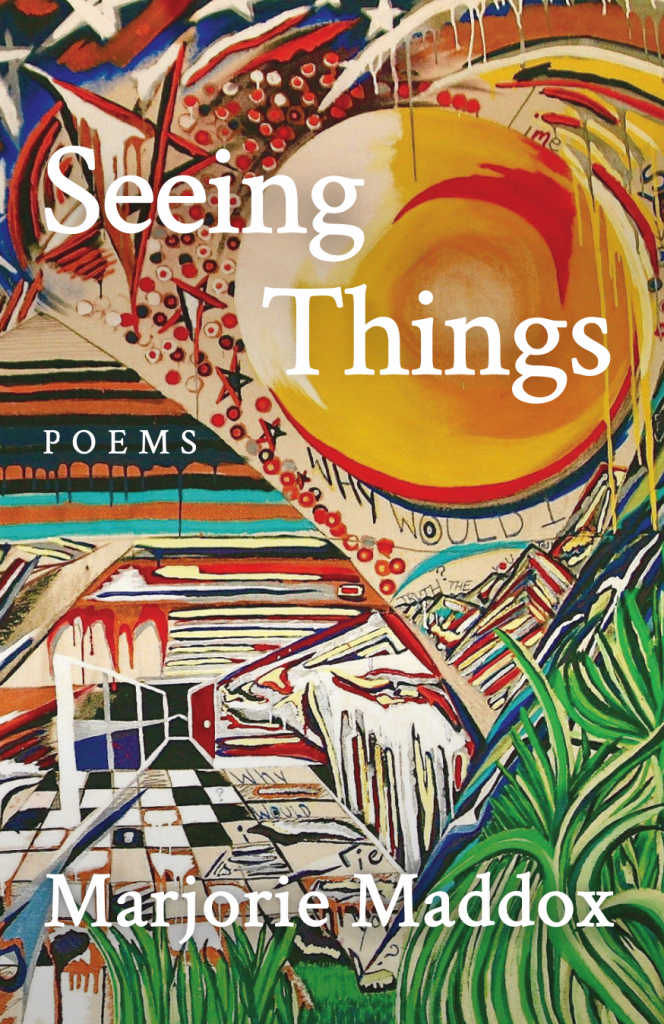
Seeing Things by Marjorie Maddox
Wildhouse Poetry (an imprint of Wildhouse Publishing), 2025.
Release Date: February 28, 2025
ISBN (print): 978-1-961741-19-5
~~
During childhood afternoons spent on the sofa in my grandparents’ front parlor, I loved to leaf through my grandmother’s eccentrically arranged photo albums, portals to an ever-shifting past. Turning their pages, I watched formal portraits, landscapes, and snapshots of people and places leap backward and forward in time. Subjects morphed miraculously from adult to baby, from teenager to child, over and over.
In Seeing Things—her seventeenth collection—the poet Marjorie Maddox accomplishes similar feats of transformation, focusing her formidable attention on sharply described events, including those in the lives of an elderly mother, a young adult daughter, and a middle-aged speaker with a strong resemblance to the poet herself.
As the book’s title implies, things seen encompass both everyday reality and a spirit world visible in times of trouble and change. The book’s cover, a lushly melting painting by Maddox’s daughter, Anna Lee Hafer, invites the reader into this liminal space through a small, receding door and an inscription repeated like an incantation: “WHY WOULD I?”
Just like that, the invisible shifts to visible, Hafer writes in the first line of her title poem, “Seeing Things.” Just like that. The astonishment of such moments is a leitmotif of this collection. In the poem “A few moments after a fall at her assisted living facility, my mother forgets,” the elderly mother’s fall while being showered repeats like a scene from a movie:
… The surprised aide
reaches too late for the frail body, tries to rewind time;
the fallen body back in the tub, on the stool.
The second before, the aide is soaping the thin torso,
the second after, she is reaching too late the frail body
sprawled on the cold floor. The daughter comes running.
The second before, the aide soaps the thin torso,
turns to adjust the spray, then the clatter,
the naked woman sprawled on the cold floor. The daughter running
in from the other world, afraid. Whose face is screaming?
The irony is that this horror film montage turns out to be nothing, merely a rehearsal of disaster:
… Safe in bed, the rest fades.
Tepid memories tip. After the fall, she forgets.
She is alive again only in the moment. Is it enough?
The speaker transforms memory itself into a character in “Ode to Memory,” one who moves through high drama to haiku-like fragments of stubborn observation:
O, you, in your slinky slip of late middle age,
turning the corner down a long dark hall
at the end of forever ago, fuzzy in the dusky light—
so say the movies, even the black-and-whites
crackling at twilight behind my eyes
or the whispered shadowy sightings
of The Shining dancing the past away
scenes before Jack Nicholson axes through
the present-moment bathroom door
to Shelley Duvall, “Here’s Johnny,”
our most memorable hauntings—
each with its own maniacal grin—
calling out, swinging the sharp object.
But this is an ode, not thriller,
and, dear Memory, here you pull close
with comfort, raise high the African Violet
and the half-smile of a child I met once at Walmart;
here you rejoice in the regal angles of the Adirondacks
the morning I woke to sunrise and retreating bear.
And in “Suicide Drafts”—whose title carries intimations of suicide notes, unfinished poems, doses of medication, and the chill that can undermine a house—the speaker tries to salve her pain over her own daughter’s illness by linking it to the insistent pain of an old friend and her sick daughter:
When my childhood friend calls, I am writing the pain of my daughter.
It is the same sound as her daughter’s siren, now cracking the ordinary sir.
If her daughter recovers, mine will as well. To even utter that other
life. . .? On the phone we can’t speak what could be. Mothers
mother each other—or else our already swollen fear
when our child calls would write this pain too real. Daughter
of my friend, your siren sounds our distance, speaks the terror
I swallow each day. Friend, when is I’m here enough to cut despair
from if. . .? My daughter recovers. Yours will as well. Let’s utter lies to each other
until they’re true.
Hauntings take vivid form in the decay of ordinary things in “To Conjugate,” whose title refers to the shifting verb forms that propel language, to bacterial exchanges, to the couplings and entangled relationships of human life:
And this is what it’s like when the dead still
sleep in your house, fill up their travel coffee mugs,
then sail off in their spray-painted clunker cars
to haunt your house long-distance, absence
thicker than the moldy crusts of pizza
stashed under their bed, than the condoms
still tight in their square packages
stuck in boxes of discarded tea;
than the three-month layers of calls
stacked unanswered on your low-
battery phone.
However, as Maddox’s work demonstrates, the act of creating art from death and despair is a form of redemption and ecstasy. “Ode to Daughter as Artist” is a remaking in words of Anna Lee Hafer’s cover painting “Your Move” and a tribute to the elevating powers of art:
Praise for the spontaneous
paint splatter; for the blank
wide face of canvas; the thin
stroke of clear; the unannounced
swirl and burst of emergence:
oils and newsprint surging
into bright, wild collage,
hue and creativity tottering
on eternity, one-day only. Or not,
the heft of 3-D spinning now
into something unlike
anything, like steady
chalk or premeditated
ink. No. Rather
thought and arm high
on epiphany,
and the brilliant eye
that arrives there
in an ordinary room,
on an ordinary day: art &
its dizzying versions of birth.
~~~~
Angele Ellis is a Pittsburgh-based writer and editor and the author of four books, including Spared (A Main Street Rag Editor’s Choice Chapbook).
Copyright 2025 by Angele Ellis
Discover more from Vox Populi
Subscribe to get the latest posts sent to your email.

It is a powerful book. Good to see a review here.
LikeLike
Thanks, Donna.
>
LikeLiked by 1 person
My favourite Heaney book title x
LikeLiked by 1 person
Thanks, Adrian!
>
LikeLiked by 1 person