
Vox Populi
A curated webspace for Poetry, Politics, and Nature with over 6,000,000 visitors since 2014 and over 9,000 archived posts.
Angele Ellis: The life and legacy of Palestinian writer Refaat Alareer (1979-2023)
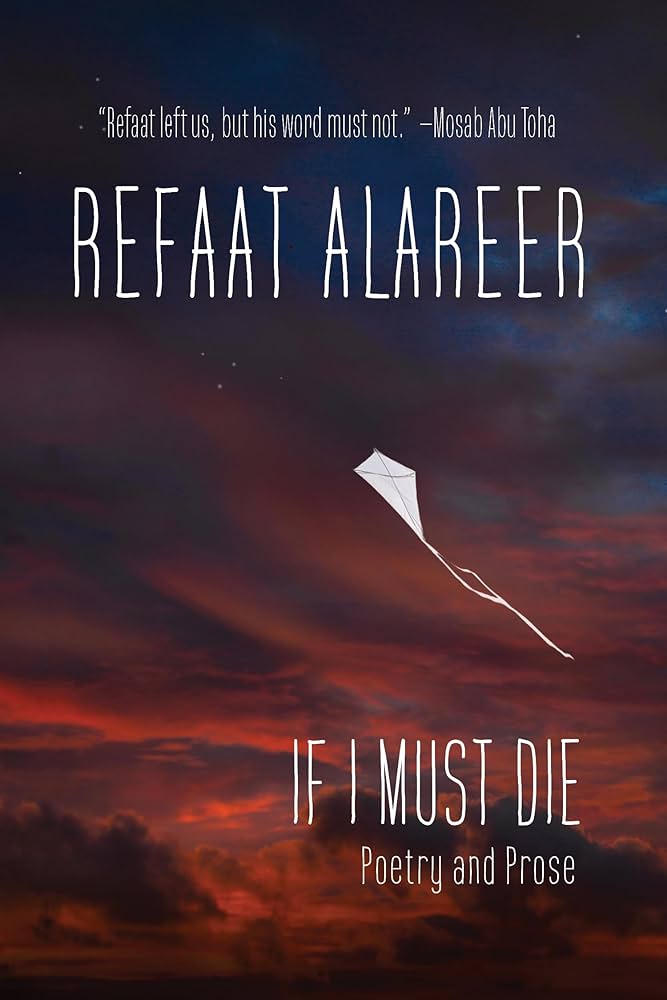
If I Must Die: Poetry and Prose by Refaat Alareer. OR Books, 2024.
Compiled by Yousef M. Aljamal, with a foreword by Susan Abulhawa.
In a photograph that I cannot unsee, the Palestinian writer, English professor, and citizen journalist Refaat Alareer stands in a field in Gaza, holding a container of freshly picked strawberries. What evokes the earth’s sweetness more fully than a ripe berry? The expression on his face—scholarly, bespectacled—is gentle and tender.
Refaat’s friend, the poet Mosab Abu Toha, recalled for a standing room only crowd at the University of Pittsburgh’s Cathedral of Learning how he and Refaat used to make regular strawberry picking trips to a farm owned by Mosab’s father-in-law. Lingering on the image, Mosab spoke of their enjoyment of the weather, how they had played cards and told jokes.
This was in December 2024. Refaat had already been dead for a year, murdered along with his sister, brother-in-law, and four nephews and nieces by a targeted Israeli airstrike on the family’s apartment building in Gaza City. Refaat’s eldest daughter, Shymaa—whose brief life her father chronicles in glimpses in If I Must Die—had been dead for seven months, murdered in another targeted bombing along with her husband and infant son.
Of all the photographs Mosab showed on that afternoon, in an effort to detail Israel’s willful destruction of Gaza and its people—homes, shops, schools, libraries, and hospitals pounded into rubble; blood-streaked men, women, and children fleeing along dangerous streets; corpses and carefully salvaged pieces of corpses shrouded for burial—it was this single shot of happiness that resonated indelibly with me.
After his death, Refaat went viral for the poem that gives this collection its title and cover image of a white kite, “If I Must Die, Let It Be A Tale.” The poem has inspired graffiti, posters, t-shirts, pins, and recorded interpretations by actors and musicians:
If I must die,
you must live
to tell my story
to sell my things
to buy a piece of cloth
and some strings,
(make it white with a long tail)
so that a child, somewhere in Gaza
while looking heaven in the eye
awaiting his dad who left in a blaze—
and bid no one farewell
not even to his flesh
not even to himself—
sees the kite, my kite you made, flying up above
and thinks for a moment an angel is there
bringing back love
If I must die
let it bring hope
let it be a tale
For those who find “If I Must Die” to be prescient—as if it had been written in the final days of a life cut short at age 44—consider that it was composed in November 2011, first appearing on Refaat’s blog Gaza, My Gaza.
“In Gaza, people can be seven wars old,” Refaat wrote [emphasis added]. He was eight at the beginning of the first Intifada against Israeli occupation of the West Bank and Gaza, as Yousef Aljamal notes in the introduction to this volume. As a teenager, he threw stones at Israeli soldiers and was injured by rubber bullets. He lost friends and relatives in Israel’s brutal Operation Cast Lead in 2008-09. His brother, sister, and three nieces were killed by Israeli bombs in the 2014 Gaza War. Refaat’s entire life was spent under siege, as were the lives of his parents and grandparents, and just as tragically, the lives of his children and grandchildren.
If I Must Die is arranged chronologically from 2010 to 2023. Its sections contain prose pieces punctuated by poems and quotations. Refaat embraced the English language as writer and professor, earning an MA from University College London and a Ph.D. from the Universiti Putra Malaysia. This decision, like his savvy mastery of social media, was motivated by both love and pragmatism. As the Palestinian American novelist Susan Abulhawa writes in the foreword to this collection, “[Refaat] found English more practical and pliable [than Arabic]. More importantly, he wanted to master the language of the empire that oppressed him…to lay bare our humanity before them.”
The book’s first piece, from 2010, contains the memorable line “the problem with Gaza is that it is full of Gazans”—and is a riff on Jonathan Swift’s 1729 essay “A Modest Proposal,” in which Swift satirically proposed that the English eat the colonized Irish. (A few days before his death in 2023, Refaat salvaged a copy of Gulliver’s Travels from his destroyed library, although it was too thick with bomb debris to read.)
In “Narrating Palestine,” from 2014, Refaat writes of the process of putting together the student short story anthology Gaza Writes Back, and of rediscovering, against a background of war, the sustaining power of stories:
…As a Palestinian, I have been brought up on stories and storytelling. It’s both selfish and treacherous to keep a story to yourself—stories are meant to be told and retold. If I allowed a story to stop, I would be betraying my legacy, my mother, my grandmother, and my homeland. To me, storytelling is one of the ingredients of Palestinian sumud—steadfastness. Stories teach life even if the hero suffers or dies at the end.
And in the middle of “Gaza Asks: When Shall This Pass?,” a long narrative essay from 2022, Refaat writes of introducing his students at Islamic University Gaza (IUG) to Dickens’s Fagin and Shakespeare’s Shylock, so that they might see these complex characters as fully human:
…Perhaps the most emotional moment in my six-year teaching career at IUG’s English Department was when I asked my students which character they identified with more: Othello, with his Arab origins, or Shylock the Jew. Most students felt they were closer to Shylock and more sympathetic to him than Othello. Only then did I realize that I had managed to help my students grow and shatter the prejudices they had grown up with because of the occupation and the siege, Sadly, the exam papers which I stored in my office were set ablaze in a way that echoes how Shylock was stripped of his money and possessions. I always wanted to make use of the answers and compile them into a book.
It is not surprising that Refaat wrote his doctoral dissertation on the 17th century English metaphysical poet John Donne. Donne’s most famous words, taken from Devotions (Meditation XVII), speak of the need for such radical identification:
No man is an island, entire of itself; every man is a piece of the continent, a part of the main. If a clod be washed away by the sea, Europe is the less, as well as if a promontory were, as well as if a manor of thy friend’s or of thine own were: any man’s death diminishes me, because I am involved in mankind, and therefore never send to know for whom the bell tolls; it tolls for thee.
As I write this review, the Trump administration is circulating AI-generated images of a casino branded TRUMP GAZA. This is a sleazy mirage, an obscene Gaza empty of Palestinians, a triumphant vision of genocide.
Instead, let the angelic kite of Refaat’s poem “If I Must Die” rise over Gaza and the world, its tail/tale joined to a key—like the house keys that dispossessed Palestinians have carried since the Nakba, through generations of oppression—vibrating with the electricity of compassion and change.
~~~~
Angele Ellis is a Pittsburgh-based writer and editor and the author of four books, including Arab on Radar (Six Gallery), whose poems about her Arab American heritage earned a fellowship from the Pennsylvania Council on the Arts.
Copyright 2025 by Angele Ellis
Discover more from Vox Populi
Subscribe to get the latest posts sent to your email.

Can’t speak. Can’t write. No words. Tears.
LikeLike
Those who murder children will not read what Refaat’s writings have to say. We live in a world that more and more accepts collateral murder as a legitimate means to some sort of end.
It just breaks my heart today, but perhaps strangely, what drove me over the emotional precipice, is re-reading the description by his friend Toha of their strawberry picking.
Toha gave his witness in the Cathedral of Learning in Pittsburgh. My friend Jan gave me a tour of that remarkable place, where many a classroom is themed by an individual country’s educational self-expression, from Austria to China, etc. To think of the beauty of such a concept, and the murder witnessed to there, has once again brought me up against human evil and its perpetrators, but also to the attempts humans make to witness and remember both the beauty and the destruction of our inner and outer beings.
Refaat ,Toha, and that secular Cathedral live as witnesses to hope and resolve.
Who among us won’t pause and let their mind linger over the terrible laying waste of beautiful Refaat. And then go on to create better structures for the delivery of peace, for our world and its children.
LikeLike
Thank you for mentioning Mosab Toha. I was present at his reading at the Cathedral of Learning at the U. Of Pittsburgh last month. It was two hours long, included a slide show of Gaza before the invasion, as well as slides of happy children, his nieces and nephews,, now dead. I have attended at least 500 readings in my life and Mosab’s was, hands down, the best. I left in tears.The poets of Palestine have a noble charge: to bring witness to slaughter through song and image.
>
LikeLiked by 1 person
I always try Better World Books first since they supply books to the world.
LikeLiked by 1 person
How I love this piece…
LikeLiked by 2 people
Is there a place to buy this book other than Amazon?
LikeLiked by 2 people
Thanks for the suggestion, Brenda. I’ve changed the link to the OR website order page for the book.
LikeLike