
Vox Populi
A curated webspace for Poetry, Politics, and Nature with over 6,000,000 visitors since 2014 and over 9,000 archived posts.
David Kirby: Inexhaustible
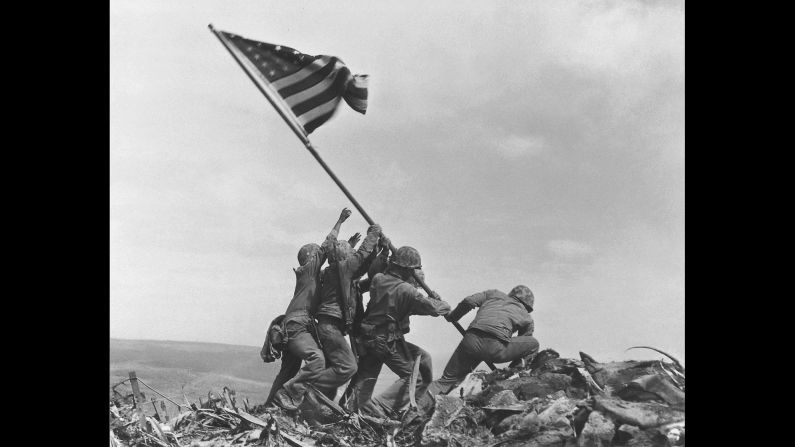
February 23, 1945: A flag is raised on Iwo Jima.
You’ve seen the photo: the marine
on the right straining like the statue
of a Greek wrestler as he hauls the flag
into place, the five on the left pushing
from their side. The photographer who
took it was talking to someone
when he caught a movement out
of the corner of his eye, spun around
and clicked off a single frame, hurried
back to base and sent the film to Guam
for processing. Did he get the shot?
When you hear that he wouldn’t know
for days, you think of the scientist who
told you that most experiments fail,
of the ultramarathoner who said
it’s not winning that counts but
trying to win, of the Mary Celeste,
the American merchant ship found
floating off the Azores in 1872,
seaworthy but deserted, its last
log entry dated ten days earlier,
its crew’s belongings undisturbed.
Yet you go to the lab every day,
lace your shoes and report to
the starting line, walk down
to the dock with a duffle on
your shoulder. The marines in
the photo are still trying to raise
that flag. The photographer
makes coffee as he waits, heats
a can of stew, starts to light
a cigarette, changes his mind.
~~~
Poet, critic, and scholar David Kirby grew up on a farm in southern Louisiana. Since 1969 he has taught at Florida State University, where he has received several teaching awards. He lives in Tallahassee, Florida, with his wife, poet Barbara Hamby. His many books include Help Me Information (LSU, 2021).
Poem copyright 2025 David Kirby. All rights reserved.
Discover more from Vox Populi
Subscribe to get the latest posts sent to your email.

David:
I love your poem, the conditional so beautifully rendered, it is “fighting fit” and ready for the world—any of it to drop in and take place, but only in the terms of your scrutiny and great talent.
what a fine soldier of words, a “lifer,” you’ve become in our midst!
LikeLike
How I admire these short, musical, and mostly enjambed lines that pull us down through this poem’s story–and the turns, from the marines and photographer to the scientist to the abandoned ship and then back again full circle to the lab and the marines and, last, the photographer again…I’m a David Kirby fan and this is just one of so many examples of why.
LikeLike
Good description of the use of enjambment. thank you.
LikeLike
This is a deft poem. And reminds us of patience, expectation, hope, and perseverance at a time when you had to wait for your photos to be developed. We now want immediate satisfaction, even though there are still a few ‘out there’ who need to be able to wait for it.
LikeLike
I love the ending’s light touch, the withholding. Nicely done.
LikeLike
yes, the withholding.
LikeLike
Wonderful poem! And, of course, under all of it is the current news, the scientific experiments that won’t be completed because of insane cuts in funding, the military heroes who have been fired after long, successful careers… Thanks for the meaningful sadness and beauty!
LikeLiked by 1 person
Spot on, Nancy.
LikeLike
Brilliant comments for a powerful poem. Many poems, stories, etc. can be found by Googling Marie Celeste.
As to the photograph, three of the six marines were killed on Iwo Jima, as the battle was not yet over. The most famous of the three survivors was Ira Hayes. A relatively famous song was written about him. Here is the wikipedia entry on the song. He also has a wikipedia entry. A tragic life made famous by a ballad. https://en.wikipedia.org/wiki/The_Ballad_of_Ira_Hayes
LikeLiked by 1 person
Thanks, Jim. I’ve never thought about what happened to the Marines after the flag was raised. The after-story provides a much more profound context to the photograph.
LikeLike
How I agree with everyone’s comments — what a truly amazing feat, that poem of yours, David! You pack such stories and history we might — already!! — have forgotten about the times you so brilliantly pack in “Inexhaustible.” For example, that it took days to get our little photos back, not knowing if they were good or blurry. And, yes, how true also that we’re in joyful awe of your and Barbara’s talent — that you both so kindly, unpretentiously, gladly and generously share!
LikeLiked by 3 people
What a lovely comment, Laure-Anne! Thank you so much. Your presence on these pages is such a gift…
LikeLike
The turn toward the Marie Celeste—it’s both mystery and absolutely enlarging at the same time. That it comes after the now almost forgotten fact of the dawdling pace of film photography is part of the magic of photography, history, and art, especially poetry. Bravo, David!
LikeLiked by 3 people
Thanks, Bob.
LikeLike
Vividly and economically told. Congrats, David. Couple of less well known facts: this flag one was the second one raised that day on Mt. Subirachi. The first went up at 10:30 that morning, but it was rather small and brass decided a bigger one should be raised. (Size matters, you see.) The second flag was attached to a piece of Japanese pipe, found somewhere nearby. The reason Rosenthal wasn’t poised and ready to get the shot is that he was stacking up rocks to raise his vantage point and only at the last second did he see he’d better move fast or lose the shot.
A brief film of the event was also made: https://en.wikipedia.org/wiki/Raising_the_Flag_on_Iwo_Jima
I never heard the story about the merchant ship found crewless. Was any explanation ever arrived at? Sounds like alien abduction!
LikeLiked by 4 people
Thank you, Alfred. Like David, you bring wit and sophistication to VP’s mission of exploring the intersection of poetry, politics and nature.
>
LikeLiked by 3 people
Almost unfair how much talent is packed into the Kirby-Hamby household. Here’s a characteristically brilliant example!
LikeLiked by 2 people
I agree, Sid. This ‘marriage of true minds’ is a gift to all of us.
>
LikeLiked by 2 people