
Vox Populi
A curated webspace for Poetry, Politics, and Nature with over 20,000 daily subscribers and over 8,000 archived posts.
W.H. Auden: Lullaby
Lay your sleeping head, my love,
Human on my faithless arm;
Time and fevers burn away
Individual beauty from
Thoughtful children, and the grave
Proves the child ephemeral:
But in my arms till break of day
Let the living creature lie,
Mortal, guilty, but to me
The entirely beautiful.
Soul and body have no bounds:
To lovers as they lie upon
Her tolerant enchanted slope
In their ordinary swoon,
Grave the vision Venus sends
Of supernatural sympathy,
Universal love and hope;
While an abstract insight wakes
Among the glaciers and the rocks
The hermit’s carnal ecstasy.
Certainty, fidelity
On the stroke of midnight pass
Like vibrations of a bell,
And fashionable madmen raise
Their pedantic boring cry:
Every farthing of the cost,
All the dreaded cards foretell,
Shall be paid, but from this night
Not a whisper, not a thought,
Not a kiss nor look be lost.
Beauty, midnight, vision dies:
Let the winds of dawn that blow
Softly round your dreaming head
Such a day of welcome show
Eye and knocking heart may bless,
Find our mortal world enough;
Noons of dryness find you fed
By the involuntary powers,
Nights of insult let you pass
Watched by every human love.
~~~~
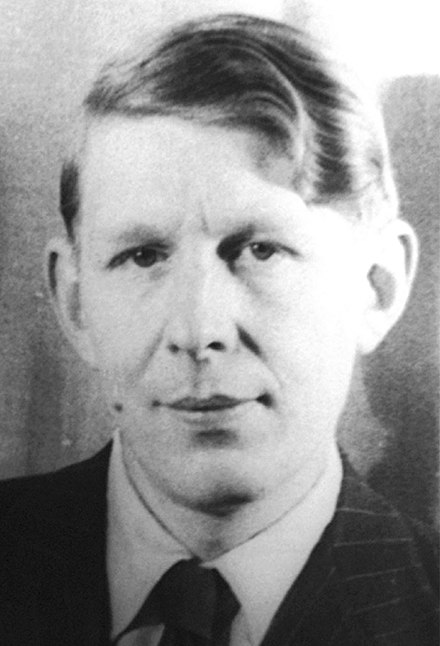
Wystan Hugh Auden (1907 – 1973) was a British-American poet. Auden’s poetry is noted for its stylistic and technical achievement, its engagement with politics, morals, love, and religion, and its variety in tone, form, and content. Some of his best known poems are about love, such as “Funeral Blues”; on political and social themes, such as “September 1, 1939” and “The Shield of Achilles”; on cultural and psychological themes, such as The Age of Anxiety; and on religious themes, such as “For the Time Being” and “Horae Canonicae”. [adapted from Wiki]
Public Domain
Discover more from Vox Populi
Subscribe to get the latest posts sent to your email.

I always remember Brodsky’s comment about Auden, whom he adored. He was looking for him at one of Auden’s parties in NY, and found him sitting tucked in the corner of a room, on top of a pile of big books, the complete OED. Brodsky said that perhaps he was looking at the person in the 20th C most worthy of such a seat.
LikeLike
Lovely anecdote about two modern masters. Thank you!
>
LikeLike
I do love Auden.
LikeLiked by 2 people
Like Shakespeare’s 19th Sonnet, Lullaby contains laments about the fading of the beauty that inspires certain types of love. But in the 4th stanza, Auden asks us (or God?) to bless the mortal world in the next waking day, and share in every human love, moving beyond the one night lie-down with a faithless arm. (restless arm syndrome?)
I’ll never figure out all or any of the allusions in this love poem. Auden knew the classics, so perhaps he was riffing off older works?
For me, Lullaby’s timely reminder: Valentine’s Day should not be seen as a one-off day of love, but a reminder of its mortal sweetness, told in 7 beat heptameter, perhaps echoing the seven days of the entire week.
LikeLiked by 3 people
Perfect response to the poem, Jim. Thank you.
>
LikeLike
masterpiece
LikeLike
Auden has many great poems… This is just one example.
>
LikeLiked by 2 people
Well, yes, to state the obvious.
LikeLike
masterpiece
LikeLiked by 1 person