
Vox Populi
A curated webspace for Poetry, Politics, and Nature with over 6,000,000 visitors since 2014 and over 9,000 archived posts.
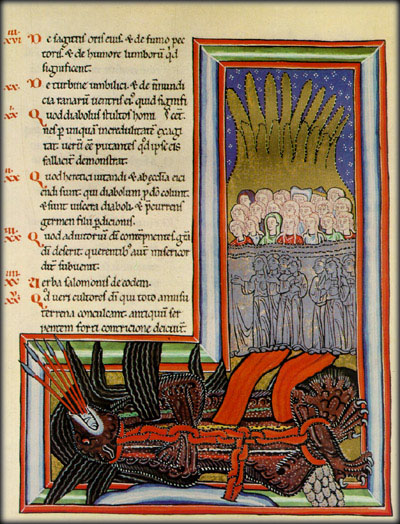
Hildegard von Bingen: Vision 7, The Devil
Then I saw a burning light, as large and as high as a mountain, divided at its summit as if into many tongues. And there stood in the presence of this light a multitude of white-clad people, before whom what seemed like a screen of translucent crystal had been placed, reaching from their breasts to their feet. And before that multitude, as if in a road, there lay on its back a monster shaped like a worm, wondrously large and long, which aroused an indescribable sense of horror and rage. On its left stood a kind of market-place, which displayed human wealth and worldly delights and various sorts of merchandise; and some people were running through it very fast and not buying anything, while others were walking slowly and stopping both to sell and to buy. Now that worm was black and bristly, covered with ulcers and pustules, and it was divided into five regions from the head down through the belly to its feet, like stripes. One was green, one white, one red, one yellow and one black; and they were full of deadly poison. But its head had been so crushed that the left side of its jawbone was dislocated. Its eyes were bloody on the surface and burning within; its ears were round and bristly : its nose and mouth were those of a viper, its hands human, its feet a viper’s feet, and its tail short and horrible.
And around its neck a chain was riveted, which also bound its hands and feet and this chain was firmly fastened to a rock in the abyss, confining it so that it could not move about as its wicked will desired. Many flames came forth from its mouth, dividing into four parts: One part ascended to the clouds, another breathed forth among secular people, another among spiritual people, and the last descended into the abyss. And the flame that sought the clouds was opposing the people who wanted to get to Heaven And I saw three groups of these. One was close to the clouds, one in the middle space between the clouds and the earth, and one moved along near the earth; and all were shouting repeatedly, “Let us get to Heaven!” But they were whirled hither and thither by that flame; some did not waver, some barely kept their balance and some fell to the earth but then rose again and started toward Heaven. The flame that breathed forth among secular people burned some of them so that they were hideously blackened and others it transfixed so that it could move them anywhere it wanted. Some escaped from the flame and moved toward those who sought Heaven, reiterating shouts of “O you faithful, give us help!” But others remained transfixed.
Meanwhile, the flame that breathed forth among spiritual people concealed them in obscurity; but I saw them in six categories. For some of them were cruelly injured by the flame’s fury; but when it could not injure one of them, it burningly breathed on them the deadly poison that flowed from the worm’s head to its feet, either green or white or red or yellow or black. But the flame that sought the abyss contained in itself diverse torments for those who had worshipped Satan in place of God, not washed by the font of baptism or knowing the light of truth and faith. And I saw sharp arrows whistling loudly from its mouth, and black smoke exhaling from its breast, and a burning fluid boiling up from its loins, and a hot whirlwind blowing from its navel, and the uncleanness of frogs issuing from its bowels; all of which affected human beings with grave disquiet. And the hideous and foul-smelling vapor that came out of it infected many people with its own perversity. But behold, a great multitude of people came, shining brightly; they forcefully trod the worm underfoot and severely tormented it, but could not be injured by its flames or its poison. And I heard again the voice from Heaven, saying to me: God strengthens the faithful so that the Devil cannot conquer them.
Public Domain
Commentary by Jerome Rothenberg: Of her initiatory visions, Hildegard (1098-1179) wrote later: “Up to my fifteenth year I saw much, and related some of the things seen to others, who would inquire with astonishment, whence such things might come. I also wondered and during my sickness I asked one of my nurses whether she also saw similar things. When she answered no, a great fear befell me. Frequently, in my conversation, I would relate future things, which I saw as if present, but, noting the amazement of my listeners, I became more reticent.” In the vision & the resultant withdrawal, her experience resembles, however much drawn into the church’s center, those of shamans, seers (voyants) & poets, wherever & however situated. Like the great outsiders too, her life & writings show a range of new inventions: music & verses that come down to us in their recent revival; what may have been the first European ”morality play” before there were commonly performed morality plays; an erratic & innovative use of Latin as her language of choice; the creation of a new alphabet & language (= lingua ignota = unknown language, litterae ignotae = unknown writing); & the translation of visions into three visual-verbal sets or books – a mixture in her case of visions & self-exegesis. Those books called Scivias (= Scito vias [Domini] = Know the Ways [of the Lord]), a mix of words & visual illuminations, possibly of her own making, are a sure sign of how vision & language may intersect. (J.R.)]
This text appears in Poems and Poetics, an open source blog created by the poet and anthropologist Jerome Rothenberg (1931-2024).
~~~
Bio: Hildegard (1098-1179) was a Benedictine abbess who documented her allegorical visions and apocalyptic prophecies in text and illuminations. Her most famous work, written over the course of ten years (1141-51). is Scivias(short for “Scito vias Domini,” “know the ways of the Lord,”). In this excerpt, Hildegard describes her vision of the devil embodied as a monstrous worm. After her description, she interprets some of the key images.
Discover more from Vox Populi
Subscribe to get the latest posts sent to your email.

Wow to all. Hildegard von Bingen is an ‘old friend’. Her music fascinates me. Her Songs of Extasy. She was also known as the ‘Sybil of the Rhine’. Like Sor Juana Inés de la Cruz and many others, these intellectual women whose mysticism was woven into the tapestry of their times and beliefs, could florish only in Convents where they had the freedom to explore their talents. Hieronymus Bosch fed from the same source 400 years later.
LikeLiked by 1 person
Cool!
>
LikeLike
I studied Hildegard in my graduate theology program, and found her mysteriously enrapturing, but at times incomprehensible. Rothenberg’s commentary you’ve attached here would have been quite helpful.
Thanks for introducing readers to her strange visions. And her labyrinth of language. And her feminist leanings. I read that the Catholic Church canonized her, and she became the patron saint of Musicians and Writers.
LikeLike
Oh, I didn’t know she’d been canonized. Thanks!
>
LikeLike
The pairing today of John of the Cross and Hildegard fills me with some kind of wild love and hope. Maybe the combo equals courage. Yes, maybe it’s stirring courage. And liberation— my imagination a bit loosened from the social, political, ideological horrors afoot. I am reminded of grace. Inspired. “Mysticism”, Evelyn Underhill wrote, “is union with Reality.” I love that – Reality with a capital “R”.
Thank you for this daily bread, Vox Populi!!! What light you shine in this dark time, morning after morning.
💞🙏💞
M
LikeLiked by 2 people
The pairing today of John of the Cross and Hildegard fills me with some kind of wild love and hope. Maybe the combo equals courage. Yes, maybe it’s stirring courage. And liberation— my imagination a bit loosened from the social, political, ideological horrors afoot. I am reminded of grace. Inspired. “Mysticism”, Evelyn Underhill wrote, “is union with Reality.” I love that – Reality with a capital “R”.
Thank you for this daily bread, Vox Populi!!! What light you shine in this dark time, morning after morning.
💞🙏💞
M
LikeLiked by 1 person
Thanks, Mare. I thought the pairing of Hildegard with St John an interesting juxtaposition. One was a privileged abbess who was famous as a composer, and the other was an abused orphan who was imprisoned and tortured for proposing reforms to a corrupt order. The abbess had visions of the devil and the orphan had visions of God. What’s the lesson here? The spirit gives each of us what we need?
>
LikeLiked by 1 person
All those tongues coming out of one man:
Crash Blues
Must be them fools
got hired because
they got these new laws
woudn happen
without those flaws
we gonna get ridda
them laws
then nobody dies ever
see how smart I am?
I got my hands in all your pockets
feel your wife up too
you don’t like it
fuck you.
LikeLiked by 2 people
Again and again I wake
an unwelcome
vision
let your music kill me
St John of the Crosswalk
holding your little sign
the traffic
of the heart unbearable
wounded
by my eyes he says
is seeing God dangerous
to God he wants
to know the soul
is like a hardworking
civil servant
a career trajectory
from entry level
scrubbing floors
in the marble halls
of the city on the hill purging
human limitations
then a betrothal
to the Boss’s
daughter and finally
to the perfect
marriage of self
and unself
a trap
set of rhythm
and soul
the beatific
flowers meadows rivers
ecstasies visions voices
the scent of strange perfumes
the hearing of sweet sounds
are signs of dementia
psychologists
say perhaps a tumor
in the brain
spreading its crab claws
into your spiritual limpness
to penetrate
the soft wet organ of
a three
fingered god? Should we,
approach the irrational
with reverent
rationality
should Jesus
and his swinging
band of angels be just
another metaphor for what
we would wish away? Death
is not something
we can analyze
it happens to the best of us
radical quietism
leads to hallucination
they say and the
Cloud of Unknowing
asks us to love
and choose
not to listen
for the song of angels
and succumb
to the taint of quietism
with its invitation
to the terrible vision
of the soul
as it is
inducing first
self-abasement
then self-purification
the beginning
of all spiritual growth and
the necessary antecedent
of all knowledge
of God
they say visions and
ecstasies
are not indications of Divine favor
but hallucinations
accidents
of the senses
and not pure
ghostliness. But I say
they are real, to be mad
is to be sane, let
the mad lead us
O Taye of the Garden
were we truly spiritual
we would not need visions
for our communion
with reality
would then be the ineffable
intercourse
of like with like
not this dark mist
of rationality
LikeLike