
Vox Populi
A curated webspace for Poetry, Politics, and Nature with over 6,000,000 visitors since 2014 and over 9,000 archived posts.
Therese L. Broderick: Beautiful Uses | The Compassion of James Crews
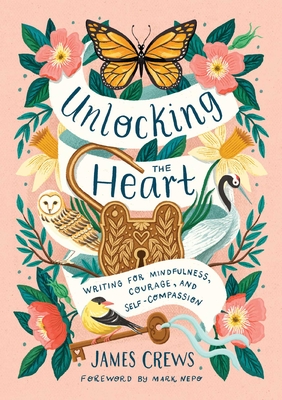
Unlocking the Heart: Writing for Mindfulness, Courage, and Self-Compassion
by James Crews
Forward by Mark Nepo
Mandala, October 2024
$24.99 Hardcover, $9.99 Kindle
Click here to order from Battenkill Books
Click here to order from Amazon
~~~~
Small devotional books called cordiforms were made in Europe during the 14th and 15th centuries. Each codex was heart-shaped and contained a book of hours, ballads, and love songs. They appeared just when books were transitioning from expensive treasures collected by the elite to mass-printed texts sold to a newly literate populace. Unlocking the Heart, by the prize-winning poet, essayist, teacher, and bestselling anthologist James Crews is a fine 21st-century iteration of the cordiform, from its cover illustration of an antique, heart-shaped lock and key, to the three-part groupings that constitute most of the book’s 208 pages. Each grouping includes a short poem, a brief personal essay, and an optional prompt for writing or reflection. Rather than highlighting the work of others, as did his previous anthologies, this book presents only his own compositions. Reprinting about a dozen poems from earlier books (Every Waking Moment, Bluebird, and Telling My Father), Unlocking the Heart offers readers sixty bundles of exceptional poetry and prose—a modern book of hours, minutes, and seconds.
The literary critic and poet Stephanie Burt has proposed six possible functions of any poem: expressing feelings, portraying characters, building an architecture of words, shaking up the norm, imparting wisdom, and fostering community. Every poem in Unlocking the Heart fulfills most of those functions and also vivifies one of James’s thematic sections: 1) courage and vulnerability; 2) self-compassion and release; 3) grief and healing; 4) mindfulness and presence; 5) gratefulness and joy; 6) wonder and awe. Consider this translucent poem from section five:
Counting Blessings
I’m stringing together my gratitudes
like these unruly preschoolers I see
crossing the street in a snaking line,
tethered to each other by a strong
neon-green rope, protected from traffic
as they shout and strain to break away.
I count my blessings to keep them close:
this body, this house, this one heart
creaking open to let in the spring sun
as I say thank you to the black-capped
flashes of chickadees at the feeder,
to sudden sleet, and stones half-buried
in our yard, having melted the snow
from around their mossy skin, each one
now somehow warmer to the touch.
The speaker’s longing to achieve unadulterated gratitude is foregrounded by the title as well as by “gratitudes,” “count my blessings,” and “I say thank you.” However, his character portrayal is nuanced. Conflicting mental states—distraction and resistance—are also conveyed through detailed imagery such as unruly children straining against discipline. This poem is wise. It imparts the messy truth that being or doing good requires acknowledging our lesser angels or inner child.
The poem also builds an architecture of words. Poetry has been called language under pressure, numbers falling through numbers. Pressure and numbers entail measurement. How does a poet put pressure on vowels and consonants? With repetitions and variations. How does a poet put pressure on phrases? With metered rhythm. On Sentences? Line and stanza breaks. On sensory images? Ratios of analogy, degrees of comparison. And paradoxically, how does a poet put pressure on the dictionary’s numbered, precise definitions? With the fuzzy math of connotation and evocation.
Constructed with unobtrusive skillfulness, “Counting Blessings” is thick with numbers. Thirteen of the poem’s fifteen lines contain nine or ten syllables; that is, a relaxed pentameter. The lines that James is “stringing together” approximate a sonnet’s architecture. The difference between the electrified “neon-green” and the “mossy” can be measured on a scale of color intensity. The word “tethered” sings a middle note between the chiming of “together” and “protected.” The spare presentation of scene and speech is made weighty, dense, by the gravitational pull of analogy, simile, and metaphor. But compelling poetry is more than the sum of its parts. The totality of this poem includes the emergence, unspecified but immanent, of a tangible symbol for intimate I-Thou encounters: a rosary or mala. A string of numbered beads held in the hand, each bead a measured utterance, each utterance a breath, each breath inhaling serenity. At poem’s end, the speaker’s gaze settles peacefully upon a single stone. Zero.
James’s poetry is paired with lucid prose. Each grouping in this book contains a brief personal essay that tells the origin story of its companion poem, plus an optional prompt that gives readers permission to reflect on or write whatever arises in their own minds. I see the essays as pourquoi pieces and the prompts as permission slips. In “Counting Blessings,” the pourquoi is, “I started this poem while writing in my journal during a difficult time … when I felt betrayed” (page 158). The prompt is, “What does it feel like to count your blessings?” (page 159), a gentle invitation allowing the reader to explore mixed feelings, ambivalence, or grief. The experiments James made in his other collections with varying proportions of poetry and prose have led to the elegant parcels within Unlocking the Heart: poem, pourquoi, and permission slip. Together they provide literary and introspective value missing from comparable anthologies such as Joy edited by Christian Wiman, Poems to Live By in Troubling Times edited by Joan Murray, or The Poetry Remedy; Prescriptions for the Heart, Mind, and Soul edited by William Sieghart.
James’s tripods could be considered a fresh take on the classical Rhetorical Triangle: Logos, Ethos, and Pathos. Respectively—the prompt engenders a take-away message; the essay establishes the author’s authenticity; and the poem arouses our emotions with skillful rhetoric and alluring music. Like his former mentor, Ted Kooser, he celebrates a readership of work-a-day people, whether they be lifelong fans of poetry or first-time explorers, teens or grandfathers. “I write and share poetry that can be understood and appreciated by people of all ages and backgrounds,” proclaims the James Crews’s website banner.
But as I learned in a workshop led by Ted Kooser, it’s difficult to write a decent poem that wins the respect and affection of one’s auto mechanic. To do so, poets must conduct themselves with honor, honesty, and hospitality. Our neighbors are a tough audience. Esoteric wordplay, heady concepts, supercilious quips, obfuscation of meaning, and haphazard imagery won’t be given the time of day.
Conversely, tender-hearted poetry has at times been dismissed by the literati as sentimental, amateurish, or insincere. In our bootstrapping American culture, generosity and gratitude have often been unfairly disdained as naive or cowardly, but I’ve listened to countless podcasts citing recent research into the “superpowers” of mindfulness and self-compassion. Reputable studies have concluded that a habit of savoring small moments of beauty and joy—through prayer, formal meditation, immersive creativity, reading, or abiding in nature—is a sustainable path to strength, peace, and justice for individuals and societies. Recent national and global upheavals have accelerated the hunt across many disciplines—counseling, neuroscience, child development, public policy—to find practical ways of cultivating human resilience and fulfillment. James Crews is delivering the literary corollary to that research along with Mark Nepo, Ross Gay, Rosemerry Wahtola Trommer and others. American readers are relishing those authors’ life-affirming words. Buying their books, watching their videos, reading their Substacks, enrolling in their workshops.
A disciplined practice of savoring beauty and joy may confer pragmatic advantages as well. Some research suggests it develops attributes associated with job success: clarity of mind, a willingness to take reasonable risks, smarter problem solving, and a self-respect stable enough to perform well under stress. The ability of our first responders, family caregivers, passionate activists, and crisis relief teams to persevere in their essential work might be refreshed and fortified by such savoring. High achievers like doctors, lawyers, and scientists have reported improvements to both their personal and professional lives. Certainly James has proved to be a high achiever, though temperamentally modest, in the poetry marketplace.
While attending a recent science conference, my husband and I walked through an exhibit featuring a plastinated human heart. Veins were dyed blue, arteries red. As a tangible object of book art—the quality output of a sensitive and talented designer—Unlocking the Heart draws from that same palette. The muted background of nearly half its pages falls within spectrums of reds or blues, colors delicately bleeding into white margins. The book carefully integrates visual and material elements. Hardcover boards are illustrated with the narcissus and hibiscus, birds of woodlands and waterways that populate the author’s Vermont environs. Paper texture, attractive page layout, fonts, and legibility are praiseworthy. The silky bookmark recalls Harold Bloom’s handsome anthology American Religious Poems. The overall effect is enchanting yet doesn’t compromise the book’s functionality. It is beautiful in part because it’s effortless for most hands to carry, to mark a favorite page. Sturdy enough to last a lifetime. A perfect gift for art lovers of any age, but also for readers like myself with stiff bones and muscles.
I’m about twenty years older than James, but I recognize my own life journeys in his poems and essays. Both of us were introverted kids who found refuge in books. Both lost our sweet fathers before we reached twenty-two, and both assumed caregiving duties for dying mothers. I resolved my debilitating midlife crisis by leaving a conventional job to pursue an MFA in poetry, and James left a conventional job to devote himself to a career in poetry. For the past few years, I’ve gradually re-oriented my own private reading, writing, and sharing toward the constellated community of seekers that James’s words have nourished. I’ve attended his virtual webinars, bookstore readings, weekend gatherings, and along the way purchased most of his books. Unlocking the Heart rounds out many years of publication by an essential contemporary American poet, developing and refining aspects of his earlier anthologies. He takes greater risks sharing emotional and spiritual struggles, revealing his hard-won maturity in both life and art. This book’s enduring beauty and daily usefulness can cradle and help to heal our broken hearts.
~~~~
For an interview with James Crews by Michael Simms, please click here.
Therese L. Broderick, MSLS, MFA, is a poet from Albany, New York. She supervises The Local Poets Library open to the general public. Her “Easy-Assembly Metaphor” free series of short craft videos is available upon request at brdrck(at)gmail.com.
Review copyright 2024 Therese L. Broderick. Poem copyright 2024 James Crews.
Discover more from Vox Populi
Subscribe to get the latest posts sent to your email.

A remarkable review of a remarkable book, a compendium to help one count one’s blessings. James’ disciplined practice of savoring beauty and joy’ are a gift to me daily. Thanks to all concerned.
LikeLike
Thanks, Jan. I completely agree.
>
LikeLike
Good grief. Thought I had ordered this. Just did. Thank you for a beautiful review.
LikeLiked by 1 person
Just a beautiful review, Therese
LikeLiked by 2 people
This review is indeed a splendid piece of writing and expression in its own right, a pleasure to read; a model of what a review should ideally be. As a writer myself, I could only wish for such a reviewer.
LikeLiked by 1 person
This review is such a pleasure to read; a model for what a literary review should ideally be. As a wrtiter myself, I could only wish for the blessing of such a review.
LikeLiked by 2 people
This review is such a pleasure to read; a model for what a review should be. As a writer myself, I could only wish for such a reviewer!
LikeLiked by 2 people
I agree. The review itself is a work of art.
>
LikeLiked by 2 people
This is a wonderful review. It accomplished several things as I read it:
it gave me beautiful and thoughtful ideas of its own, including numerous insights into Crews’s work, but also Broderick’s own poetics. It was a pleasure to read all by itself. But it also did another important task: it got me to buy the Kindle version of Unlocking the Heart for bedtime contemplation. I can hardly wait for tonight.
LikeLiked by 2 people
It’s a lovely book, Jim. I think you’ll grow to love it as much as I do.
>
LikeLiked by 2 people
I love James Crews’s poems and prose for their healing quality. I always feel refreshed and restored after reading his work. I’m grateful to Therese for describing this quality…
LikeLiked by 4 people