
Vox Populi
A curated webspace for Poetry, Politics, and Nature with over 6,000,000 visitors since 2014 and over 9,000 archived posts.
Baron Wormser: The Missing Poet
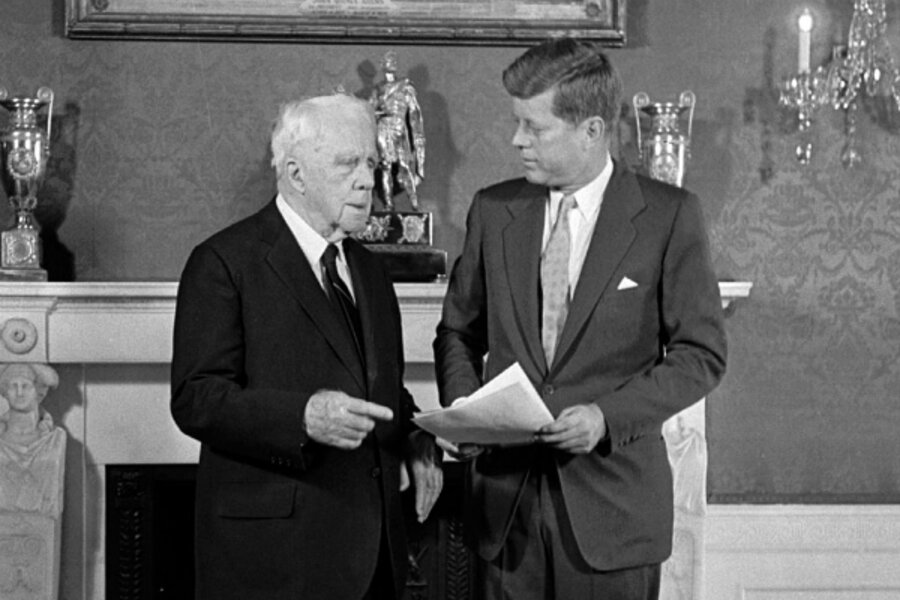
It goes without saying that a poet will not be reading a poem at the inauguration of Donald Trump. The tradition, such as it has been, is for Democrats to favor poetry and Republicans to pass. Some of us remember Robert Frost at John F. Kennedy’s inauguration, his aged presence a spirited yet heart-tugging foil to the youthful president. Since poets are steeped in the liberal arts and since Republicans have gone out of their way for decades to demonize the very word “liberal,” (ignoring that the United States was conceived as a liberal democracy) the lack of interest in poetry on the part of Republicans seems understandable. Then there is the personal, subjective, what-does-it-mean dimension of poetry, a dimension which, no doubt, has contributed to a societal lack of interest in poetry as an important aspect of being human. Then there is the impracticality of poetry, its lack of net worth and STEM relevance. Then there is the simple fact that poetry is not a required course in school studies. At best, it is a “unit.” Then there is the engagement with the American language and how many different forms of resonance American poetry has achieved. Reasons abound for Republicans to not think twice or to dismiss poetry as elitist or more identity politics or whatever pejorative comes to mind. Much more important work is waiting– or so we are told.
Is something lost in the opportunity to remind the nation that poetry exists? Is the poet’s presence simply a symbol of something that should mean something but doesn’t have much staying power, if any, in the society-at-large? Is it yet one more instance of tokenism? When one looks at Frost and the depth of his poetry, one pauses. He was memorable, artful, straightforward yet subtle, and, as he put it, “acquainted with the night.” Though determinedly sly in his New England way, he practiced poetry as a spiritual vocation. No doubt he would pooh-pooh such a highfalutin phrase but that would be part of his slyness. He believed in the power of poetry and bet his life on it. He won, so to speak, although plenty of grief came his way. He certainly stood for the power of poetry to inspire, console, harrow, and probe. He was ever looking for the truth of the matter.
“Vision” is one more word appropriated by speech writers for low purposes, a bit of compassionate buzz before the real work – war, for instance, or “regime change,” as it has come to be called – begins. Poetry, however, is based on the validity of vision, that inward awareness that sees into whatever is at hand, very much including the contents of the poet’s mind, and issues in a poem that others can take up. Nothing exists to guarantee that validity. The laws of popularity that govern mass culture have no bearing on poetry, however much poets on the Internet may trumpet their number of hits. Again, this makes poetry seem problematic. If it isn’t runaway popular, why bother with it? And isn’t commerce founded on the notion that everything can be a commodity with an assigned worth? Poetry, with its emphasis on vision, seems both wayward and antiquated. As it bears down on the very sinews of life, in its airy yet forceful way, it may both please and unnerve. It knows what entertains – rhythm and sound beguile – but, as it bears down, it leaves entertainment behind.
Poetry has always saluted important occasions, be they weddings, anniversaries, or funerals. At an inauguration, one wants something upbeat and hopeful, the sort of vision that Amanda Gorman offered at Joseph Biden’s inauguration. We may shake rueful heads at this point in time about such a vision, and plenty of poetry has been about those rueful shakes of the head, but poetry has always been rooted foremost in the praise of being, the beauty of existence rooted in the Earth which is something very different from political being, the seemingly perpetual endeavor of ordering human chaos according to the various dictates of human power, sometimes benign, sometimes vicious. Indeed, when poetry involves itself in those dictates, when it involves itself in partisanship, it is likely to lose part of its own being. That insight into the magisterial nature of being resists reduction on behalf of a political party or leader, however virtuous the cause may seem to the poet as a citizen or ideologue.
The accrual of vision is part of what constitutes culture. It’s a kind of tending that is related to other kinds of tending – tending to the soil, tending to plants and animals, tending to children, tending to the sick, tending to preparation of food, tending to language, tending to justice, tending to the grounds of human dignity. Over time, it represents lore about how to live. A society without culture is not really a society but a melange of individuals who work and recreate but have no substantial basis to their days beyond what commerce and conditioned habits tell them. For many Americans, the very notion of culture sticks in their craw as something foisted on them by various insidious forces, something that is meant to demean and misrepresent them. If those Americans believe themselves to be religious, often that religion enforces distrust of culture as something that impugns the church and Bible and that tempts souls to go down worthless paths. Many a good Christian politician wouldn’t mind if literature – an integral part of any society’s culture – disappeared this afternoon. Who needs it when a person is busy and then busy being not busy? If, nonetheless, literature and its often unsettling visions accrue (witness The Library of America), they can be pushed aside as the detritus of the unwanted past. Who needs them?
As I write this I feel, however, that I have understated the situation of a poet not being at the inauguration in 2025. For what it manifests is a real loathing of culture, a desire that goes back to the nation’s Puritan roots to abolish anything that takes away from the individual’s righteousness. This is of course ludicrous given many of the characters who will be running around in Washington, beginning with the big character-in-charge but though times may change, faiths do not and the American faith is based on an inherent righteousness that supports American endeavors, no matter what. This is willful and childish but it is also American to the core. Who gets called “American” has been a large sticking point just as it was in the 17th century concerning who was a believer and who was a backslider or a “stranger,” as those outside the fold were denominated. That hasn’t changed.
What continues to rub many people the wrong way about poetry, as the absence of a poet at the inauguration indicates, is that it is so often the work of strangers, of people who were outsiders and who, precisely because they were outsiders did not look upon poetry as a career or a door to some societal advancement, but claimed the vision that poetry offered as something like a sacred boon. We can cite two very different poets from the 19th century, Emily Dickinson and Walt Whitman (yes, I could cite that arch stranger Edgar Allan Poe, to say nothing of Paul Laurence Dunbar) as crucial creators of American culture and who very much took poetry as that boon and made something remarkable in the process, something that, if given a chance, can speak to any American and that offers a powerful lesson in openness on the parts of both poets that speaks eloquent volumes to the coarseness that now typifies too much of American politics. I rush to say that neither poet is decorous. They refused to be stifled and that is the audacious point of them. They would not back down despite a bevy of societal remonstrances.
The United States is a society of strangers and thus its sense of culture is different from other nations since the United States is an idea, something created out of words as it much as it has been created out of countless lives, many of which were brutalized in the process of the continual founding of the ever-destined nation. Poetry recognizes that strangeness and revels in it because poetry that respects itself as poetry rejects platitude. The glory of being is exactly its strangeness – none of this has to be, however much we pretend otherwise. Yet poetry speaks to humanness in which nothing is strange because it is human. Everyone can apply and everyone can take poetry up. How much is up to the individual. There is no shortage of poems to go around but some focused nurture is important. If people aren’t given poetry, they won’t know it. If people aren’t given the taste of real food, much less the time to prepare it, they won’t know it. If culture isn’t held up as a value, something that runs deeper than commodification, then people won’t know it.
Poetry is not a salvation enterprise and that is what a good deal of the United States is concerned with. Unhappily, the society seeks its salvation in places that vary from meretricious to nasty. I wouldn’t be the first to comment that something seems missing in the United States despite all its promulgating energy, a hole in its not collective soul. Poetry will do what it does. Official organs have never mattered that much in its American life. How much a society can dispense with what truly nurtures it is another story.
Baron Wormser has received the Frederick Bock Prize from Poetry and the Kathryn A. Morton Prize along with fellowships from Bread Loaf, the National Endowment for the Arts and the John Simon Guggenheim Memorial Foundation. Wormser founded the Frost Place Conference on Poetry and Teaching and also the Frost Place Seminar. For a list of his books, please click here.
Copyright 2025 Baron Wormser
Discover more from Vox Populi
Subscribe to get the latest posts sent to your email.

“Yet poetry speaks to humanness in which nothing is strange because it is human. Everyone can apply and everyone can take poetry up. How much is up to the individual. There is no shortage of poems to go around but some focused nurture is important. If people aren’t given poetry, they won’t know it. If people aren’t given the taste of real food, much less the time to prepare it, they won’t know it. If culture isn’t held up as a value, something that runs deeper than commodification, then people won’t know it.”
Such a powerful article. Let us poets keep writing, no matter what.
LikeLike
Such an important article. Thank you !
LikeLike
I agree, Nancy!
>
LikeLike
I am going to read this again and absorb it some more, as there is so much here (Baron’s brain always amazes) to contemplate. Two things come to mind, one that gives hope and one that makes me wonder: 1) when 9/11 happened, it was remarkable how many people who do not normally read poetry turned to poems for solace. Would that happen again should another such horrific event happen? And 2) often when there is “regime change” or war, “they” come for the poets first, as poets are not afraid to speak the truth. Would the incoming crazies taking over our nation’s government know enough this time to come for the poets first? They are afraid of public broadcasting and its truth-telling, but perhaps the lack of an inaugural poet is also a sign that they aren’t smart enough to go after the writers of verse. Or I am just being naive / hopeful?
LikeLike
Thanks, Meg. You bring up a number of important points. I don’t think Americans take poetry seriously enough to feel threatened by it, but journalists and “leakers” often go to jail in this country for telling the truth.
>
LikeLiked by 1 person
Brilliant, as ever, Baron! No one can put such matters so eloquently. Thanks!
LikeLike
I agree, Syd. Baron is able to observe our world and find new things to say about it.
>
LikeLike
An essay worth reading again and again as we enter a new puritanical era. Poetry as a sacred boon. Baron Wormser always gets to the heart of the matter.
LikeLike
Thanks for this thought-provoking essay. I will not be watching the inauguration, so I will not miss the absence of a Poet, as, my absence in the viewership will not be missed. When I see an image of Trump or hear his voice, I experience a surge of emotional nausea. I will probably be seeking treatment for my illness by rereading Walden or some Poet who waits on my bookshelves, hoping to inspire.
“…..poetry has always been rooted foremost in the praise of being” This phrase caught my immediate attention for I have often used the acknowledgment and acceptance of the moment as our blessing in my untrained, and, hopefully, untainted poetic attempts. Outside my window, though still cold, the sun sparkles on the evergreen holly shrubs already producing their red berries; a bluebird who, strangely, did not migrate this year, flutters about them, debating a taste. Yes, they are edible! Thanks, to whoever or whatever gave me this moment. Oops, someone said Trump on the TV! Where’s the mute button?
LikeLiked by 3 people
Thanks, Leo. You’ve expressed my feelings as well.
>
LikeLiked by 1 person
In a nutshell, quote “The accrual of vision is part of what constitutes culture. It’s a kind of tending that is related to other kinds of tending – tending to the soil, tending to plants and animals, tending to children, tending to the sick, tending to preparation of food, tending to language, tending to justice, tending to the grounds of human dignity. Over time, it represents lore about how to live. A society without culture is not really a society but a melange of individuals who work and recreate but have no substantial basis to their days beyond what commerce and conditioned habits tell them.”
LikeLiked by 4 people
Thank you, Rose Mary.
>
LikeLike
And the internet as it is used for snark, creative lying, and financial profiteering is not prone to much tending. It once promised collective joys it hasn’t delivered. It’s an unpoetic medium at its often grimy heart. Thank you for your insights, Rose Mary.
Baron is right: poetry thrives for those who know where to engage with it, but teaching it needs more support.
LikeLike
I can’t take credit. I quoted Baron.
LikeLike
I can’t take credit. I quoted Baron.
—
Rosmarie Epaminondas (Rose Mary Boehm)
https://www.rose-mary-boehm-poet.com/ https://www.rose-mary-boehm-poet.com/
https://www.youtube.com/channel/UCR9fygcz_kL4LGuYcvmC8lQ https://www.youtube.com/channel/UCR9fygcz_kL4LGuYcvmC8lQ @rmboehmpoet.bsky.social https://bsky.app/profile/rmboehmpoet.bsky.social
LikeLike