
Vox Populi
A curated webspace for Poetry, Politics, and Nature with over 6,000,000 visitors since 2014 and over 9,000 archived posts.
Video: Incident (Mature content, includes actual violence)
Running time: 30 minutes
From The New Yorker
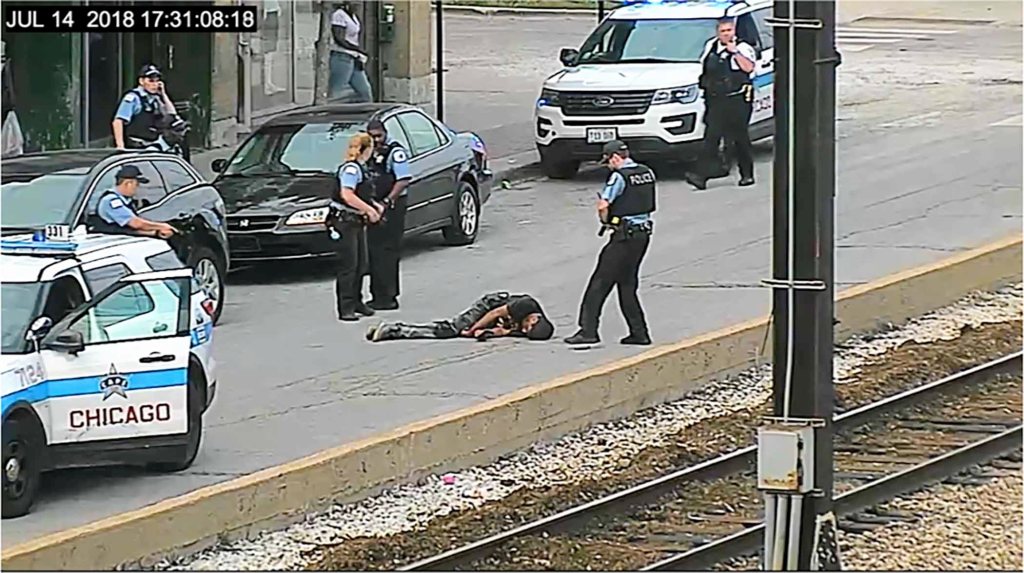
The opening of Bill Morrison’s short film “Incident” is silent. Security footage shows a section of a Chicago street on what looks to be an ordinary summer afternoon. A few people walk down the sidewalk, a seagull flies past the camera, a police cruiser idles on the corner. Suddenly the view changes and the sound comes on. The effect is jarring, and the new scene is one that has become all too familiar: police officers have shot and killed a Black civilian.
Harith (Snoop) Augustus had left work at the barbershop down the street when he was shot by a Chicago police officer. Morrison’s documentary captures the final moments of his life, and the actions and reactions of the police and neighbors who were there when it happened. Using police body-cam footage to create a multifaceted record of the shooting, along with simple onscreen text to place the shooting in its local political context, the film is a powerful record of one man’s death and of the ongoing crisis of police violence.
The shooting in “Incident” is closely tied to an earlier, more famous police shooting in Chicago. In 2014, Officer Jason Van Dyke killed seventeen-year-old Laquan McDonald. A journalist sued to get access to body-cam footage, which unravelled Van Dyke’s claim that he had acted in self-defense. A striking, troubling element of “Incident” comes when we see the police officers immediately begin to describe the shooting to one another—in an account that contradicts what we see on tape. For Bill Morrison, this is at the crux of the film: “With the public’s access to this footage established, a shift in police behavior happens. The cops are all performing now. They know that they’re on camera and that it’s going to be reviewed, and they are creating a narrative to vindicate their actions.”
After the film was completed, in December, 2023, the City of Chicago reached a new collective-bargaining agreement with the Fraternal Order of Police. A provision of the contract, ratified by the Chicago City Council, allows officers to turn off body cameras during conversations that follow an incident, and to delete post-incident conversations that are recorded.
Discover more from Vox Populi
Subscribe to get the latest posts sent to your email.

And now it seems that so many of those who were hired to serve and protect can now kill and torture with no consequences. How sad, how dangerous.
LikeLike
Okay, I tried to watch it but after the first 8 minutes I just couldn’t. The speed with which the cops began to spin what really happened–removing the man’s gun from the holster, etc.–and so it goes. 😔
LikeLike
I find this film terrifying, how practiced the cops are in spinning the report.
>
LikeLike
Just read text and comments, also.
LikeLike
Sorry, I’m not going to watch this; I’ve seen too much.
LikeLiked by 1 person
I understand, Leo. It is difficult to watch.
>
LikeLiked by 1 person
“A provision of the contract, ratified by the Chicago City Council, allows officers to turn off body cameras during conversations that follow an incident, and to delete post-incident conversations that are recorded.” To read the above, after such post-incident conversations clearly contradict the police account, is astounding, outrageous, and marks the Chicago City Council as complicit in police criminality.
LikeLiked by 1 person
Exactly. The Chicago Police have a very long history of brutality, especially toward Black citizens. The City Council has been complicit in these crimes.
>
LikeLiked by 1 person