
Vox Populi
A curated webspace for Poetry, Politics, and Nature with over 6,000,000 visitors since 2014 and over 9,000 archived posts.
Adam Patric Miller: Next Year’s Words
I click on my work email and read the December Principal’s Newsletter that starts with a quote from T.S. Eliot: “For last year’s words belong to last year’s language/And next year’s words await another voice.” I skip the first paragraph about his personal life—in this newsletter he attends a production of Rudolph the Red-nosed Reindeer—and get to the serious academic stuff: “As we approach the end of this academic term, I would ask that you pay special attention to your student’s stress levels over the coming weeks.” Fine. I scroll down and am stunned to see a large ad sponsored by The Jewish Agency for Israel featuring a former student who is going to share his “powerful story of strength, sacrifice, and service” fighting as “a lone soldier” for the IDF.
I recognize the kid’s face, smiling in his paratrooper gear, with a buzz cut. I find an article online that quotes the 2020 high school graduate saying on October 10, 2023, “I wanted to do something special before going to law school.” As an English teacher, I show students how every word they choose is important. I wonder what his “special” contributions were to the tens of thousands of deaths and suffering in the occupied region—so many of them women, children, babies. He says he wanted to honor his grandfather who fought in the Six Day War. So occupation and oppression is a family affair. The ad features two waving Israeli flags. This year’s voice, supported by Biden and intensified after the election of Trump, is well-advertised—even in a principal’s newsletter. It’s going to be a “powerful” story of “strength and sacrifice” that supports one narrative in our school and beyond.
I remember last year’s words and last year’s language when I wore a keffiyeh to school. Wearing the garment put my job at risk. After receiving complaints, our central office made it clear I was prohibited from saying “Palestine,” “Israel,” and “genocide.” I was told not to wear the keffiyeh on school grounds or at any school event. I agreed to keep my job. After I published an article about what happened, I was called into a meeting at the end of summer and told if I wanted to teach a lesson involving that region and events, I was required to work with a thinking partner and when I taught the lesson, I needed another adult in the room to document what was said. To date, I haven’t taught any lessons connected to the Middle East. Also: “Adam, we want you to be very thoughtful about what you post on social media.” So I’ve posted thoughtful stories showing children being rushed away from the rubble in Gaza or in one case, a baby whose head was blown open.
I’ve read that the novelist Lisa Ko was being harassed and smeared in the media for privately expressing support for the writer Aisha Abdel Gawad who withdrew from a panel at the Albany Book Festival because of a series of posts and published articles by the panel’s moderator, Elisa Albert. I’ve read Albert’s posts and I’m certain she would love to attend the event here in St. Louis where “a lone soldier” will tell his story of sacrifice, pulling the ripcord on his parachute for the IDF At the end of 2024, Ko, Gawad, and Albert have contributed their voices to the national dialogue about the war, mixing locally with a high school English teacher and a 2020 high school graduate. One voice, Albert’s, was chosen to be a book festival’s moderator. Another voice, the IDF soldier’s, is being advertised in full color with a photo in a high school newsletter. The other voices come from those who have been censured and defamed.
More than likely, the principal where I teach doesn’t know T.S. Eliot was an extraordinary anti-semite. Surely, he didn’t intend to quote an anti-semite in his newsletter where he advertises the story of a high school graduate who chose to fight for a settler-colonial state that may, through its own extraordinary war crimes, do more to contribute to Jewish hate worldwide than Hitler himself. As Eliot wrote during The Blitz in 1941 while serving as a volunteer firewatcher, “Next year’s words await another voice.” As a writer of Jewish heritage and as a teacher who is concerned about the stress levels at school—especially for those students who are silent because they are Muslim in an intolerant school or those with grandparents and cousins in Lebanon where white phosphorous falls from the sky or a janitor with family in Palestine who came here so his son could thrive in a country that professes to celebrate free speech—I hope another voice will say three words: “Resist, resist, resist.”
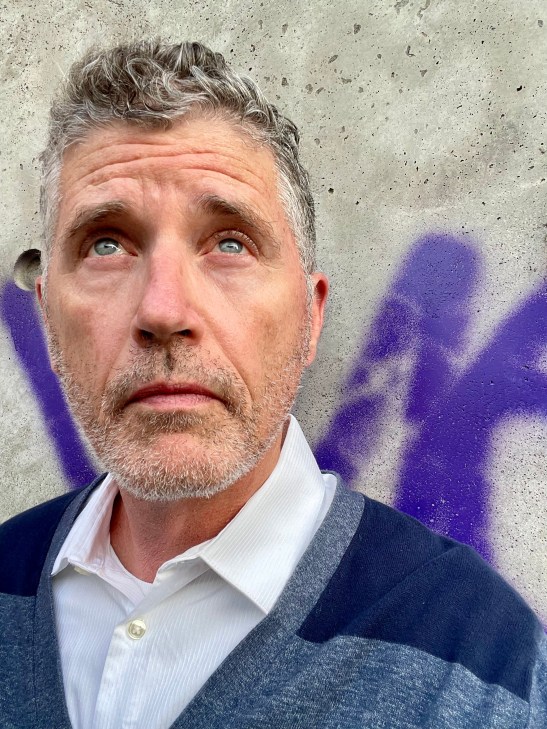
Adam Patric Miller’s debut essay collection, A Greater Monster, won the Autumn House Press Nonfiction Contest, selected by Phillip Lopate. He teaches high school in St. Louis.
Copyright 2024 Adam Patric Miller
Discover more from Vox Populi
Subscribe to get the latest posts sent to your email.

While I profoundly disagree with the less than historical facts presented by Adam Miller on the current conflict in Gaza and the Six Day War, I praise God for living in a country where he can continue to express his personal views for readers outside the school environment. For those interested in a different perspective of an Israeli Muslim addressing an audience at Oxford and a historical view which I share, please see Yoseph Haddad’s speech at Oxford at הנאום המלא שלי בעימות באוקספורד! Yoseph Haddad’s speech at Oxford
LikeLike
“Adam,” you’ve gifted us with an essay so steeped in self-righteous posturing and intellectual dishonesty that it could serve as the gold standard for performative activism.
It’s clear that you aren’t merely interested in the Palestinian-Israeli conflict or justice in any meaningful sense—you’re interested in you. This isn’t advocacy; it’s appropriation. You’ve co-opted the suffering of others and reframed it as your personal battle, turning real human tragedy into a stage upon which to flaunt your martyrdom complex. The Palestinian-Israeli conflict is not your therapy session, and the people whose lives and deaths you invoke deserve better than to be reduced to fuel for your narcissistic self-image.
And let’s not forget the collateral damage of your self-absorption. You outright dismiss the feelings of a scared Jewish student. How selfish must one be to prioritize their own sense of moral superiority over the well-being of a young girl in your care? You’re not resisting oppression, “Adam”—you’re inflicting it. Your inability to recognize that the student’s fear was valid, even if inconvenient for your narrative, exposes the selfishness at the heart of your activism.
Let’s talk about the irony that seems to escape you. In a previous essay, you name-drop Dreyfus, presumably as some attempt to link yourself to a storied legacy of wrongful accusations and antisemitism. Yet you fail to grasp that the Dreyfus Affair was built on lies, much like so many of the narratives peddled by your “side.” Lies fueled by bias, ignorance, and malice—sound familiar? This historical pattern culminates in the ultimate tragedy of Hitler’s regime, another house of cards built on propaganda and deceit. That you, of all people, a self-proclaimed teacher of history and literature, fail to see the parallel between these falsehoods and your own myopic rhetoric is both laughable and tragic.
Your misunderstanding of the Six-Day War is another highlight of your intellectual ineptitude. You sneered at a young man’s decision to honor his grandfather, dismissing it as a “family affair.” Let’s set the record straight: the Six-Day War was a defensive conflict, initiated after Israel faced existential threats from neighboring nations—Egypt, Jordan, and Syria—who massed troops on its borders and explicitly declared their intention to annihilate it. That you frame this defensive war as an exercise in oppression demonstrates your complete inability to grasp historical nuance (and plain fact!). This topic is clearly beyond your capacities, and your flippant engagement with it does a disservice to everyone—especially your students.
The most troubling aspect of your essays are your relentless focus on how you feel—your discomfort, your struggles, your supposed bravery. You callously exploit the suffering of Palestinians, Israelis, and even a frightened student in your classroom, all to build a narrative where you are the central figure, the misunderstood hero in a story that isn’t even yours. This isn’t solidarity; it’s selfishness. This isn’t advocacy; it’s appropriation in some attempted narcissistic power play. And the fact that you can’t see how deeply exploitative and damaging this is only underscores how unfit you are to engage with such a complex, sensitive topic.
Your essays are built on a foundation of selective history, intellectual laziness, and an almost pathological need for validation. As an English teacher, one might assume you’d be well-versed in logic, rhetoric, and the avoidance of these fallacies. Yet your essays are riddled with every classic misstep in the book. Straw man arguments? Check. False equivalencies? Check. Appeals to emotion at the expense of facts? Cornerstone of your prose.
The Israeli-Palestinian conflict is a significant humanitarian crisis. It encompasses decades of deeply rooted historical tensions, impacting millions of lives on both sides. Such a profound and complex issue demands thoughtful engagement, nuanced understanding, and a genuine commitment to dialogue and solutions. What it does not need is narcissistic posturing from individuals like you, “Adam,” who reduce the gravity of the crisis to a vehicle for personal fetishization and psychological fulfillment.
-PUBLIUS
LikeLike
When I was a teacher, there was a dance I played with what I could get away with with much less serious content. I applaud you, Adam. I recently connected with students I taught in 5th grade over a half century ago who still remember the words of The Cat Came Back and House of the Rising Sun. I got away with that? Your presence in their lives is so important. Don’t lose your job, they need you, but keep dancing.
LikeLiked by 1 person
I dislike the way that public schools try to indoctrinate students to a specific political ideology, rather than teaching them about the issues and letting them decide.
LikeLiked by 2 people
Thank you, Adam Patrick Miller.
LikeLiked by 2 people