
Vox Populi
A curated webspace for Poetry, Politics, and Nature with over 6,000,000 visitors since 2014 and over 9,000 archived posts.
Charles Davidson: Reflections on “Bonhoeffer: Pastor. Spy. Assassin.” (the Movie and the Man)
The promotional trailers to Bonhoeffer: Pastor. Spy. Assassin. promise the viewer a gripping, action-packed spy thriller. In an interview, the writer, producer, and director, Todd Komarnicki, primes the audience to receive the Reverend Dr. Dietrich Bonhoeffer as a religious hero for our time. But we have to ask, “Is this the religious hero we want?” And more importantly, “What purpose is being served by this depiction?”
Take a close look at the poster dripping with the color blood-red.
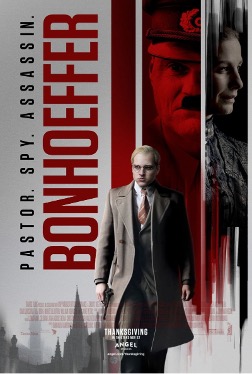
The singularly focused, blond-haired Bonhoeffer is suited up for the action. He directs his sly gaze to his right. Why not to his left? Could this be a subtle political statement pointing in the one direction as opposed to the other?
Does Hitler’s split image (split personality?) staring over top of his infernal moustache pull you into his netherworld, or distance you from it?
What about the woman looking aside, eyeing her invisible subject with empathy, in contrast to Herr Hitler’s militant mien? What does her soft presence convey? What part might she play in a dystopian Nazi universe of back-alley brawls, flying bullets, and shattered glass, which the non-fiction writer Erik Larson aptly located In the Garden of Beasts?[1]
And the pistol in Bonhoeffer’s right hand? Is that the clincher?
Are you now sufficiently intrigued? Does a pastor brandishing a handgun quicken your steps toward the action?
As I sat watching the movie, I soon began to question what I was seeing—
- Does the film fairly present the real Bonhoeffer? Which scenes get him right? Which ones go markedly astray?
- Do I recognize him as the Bonhoeffer I met for the first time during my college years seven decades ago?
- Is he the same Bonhoeffer I encountered in The Cost of Discipleship, Life Together, Letters and Papers from Prison, and Ethics, as well as in the meticulous biographical tome his pupil Eberhard Bethge painstakingly crafted of his friend and teacher?[2]
At times throughout the movie the real Bonhoeffer appears partially recognizable, at other times a caricature of himself. But mostly he is far less complex and nuanced than the person he actually was.
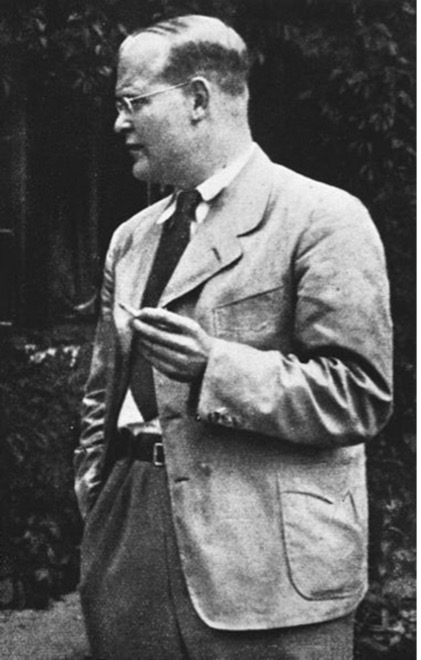
As for the externals, isn’t his coiffured and dapper cinematic persona a bit too fussy? Where now are the puffy trousers and frumpy jacket, accented by the cigarette propped between his fingers in that casual pose caught of him in 1939?
Has the kind, generous, composed, principled, and deeply thoughtful German actually morphed overnight into a resolute assassin as the film would lead you to think? Really, now? What’s your definition of an assassin? Must the deed be done or is the thought alone enough? Explain, if you will, just how the man qualifies. There were moments when I thought I was observing a Hollywood stuntman as a stand-in for the real Dietrich Bonhoeffer.

Dietrich labored diligently and faithfully in the field of theology. Yet the film offers barely a morsel of the brilliant theologian. Some scenes, to their discredit, typecast him more like a hastily driven crusader than the irenic person he was, engaged in profound, prolonged, and deep reflection, conversant with a vast repertoire of literary, historical, and philosophical works, and wed to the demanding self-discipline involved in crafting his books, diaries, theses, lectures, letters, and sermons.
As for his life and ministry as a Lutheran pastor and preacher, Dietrich drank deeply from the biblical canon. For him the scriptures were like a great constellation of lights from the heavens with Christ as their north star. Of its pages he was a serious exegete and consummate interpreter. By no stretch of the imagination was he ever a propagandist exploiting the Bible for rightwing or leftwing cannon fodder.
But there are those today in the United States, notably the authors of the Heritage Foundation’s Project 2025 and legions of MAGA Christians and Christian nationalists, who have commandeered Bonhoeffer to boost their authoritarian agenda for the incoming Trump regime.
Blatantly they falsify Bonhoeffer’s legacy to suit their ideological whim. And they abuse the sacrificial honor of his martyrdom to bolster the credibility of their childishly foolish leader who honors no one but himself and a cadre of other dictatorial strongmen.
Unfortunately, despite efforts by its creator and its actors to distance themselves from this misappropriation, the Komarnicki film portrays a hyped version of Bonhoeffer that lends itself to the willfully naïve and theologically apostate supporters of MAGA politics who claim Bonhoeffer as their righteous Gentile and heroic savior in a triumphalist battle for the human soul and the nation. Thus the need for an official disclaimer.
One such Trump devotee whose presidential endorsement (“The Christian Case for Trump”) appeared in the Wall Street Journal on October 16, 2016, is the thoroughly misguided and misguiding Erik Metaxas who slanderously referred to President Biden as “our Hitler.” But in true Trumpian fashion, Metaxas directed his slander at the wrong person.
Metaxas’s biography, Bonhoeffer: Pastor, Prophet, Martyr, Spy, has become a favorite among MAGA Christians and Christian nationalists who enthusiastically rally behind Trump’s brazen and nascent fascism. Metaxas’s depiction of Bonhoeffer is a shoddy piece of politically motivated scholarship that was amply exposed for its infidelity to Bonhoeffer in a scathing 2010 review in The Christian Century by Clifford Green, one of the editors of the Bonhoeffer Works project.
An exponent of fundamentalist end-time spiritual warfare, Metaxas has been called out not only by lead actors in the Komarnicki film, for his manipulation of Bonhoeffer, but also by the International Bonhoeffer Society, Bonhoeffer scholars, and Bonhoeffer family descendants.
One of the most shameful aspects of the film is its symbolization of Bonhoeffer as a Christian pastor with a pistol in his hand, which gives implicit permission to anyone who may rationalize: If Pastor Bonhoeffer can take aim at his enemy, then why can’t I do the same to mine?
Just where Mr. Komarnicki found the gun that he placed in Bonhoeffer’s possession, I do not know. Perhaps I missed something during all my years of reading Bonhoeffer. My hunch is that the pistol was a powerful projection and useful means for beefing up the movie, which Mr. Komarnicki simply couldn’t resist. A pastor brandishing a pistol would surely seduce almost any audience to come and see just what in God’s name is happening.
Surrounded as we all are, like it or not, by the American gun culture, the film industry sticks it to us as soon as we walk into the theater. The archetypal symbol of America’s love affair with instruments of killing can’t even escape the grip of the peacemaking pacifist, Dietrich Bonhoeffer. I don’t think that Bonhoeffer, were he still alive, could anymore dissuade his gung-ho American “captors” to disown their fetish for power-hungry politics and the idol of the gun than he could have persuaded his Nazi captors in Tegel prison to release themselves from the grip that Hitler held upon their souls.
After all, every Americanized “hero” from John Wayne’s Shootist to Arnold Schwarzenegger’s Terminator has monetized the nation’s cultural addiction to violence until the predictable outcome resulted in live coverage of the January 6th siege of the U. S. Capitol.
And now, as a cameo to the main feature of such abhorrent politics, we have before us a cinematic Bonhoeffer being hijacked by some of the very same people who, come January 2025, will return to Washington, DC, to do their darndest to hijack democracy. Or as they spuriously vow, to Christianize America into their fabricated version of a nationalist Christ.
Despite the film’s deficiencies, excesses, and flagrant exploitation by those willing to corrupt Bonhoeffer to their own sinister purposes, there is something to be said for the film’s implied warning about the rising tide of authoritarianism in America.
In a delicate scene in which Bonhoeffer’s twin sister Sabene is engaged in softly spoken conversation with her brother, she says to him with reference to Germany’s future under the foreboding shadow of Hitler: “Something’s coming. Something unstoppable.”
Whatever else may be taken to heart from seeing the movie (there’s still more one could glean), that solemn moment shared between the two Bonhoeffer siblings presents us with our own urgent wake-up call. For an American Gestapo may soon come knocking on our doors just as it did on Dietrich Bonhoeffer’s when the German Gestapo hauled him off to prison.
The question then will become not how much we remember of Bonhoeffer, but how much we have become like him ourselves, with no gun in hand.
An English officer of the British Secret service, by the name of Payne Best, who was incarcerated with Bonhoeffer at Buchenwald, Regensburg, Schönberg, and Flossenbürg, being all the while unaware of Bonhoeffer’s past, came to know him quite well within the confines of prison. He left behind an abiding portrait of the Bonhoeffer who in no respect matched the character or the behavior of an assassin.
Best wrote: “Bonhoeffer was all humility and sweetness: he always seemed to diffuse an atmosphere of happiness, of joy in every smallest event in life, and of deep gratitude for the mere fact that he was alive. There was something dog-like in the look of fidelity in his eyes and his gladness if you showed that you liked him. He was one of the very few men I have ever met to whom his God was real and ever close to him.”
In the letter Payne Best sent to Bonhoeffer’s family subsequent to Dietrich’s death, he concluded: “In fact my feeling was far stronger than these words imply. He was, without exception, the finest and most lovable man I have ever met. . . . Bonhoeffer was different; just quite calm and normal, seemingly perfectly at ease . . . his soul really shone in the dark desperation of our prison.”[3]
The last words that Payne Best heard Bonhoeffer speak not long before his execution by hanging at the command of Adolf Hitler were these: “This is the end—for me the beginning of life.”
The prison camp doctor who had seen Bonhoeffer just before his death, not knowing at the time who Bonhoeffer was, wrote this of him ten years later:
“Through the half-open door in one room of the huts I saw Pastor Bonhoeffer, before taking off his prison garb, kneeling on the floor praying fervently to his God. I was most deeply moved by the way this lovable man prayed, so devout and so certain that God heard his prayer. At the place of execution, he again said a short prayer and then climbed the steps to the gallows, brave and composed. His death ensued after a few seconds. In the almost fifty years that I worked as a doctor, I have hardly ever seen a man die so entirely submissive to the will of God.”[4]
[1] Erik Larson, In the Garden of Beasts: Love, Terror, and an American Family in Hitler’s Berlin (New York: Crown, 2011).
[2] Eberhard Bethge, Dietrich Bonhoeffer: Man of Vision, Man of Courage (New York: Harper & Row, [German 1957] 1977), 867 pp.
[3] Bethge, 823.
[4] H. Fischer-Hüllstrung, “A Report from Flossenbürg,” I Knew Dietrich Bonhoeffer, p. 232, Bethge, 830–31.
~~~~

Charles Davidson, a retired Presbyterian (PCUSA) pastor, psychotherapist, and professor of pastoral theology, care, and counseling, is the convener of The Fellowship of Confessing Christians. He is the editor of George Buttrick’s Guide to Preaching the Gospel, the author of Foster’s Pie Pan: Stories of Grace Abounding in a Fallen World and Bone, Dead and Rising: Vincent van Gogh and the Self Before God.
Copyright 2024 Charles Davidson – All Rights Reserved
Discover more from Vox Populi
Subscribe to get the latest posts sent to your email.

My thanks to each and all of you for your thoughtful comments in response to my essay about the Bonhoeffer movie. Unfortunately, some of my individual replies did not post, which is why some of you have not received one. This is an issue I’ve frequently had with WordPress. Michael Simms has graciously offered to post this one for me by way of expressing my gratitude. I would be interested in knowing how those of you who will have seen the movie respond to it. With every good wish to you, Charles Davidson.
LikeLiked by 1 person
No matter how often I attempt to convey a response to each of you, WordPress invariably fails to post my replies. So this is a general one by way of saying thank you to each of you. We’ll see if this one posts.
LikeLiked by 1 person
I appreciate this clarifying article about a recent film concerning a good, kind, brilliant, spiritual man. It is so easy these days to trash and distort the reputation of good people.
LikeLiked by 1 person
Thank you, drmandy99. I am glad the article was helpful. You are so right about Bonhoeffer as a good, kind, brilliant, spiritual man.
LikeLike
I’m currently reading Charles Davidson’s spiritual autobiography of Vincent Van Gogh, and recommend it highly to those who want to learn of another hero Davidson has previously highlighted.
Reverend Davidson is an excellent describer of the human/Christian love connection, as he does here in pondering the distortions Hollywood has made of Bonhoeffer, (like the moviemaking machine has also done in their mythology about many other figures in history)..
My mother, a bright and devout Lutheran, always considered Bonhoeffer her spiritual hero. I found him tough sledding when looking for a “good read” rather than a truthful one, whereas he shone for my mom. As for the lurid cover, isn’t that a typical Hollywood attention grabber? Much like local news where the old adage “if it bleeds, it leads” can be applied to enticing viewers of movies, too. In the end, it’s disheartening to see Bonhoeffer co-opted into a hero of the current dissemblers whose authoritarianism Bonhoeffer abhorred.
But I still might watch it.
LikeLiked by 1 person
Thanks for this, Jim.
LikeLike
JMNewsome,
Thank you for your thoughtful and kind reply. Most of all, my goal is to do justice to those about whom I write, whether Bonhoeffer, Van Gogh, or another. How fortunate that your mother found her way to Bonhoeffer, as did you. And you are so right. The human/love connection is the heart of the matter.
LikeLiked by 1 person
Thanks for your writing in defense of justice and the human/love connection. I hope there will be more to come. Jim Newsome
LikeLike
Wow. I’m feeling very shallow after reading this as I loved the movie and found it very inspirational to step up and do the tough stuff in our fight against fascism. I sat and cried in the theater for 10 minutes before I could walk out. I bought the book “Preaching in Hitler’s Shadow: Sermons of Resistance” as a results of seeing it and gifted it to some local ministers!! So, I gotta re-read this and re-think how the movie affected me. Thanks!!
LikeLiked by 2 people
I’m looking forward to seeing the movie, Patricia. It’s not showing yet in Pittsburgh.
LikeLiked by 1 person
Ms. Nugent,
Thank you for your response. I think the movie can lend itself to being inspirational with respect to the fight against fascism, which was the objective of Bonhoeffer’s own resistance. The trouble is that the MAGAites want to lasso Bonhoeffer to be something that he was not. They seek to use him against Trump’s critics when Bonhoeffer would have been among the very first to stand resolutely against everything Trump has come to represent, including his prostitution of the Bible as a commercial and political instrument of his self-aggrandizement. Trump knows not the first thing about the contents of the Bible, nor, in contrast to Bonhoeffer, does he seek to live by it.
LikeLike
I have admired Bonhoeffer as long as I could think. I am definitely not going to see this film, it would probably make me sick to the heart. Bonhoeffer was one of the most intelligent, decent, and truly GOOD men of his generation. Just think of some of his quotes: “Silence in the face of evil is itself evil: God will not hold us guiltless. Not to speak is to speak. Not to act is to act.” “Silence in the face of evil is itself evil: God will not hold us guiltless. Not to speak is to speak. Not to act is to act.” “The church is the church only when it exists for others.” etc. Yes, he was an activist: walking the talk. Whether he wanted to kill Hitler? I somehow don’t think so, reading his work.
LikeLiked by 2 people
For some reason this didn’t paste into th text: “The ultimate test of a moral society is the kind of world that it leaves to its children.”
LikeLiked by 1 person
I never knew for sure of Bonhoeffer actually conspired to kill Hitler or if he was just accused of it as a pretext for getting rid of him. I will accept him either way. Assassinating Adolf Hitler would have been an act of love. I’m a little irritated by moral judgment in his case if he did in fact plan to kill Hitler. Anyone, presented with the right circumstances, can commit a lethal act. Few people actually experience this existential condition in their lives. If he intended it, I’m sorry he didn’t succeed. It would have saved a few hundred thousand lives, perhaps.
LikeLiked by 2 people
I haven’t seen the film yet, but I plan to because Bonhoeffer has long been one of my heroes though turning him into 007 is, I think, a disservice to his moral struggle. That being said, faced with the choices, developing a plan to kill Hitler is understandable, perhaps even heroic. As Charles argues in his review, it is offensive for MAGA Americans to use his example as a way to justify their own radicalism. I have no doubt that Bonhoeffer would have seen Trump as a threat to humanity, much like Hitler.
>
LikeLiked by 2 people