
Vox Populi
A curated webspace for Poetry, Politics, and Nature with over 6,000,000 visitors since 2014 and over 9,000 archived posts.
Charles Davidson | A Call to Confess: Christians on the Eve of the 2024 U.S. Election
Dietrich Bonhoeffer and the 1930s German “Confessing Church” Speak to Us.
BY THE MID-1930s, Adolf Hitler had gutted the legitimate institutions of the German Democratic Republic and solidified his tyrannical fascist rule over the German people. Violence prevailed across the country.
Hitler’s Gestapo (Geheime Staatspolizei), the secret state police under the direction of Heinrich Himmler, arrested, detained, and imprisoned persons at will as “enemies of the state.”
In its initial year of operation, the concentration camp at Dachau, the first of 44,000 camps to be built and utilized between 1933 and 1945, housed 5,000 political prisoners, including German Communists, Social Democrats, trade unionists, and eventually Jehovah’s Witnesses, Romani people, gay men, and others.[1]
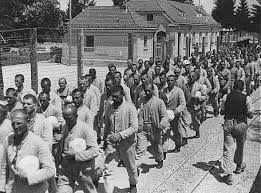
Prisoners carrying bowls at Dachau (KZ Gedenkstaette Dachau)
Coincident with the Nazi boycott of Jewish businesses, Jews remained under constant surveillance and attack. By the second half of the decade and until 1945, deportations of millions of Jews to concentrations camps purged Germany of their presence, as well as other parts of Europe, and sealed their fate in death.
Already, by July 1933, the month in which Pope Pius XI committed the Catholic Church to the concordat (Reichskonkordat) with Hitler, which severely compromised the “Roman” Church’s relationship to the Nazi regime as well as to the gospel of Jesus Christ, massive numbers of congregants from German Evangelical (Protestant) churches had become ardent Nazis, having caved into the wiles of the Führer.
The golden calf of fascism had lured most, though not all German Evangelicals, into the wolf’s den of the evil despot. In 1934, the heretical party within the Evangelical churches, known as the “German Christians” (Deutsche Christen), displayed the Nazi flag with the Swastika imposed over the crossbeams of the Christian cross, displacing Christ with Hitler as head of the church despite official Nazi verbiage and propaganda to the contrary.
Hitler cemented his ecclesiastical “coup” of the German Evangelicals on August 4, 1933, by appointing one of their own, Ludwig Müller, a loyal Hitler supplicant, member of the Nazi Party, and Evangelical minister, as the one to preside over the co-opted, re-constituted, and anti-Semitic Reich Church (Reichskirche).
On September 14th , Müller stood before the Berlin Protestant Cathedral (Berliner Dom) to give his inaugural address as the newly elected Reich bishop (Reichsbishof).
Previously, on June 28th, with the assistance of Hitler’s brown-shirted SA (Sturmabteilung), the paramilitary arm of the Nazi Party known as the “Stormtroopers,” Bishop Müller seized the headquarters buildings of the Church Federation of the 28 regional German states’ Evangelical churches that Hitler unified as the Reich Church. Thus the Nazification of the “German Christians” was achieved.
The conquest and capture of German Christianity included banishment of the Old Testament canon (Hebrew Scripture) from use in the Reich Church, revision of the New Testament canon (Christian Scripture) by removing Jewish references, and denial of the Jewishness of Jesus.
At the heart of the Third Reich’s civil law stood the 1933 “Aryan Clause” banning all Jews and non-Aryans from the civil service, the public health system, and the rights of citizenship. Non-Aryans included Poles, Russians, Serbians, and other Slavs.
Jews who had converted to Christianity and Christians of Jewish descent were barred from the Reich Church which had thoroughly succumbed to virulent anti-Semitism despite the protest of many pastors and congregants.
To couch the church’s surrender in biblical terms, the diabolical nature of its reconstruction was as though the ancient yet ever-contemporary pagan Canaanite god, Ba‘al, had seized hold of the Christians and anyone else who raised an arm in the “Heil Hitler” salute. For Ba‘al (whose name in Semitic Hebrew means to “control” or “lord over”—that is, to “possess”) had reached down through the ages to impose yet another Babylonian-style captivity of Yahweh-God’s people.
Jews were “possessed” by public ridicule, isolation, and annihilation. “German Christians” were “possessed” by persuasion and coercion into the ranks of the Nazis as instigators and instruments of the Holocaust as the Final Solution.
As one Christian historian avowed, “The devil resorts to murder only when he has failed as the tempter.”[2] In Nazi Germany, the devil, Adolf Hitler, had succeeded in both.

Despite the Nazi takeover of the Christian Church, there remained yet throughout Germany a faithful remnant of Christians comprised of pastors and congregants primarily from Lutheran and Reformed churches, among other Christians and non-Christians, who refused to bow the knee in obeisance to the demonic spirit of Hitler.
In the midst of the cataclysm, a young Lutheran pastor by the name of Dietrich Bonhoeffer emerged as a prominent leader of the resistance against the Nazis.
Bonhoeffer, along with Karl Barth, Martin Niemöller, and other Lutheran and Reformed pastors, formed the Pastors’ Emergency League from which arose the “Confessional Synod of the German Evangelical Church,” referred to as the “Confessing Church” (Bekennende Kirche).
On January 4, 1934, Reich bishop Müller issued the “Muzzling Order,” which was an official government decree that forbade pastors from preaching sermons on any subject related to the “church struggle” that persisted between those who stood with Hitler and those who opposed him.
In outright defiance of the decree, the 4,000 pastors belonging to the Pastor’s Emergency League crafted a formal protest. The very next Sunday all 4,000 of them read it from their pulpits.
As a consequence, on January 25, Hitler summoned church leaders, including those of the “German Christians” and various bishops and presidents, as well as Pastor Martin Niemöller, president of the Emergency League, to meet with the Führer in the Reich Chancellery. In attendance were Hermann Göring, Hitler’s Reichsminister without portfolio as well as governor of Prussia, and Wilhelm Frick, Hitler’s Reichsminister of Internal Affairs.
Historian Arthur Cochrane related the story as it unfolded:
“Hitler began to read a prepared statement concerning the purpose of the conference. He had hardly uttered more than a few sentences when Göring rushed into the room and requested permission to read a transcript of a telephone conversation between Niemöller and [theologian] Walther Künneth . . . that had taken place scarcely an hour before, and which Göring’s police had listened in on.
“Künneth had called to inquire about information concerning the impending meeting. Niemöller replied that he understood that Frick was anxious to secure a peaceful solution because of Muller’s precarious position and had solicited the support of the aged President Hindenburg.
“At that point Niemöller’s secretary is said to have jokingly called into the telephone something about Hindenburg administering extreme unction to Hitler. Göring seized upon this silly remark to exclaim: ‘These people are trying to drive a wedge between yourself and the Reich President!’ Hitler exploded in anger. During his outburst Niemöller moved forward so as to be able to speak when Hitler ceased ranting.
“He tried to explain that the remark about extreme unction was meant as a joke and should not be taken seriously. He concluded by saying that the Confessing Church was concerned only for the Church, the nation, and the State. To this Hitler replied: ‘You leave the care of the Third Reich to me, and you look after the Church.’
“Again Göring threw oil on the fire when he claimed that he had proof that the Emergency League had ‘foreign connections.’ As the clergymen were taking their leave, Niemöller took the opportunity to say a few words to Hitler.
“‘You have said that I should leave the care of the German people to you. I am bound to declare that neither you nor any power in the world is in a position to take from us Christians and the Church the responsibility God has laid upon us for our people.’
“Hitler never forgot and never forgave the Dahlem pastor. It was the reason Niemöller was later dealt with as the ‘personal prisoner of the Führer.’”[3]
In 1937, Pastor Dietrich Bonhoeffer undertook brief stays in New York City and London. Subsequent to his return to Germany he was summarily denounced as an enemy of the Third Reich while Hitler’s Gestapo continued arresting pastors and seminarians of the Confessing Church. It was within that ferocious whirlwind that Bonhoeffer published his epochal book, The Cost of Discipleship.
Pointing directly to the majority of his fellow German Evangelicals (the Deutsche Christen) who had willingly succumbed to Hitler’s dominion and power, Bonhoeffer wrote:
“We Lutherans have gathered like eagles round the carcass of cheap grace and there we have drunk of the poison which has killed the life of following Christ. It is true, of course, that we have paid the doctrine of pure grace divine honours unparalleled in Christendom; in fact we have exalted that doctrine to the position of God himself. . . .
“The result was that a nation became Christian and Lutheran, but at the cost of true discipleship. The price it was called upon to pay was all too cheap. Cheap grace had won the day.
“But do we realize that this cheap grace has turned back upon us like a boomerang? The price we are having to pay to-day in the shape of the collapse [before Hitler] of the organized Church is only the inevitable consequence of our policy of making cheap grace available to all at too low a cost. . . .
“This cheap grace has been no less disastrous to our own spiritual lives. Instead of opening the way to Christ it has closed it. Instead of calling us to follow Christ, it has hardened us in our disobedience. . . .”[4]
Bonhoeffer defined “cheap grace” as “the preaching of forgiveness without requiring repentance, baptism without church discipline, Communion without confession, absolution without personal confession. Cheap grace is grace without discipleship, grace without the cross, grace without Jesus Christ, living and incarnate.”[5]
On the other hand, “Costly grace is the treasure hidden in the field . . . the pearl of great price . . . the kingly rule of Christ, for whose sake a man will pluck out the eye which causes him to stumble . . . the call of Jesus Christ at which the disciple leaves his nets and follows him.”[6]
Cheap grace had blinded the eyes of the “German Christians” to the folly of their sanctifying the evils of Hitler’s reign with the imprimatur of Christ’s name. For thereby they betrayed Christ with a falsified blessing of the superiority of the Aryan race. Blue-eyed, blond-haired, and white-skinned Christians had bowed low in worship of the Germanic Fiend, Adolf Hitler.
During the days of May 29–31, 1934, the Confessional Synod of the German Evangelical Church met in Barmen, where its representatives voted on and publicized “The Theological Declaration of Barmen” as its testimony to Hitler, Germany, and the world. Its fifth thesis declared the following:
“We reject the false doctrine, as though the State, over and beyond its special commission, should and could become the single and totalitarian order of human life, thus fulfilling the church’s vocation as well.”
And—“We reject the false doctrine, as though the church, over and beyond its special commission, should and could appropriate the characteristics, the tasks, and the dignity of the State, thus itself becoming an organ of the State.”
Two years later, on June 4, 1936, “the Provisional Board and Council of the Confessing Church sent a lengthy Memorandum to Hitler. It not only called attention to the anti-Christian and pagan character of the Nazi State but openly condemned anti-Semitism, racialism, concentration camps, secret police methods, violation of the ballot, oaths of allegiance contrary to God’s Word, the destruction of justice in the civil law courts, and corruption of public morals.”[7]
Thereby the Confessing Church bore witness to its faith in Jesus Christ “with one accord in a confession of the one Lord of the one, holy, apostolic Church.”[8]

Dietrich Bonhoeffer: Born February 4, 1906, Executed by Hitler April 9, 1945 (Age 39)
In hindsight, it is easy for 21st-century Christians within these United States to point the finger back at “them”—the “German Christians” of the 20th century—for having abandoned Christ and the costly grace of the gospel of God’s kingdom, in exchange for surrendering to the temporal powers of Hitler’s Nazi regime that sacrificed six million Jews on the altars of fascism and caused a Second World War.
Far more difficult, yet imperative, is it now to call out those American “MAGA Christians” who at this very moment, by the millions, bear false witness before God to Christ as the totem of their fascist holy war on immigrants, women, people of color, fellow citizens, and anyone they deem to be their earthly enemies.
For by presenting a counterfeit version of Christianity they commit precisely the same apostasy as did the “German Christians,” gathering “like eagles round the carcass of cheap grace” in order to drink of the poison of their cultic idol—Donald Trump—whose tongue strikes with the ire of a venomous serpent.
Christians must recall what Jesus said: “No one can serve two masters; for a slave will either hate the one and love the other, or be devoted to the one and despise the other” (Matthew 6:24, NRSV).
It is not possible to be devoted to Donald Trump, any more than it was possible to be devoted to Adolf Hitler, and also be devoted to Jesus Christ.
Today, in America, a “confessional moment” has come for the Christians whose faces are turned toward Christ—and away from the messianic MAGA movement and its sociopathic leader, Donald Trump.
[1] “Dachau,” Holocaust Encyclopedia (United States Holocaust Memorial Museum). https://encyclopedia.ushmm.org/content/en/article/dachau
[2] Arthur C. Cochrane, The Church’s Confession Under Hitler (Philadelphia: The Westminster Press, 1962), 210.
[3] Cochrane, 131. Cochrane’s lengthy single-paragraph quotation was broken into shorter paragraphs for this essay.
[4] Dietrich Bonhoeffer, The Cost of Discipleship (New York: The Macmillan Company, [1937] 1959), 57–59.
[5] Bonhoeffer, 47.
[6] Bonhoeffer, 47.
[7] “Memorandum to Hitler,” Cochrane, 207–08.
[8] “The Theological Declaration of Barmen,” Cochrane, 241; The Book of Confessions (Louisville: Presbyterian Church, USA, Office of the General Assembly, 1999), 250.

Charles Davidson is a retired Presbyterian (PCUSA) pastor, psychotherapist, and professor of pastoral theology, care, and counseling. He is the editor of George Buttrick’s Guide to Preaching the Gospel (Abingdon Press) and the author of Bone, Dead and Rising: Vincent van Gogh and the Self Before God (Cascade Books).
Copyright © 2024 Charles Davidson. All Rights Reserved.
Discover more from Vox Populi
Subscribe to get the latest posts sent to your email.

#/media/File:Deutsche_Christen_Flagge.svg)
Thanks for reminding us of Dietrich Bonhoeffer who resisted the Aryan state; a martyr when there were few in that land. Not many had his courage. My friend Etty Hillesum of Amsterdam did too, in her very different way. Though some of us may feel like the cowardly lion, courage can come forth in unexpected ways. Keep up the good writing about this. It helps.
LikeLiked by 1 person
Thank you for your comments and support. I think you are right about courage. It can surprise us when we think we are without recourse. Etty by all means, a brave and powerful source of strength in her witness.
LikeLike
I have posted this to my FB page, even if nobody bothers to read it. This is my people’s story and needs to be heard – with urgency.
LikeLiked by 1 person
The parallels between current US politics and Germany’s in the 1930s is scary.
>
LikeLiked by 1 person
I love this piece, it’s reference to two masters in particular, as well as to Ba’al, aka Ba’al ze bul, Lord of Flies, the demon of gluttony, a telling moniker for Trump and his ilk. These same masters of mendacity also recall Proverbs 12:22: “Lying lips are an abomination to the Lord.” I’ve always remembered this line not because I’m overly devout (I’m not, although I was raised Catholic and attended Catholic school from first to fourth grade) but because of how it so deftly points out the duplicitousness that’s often found in political speech. Lying to your constituents is to me the pinnacle of incivility.
I’m also reminded of how the Catholic church, despite its many sins, has always embraced a steady level of erudition. I’ve forever been particularly fond of the Jesuits – my dream has been to teach at Fordham in the Bronx, a beautiful campus that nestles another old haunt of mine, the New York Botanical Gardens, not to mention the Actual Little Italy of NYC, Aurthur Avenue. I did, however, spend a few semesters teaching comp at Benedictine University, where I consorted with wonderful fellow faculty.
And lastly, the powerful phrase “the carcass of cheap grace” reminds me of fiction, in particular Roberto Bolaños “Nocturno de Chile,” or “By Night in Chile.” In a Times review of another of his novels, “Nazi Literature in the Americas,” Stacey D’Erasmo queries: “But what can it mean, [Bolaño] asks us and himself, in his dark, extraordinary, stinging novella “By Night in Chile,” that the intellectual elite can write poetry, paint and discuss the finer points of avant-garde theater as the junta tortures people in basements?”
D’Erasmo, btw, is now a professor at Fordham, but taught fiction at Colombia while I was there from 2007 – 2012. But again, thank you for this.
LikeLiked by 1 person
Wow, what a brilliant fulsome comment! Thank you, Matt!
>
LikeLike
Con mucho gusto. With much pleasure. And thank you. Vox Populi is my morning elixir, my balm of Gilead. Good stuff in this day and age.
LikeLiked by 1 person
yes
LikeLike
exceptionally cogent and relevant. I received my Masters Degree in Theology from St. Catherine University. Social justice, a fundamental caring for the poor, and a graduate class almost all women, changed my mind about what Catholicism can be. As an undergraduate at St. Olaf, a Lutheran college, I learned about cheap grace versus lived grace, a debate that continues to this day, crossing political boundaries. Of course Trump has no grace.
But more importantly, as you indicate, Trump is the epitome of a user of whatever religion he can co-opt for his own narcissistic purposes. Thus like Hitler, in that regard. There is no faith in God emanating from him, only for himself in the place of God. My professors at Kates would call him a functional atheist, as his behavior actually denies the existence of a transcendent realm. Oddly, I also see him embodying what Ayn Rand advocated: selfishness as a virtue.
LikeLiked by 1 person
Exactly. Trump believes that what serves his desire is a good, what defies him is evil. No sense of a higher purpose or morality.
>
LikeLike
Thank you for your comments. I concur with your conclusions. Let’s hope that wisdom in sufficient numbers will prevail. So much is at stake for so many.
LikeLike
Thank you for your comments. I concur with your conclusions. Let’s hope that wisdom in sufficient numbers will prevail. So much is at stake for so many.
LikeLike
Thank you for your comments. I concur with your conclusions. Let’s hope that wisdom in sufficient numbers will prevail. So much is at stake for so many.
LikeLike
Correction: Dietrich Bonhoeffer was in London briefly in 1937 and New York City in 1939 before his return to his home in Germany, knowing he faced a perilous future.
LikeLike
Thanks, Charles.
>
LikeLike