
Vox Populi
A curated webspace for Poetry, Politics, and Nature with over 6,000,000 visitors since 2014 and over 9,000 archived posts.
Michael Simms: A Cowboy in the Chapel of Bones
Baby Head Cemetery, Llano, Texas
Where I come from
it’s bad manners to speak of death
except in dead metaphors. Kick the bucket. Bite the dust.
Give up the ghost. Swan song – a pretty phrase, but bad ornithology.
I once heard a lady from London say pop your clogs
as if we throw off a pair of muddy shoes after a long walk in the rain —
not likely in the dusty streets of Llano, Texas,
where tooled boots Death might wear are the rage.
Cowboys are Calvinists.
We like the dead to stay dead,
ashes to ashes with no dust left over, no grave to visit.
Ancient cemeteries are just grazing land, undeveloped real estate
waiting its turn to be turned over to developers
of green and gold towers rising above the dry plains.
But our metaphors are a dead giveaway
that once we had more respect for the dead.
After all, a cliché is simply a beautiful phrase
we ride hot and put away wet until it weakens and dies.
*
On Día de los Muertos
my ex-in-laws visit the cemetery to party
with the dead, a celebration of mortality.
They laugh, eat, drink, wear tall masks of demons,
make gifts to the dead and the living alike,
skulls made of sugar and pan de muerto with frosting shaped like bones.
I love the calaveras literarias, irreverent epitaphs dedicated to the living.
Rudolfo, mourning his mother who stands alive in front of him, recites
Como extraño sus tamales, empanadas y atolito;
voy a tener que aprender a cocinar yo solito.
(He misses his mother because he hates his own cooking)
To joke with death gives urgency to our lives.
When we remember what we’d rather forget
we see and speak more clearly.
Every day becomes an emergency, an emergence, una aparición
that forces us to become fierce about our faith,
to taste the chocolate before it melts,
to love the lover before love fades
and to honor the body with marigold before it rots.
*
Years ago in Portugal
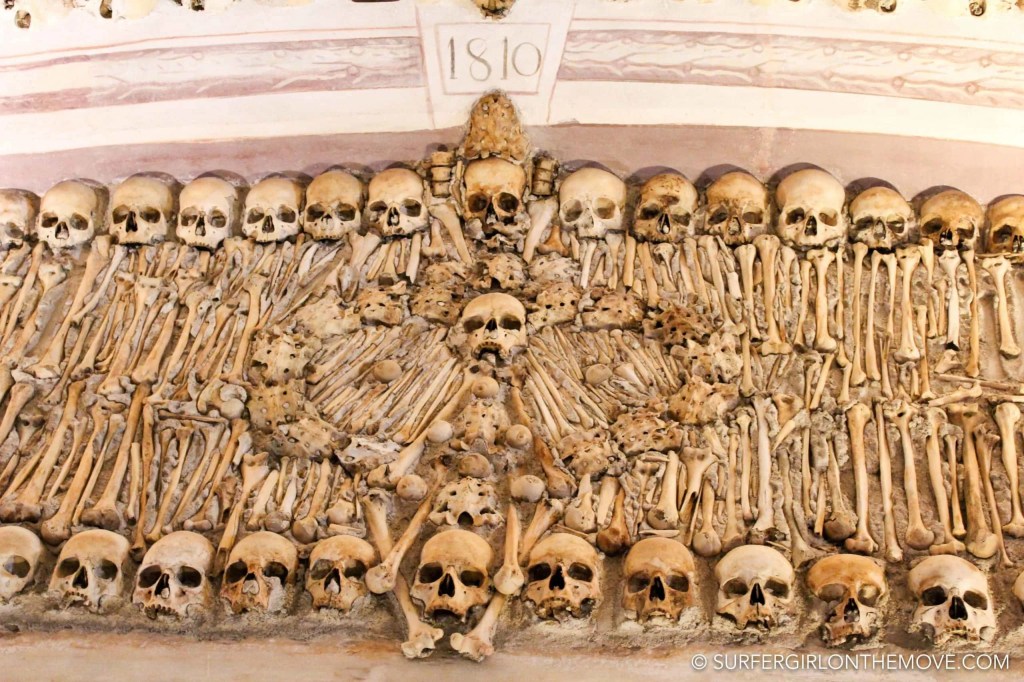
I walked into the Chapel of Bones as if in a dream,
skulls, femurs, vertebrae cemented into walls,
three high windows casting a skeleton of light on the floor.
Our guide Virgilio told us the Capela dos Ossos
reminds us of the swift passage of life on earth.
No shit, I thought. 5,000 corpses, he said,
peasants exhumed from Évora’s medieval cemeteries,
bones arranged by the Franciscans in squares, spirals, pyramids,
a ceiling of white brick painted with black motifs.
Skulls scribbled with graffiti. Skeletons hanging from ropes.
Two desiccated corpses in glass cases, one a child.
Aonde vais, caminhante, acelerado?
Where are you going in such a hurry, traveler?
~~
~~~~
Copyright 2023 Michael Simms. From Strange Meadowlark (Ragged Sky, 2023). This poem was first published in the Asheville Review.
Michael Simms is the Founding Editor of Vox Populi and the Founding Editor Emeritus of Autumn House Press. He grew up in Texas.
Discover more from Vox Populi
Subscribe to get the latest posts sent to your email.

This is the kind of poem that lives up to the name. Spare, alert, very much alive even as it nimbly approaches, without fear, the topic of the big D. Without strain, it goes in several directions geographically and draws on three language traditions. It shows that even craniums and femurs can gather into an engaging pattern if transformed by the creative imagination.
LikeLiked by 2 people
Oh my, Alfred. Thank you! I didn’t expect praise from someone of your skill and reputation.
>
LikeLiked by 2 people
Both the poems and the comments are exquisite and point out not only the fragility of life but the eternity of death. Ah, a special thanks to all of you.
LikeLiked by 2 people
Thanks, Mandy!
>
LikeLiked by 2 people
What a fine poem for this day, Michael. It makes me want to slow down. For the poem, and in my life.
LikeLiked by 2 people
Thanks, Lisa.
>
LikeLiked by 2 people
Your beautiful poem made me think of the Guatemalan poet, Humberto Ak’abal
Dos Lágrimas
Cuando nací
me pusieron dos lágrimas
en los ojos
para que pudiera ver
el tamaño del dolor de mi gente.
It’s a simple poem that I loosely (some will say badly) translate as –
Two Tears
When I was born
they put two tears
in my eyes
so that I could see
the measure of pain of my people.
John
LikeLiked by 2 people
Lovely, John. Thank you!
>
LikeLiked by 2 people
This poem made me think —
you were born with two eyes
one to measure the pain of your people
one to measure the pain of your soul
LikeLiked by 2 people
Thanks, John.
>
LikeLiked by 2 people
To joke with death gives urgency to our lives.
When we remember what we’d rather forget
we see and speak more clearly.
Every day becomes an emergency, an emergence, una aparición
that forces us to become fierce about our faith
This. This. Thank you, Michael.
LikeLiked by 2 people
Thank you, Rosemerry, for this and for your beautiful elegies.
>
LikeLiked by 2 people
Yes, día de los muertos, the day/night where the two dimensions meet. Samhein. This poem allows us to include death into our lives as an inevitable event that can take laughter as well as tears. I am going to post it on my FB. Perhaps someone else will take comfort from it.
LikeLiked by 2 people
Thank you, Rose Mary!
>
LikeLiked by 2 people
In writing this poem, I wanted to honor The Day of the Dead in contrast to the white cowboy culture of central Texas as well as the medieval death cults. The Mexican culture has, I think, a very healthy response to our mortality. Celebrate Death with food, laughter and satire.
>
LikeLiked by 2 people
Michael – I’ve just copied in a portion of this into my daily ‘book.’ To keep it at hand, to go back to again and again. Wonderful! Many thanks.
LikeLiked by 2 people
Thank you, Jackie. I’m honored.
>
LikeLiked by 2 people
Both are excellent, but the “Dia de los muertos,” as my Pennsylvania Dutch grandma used to day, “takes the rag off the bush.” Speaking of metaphors, where in hell did THAT one come from? Anyhow, it signified– as I do here- pure excellence.
LikeLiked by 2 people
Thanks, Syd! I appreciate your work as well.
LikeLike
..and me!
LikeLiked by 2 people
Awe, thank you! “When we remember what we’d rather forget we see and speak more clearly.” Yes…..
LikeLiked by 3 people
Thanks, Mare!
LikeLiked by 2 people
Michael! What a poem! The perfect one for today — and such leaps & imagery! NO SHIT!
(And thank you Jim Newsome for your comments)
LikeLiked by 4 people
Thanks, Laure-Anne. You know I admire your poems above all others.
>
LikeLiked by 3 people
We build ossuaries to help us face fear, we erect Macabre memorials, faux fright gardens, places or objects which say death be damned. I want to celebrate human life from beginning right through the end, even laughing at fate with my ancestors. Blunder into 109 East Palace in Santa Fe, and you will discover the spot from where Oppenheimer and crew were all secretly transported to the abandoned ranch school where they designed the atomic bomb. When I strolled into the space, there was a Mexican art gallery featuring Dia de los Muertos skeletons, black skulls, and the like (this was ten years ago). It seemed fitting, whether deliberate or not. More than a joke.
Michael Simms’s poem is a wonderland with much death landscape to ponder, but not just about death and the games we play with it. Sean Sexton’s response is also a sly look at our Halloweenish death dialogues, but also what poetry, art, and humanity can pass on. (along with fun size candy).
LikeLiked by 4 people
Beautiful response, Jim. Thank you for so much you do on these pages.
>
LikeLiked by 2 people
Perfect poem for this day, a verbal diorama like those little hand-sized skeleton honeymoons you can buy in travel novelty stores—bony bride and groom in wedding attire, sometimes a “bonafide” mariachi band there, everybody and Celebration itself already dead. Perhaps we couldn’t make it through the “Vale of Soul-making” without some sort of macabre humor echoing demise, even our nursery rhymes to prepare that certain microbial feast.
Michael: Besides all these, your beginnings have rubbed off on you! I get it—seems like anybody can die these days!
LikeLiked by 4 people
Thanks, Sean. Your comments in this space are much appreciated by all the writers, including me.
>
LikeLiked by 2 people