
Vox Populi
A curated webspace for Poetry, Politics, and Nature with over 6,000,000 visitors since 2014 and over 9,000 archived posts.
Amy Lowell: The Broken Fountain
Autumn
All day I have watched the purple vine leaves
Fall into the water.
And now in the moonlight they still fall,
But each leaf is fringed with silver.
~~
The Artist
Why do you subdue yourself in golds and purples?
Why do you dim yourself with folded silks?
Do you not see that I can buy brocades in any draper’s shop,
And that I am choked in the twilight of all these colors.
How pale you would be, and startling—
How quiet;
But your curves would spring upward
Like a clear jet of flung water,
You would quiver like a shot-up spray of water,
You would waver, and relapse, and tremble.
And I too should tremble,
Watching.
Murex-dyes and tinsel—
And yet I think I could bear your beauty unshaded.
~~
The Broken Fountain
Oblong, its jutted ends rounding into circles,
The old sunken basin lies with its flat, marble lip
An inch below the terrace tiles.
Over the stagnant water
Slide reflections:
The blue-green of coned yews;
The purple and red of trailing fuchsias
Dripping out of marble urns;
Bright squares of sky
Ribbed by the wake of a swimming beetle.
Through the blue-bronze water
Wavers the pale uncertainty of a shadow.
An arm flashes through the reflections,
A breast is outlined with leaves.
Outstretched in the quiet water
The statue of a Goddess slumbers.
But when Autumn comes
The beech leaves cover her with a golden counter-pane.
~~
Carrefour
O You,
Who came upon me once
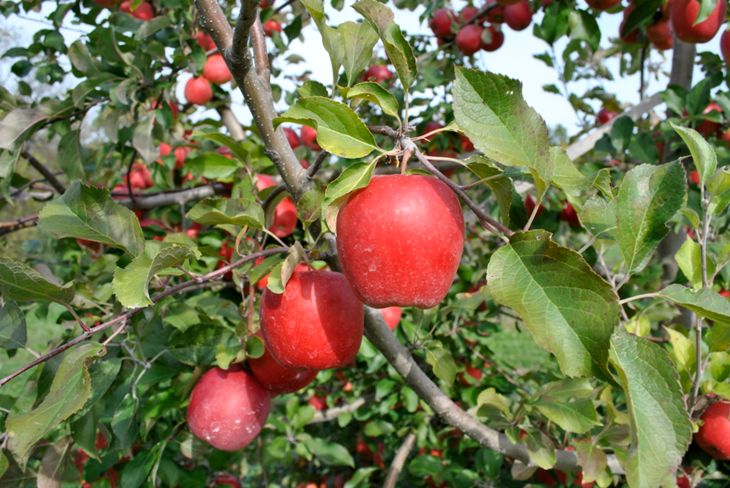
Stretched under apple-trees just after bathing,
Why did you not strangle me before speaking
Rather than fill me with the wild white honey of your words
And then leave me to the mercy
Of the forest bees.
Public Domain. Sources: Pictures of the Floating World (1919) and Carrefour (1920).
Amy Lowell, born on February 9, 1874 in Brookline, Massachusetts, was a poet, critic, and editor affiliated with the Imagist movement. Her books include What’s O’Clock (Houghton Mifflin Company, 1925), which posthumously won her the 1926 Pulitzer Prize for Poetry. She died on May 12, 1925. Lowell’s partner Ada Dwyer Russell was the subject of many of Lowell’s romantic poems, and Lowell wanted to dedicate her books to Russell, but Russell would not allow that, and relented only once for Lowell’s biography of John Keats, in which Lowell wrote, “To A.D.R., This, and all my books. A.L.” Examples of these love poems to Russell include A Decade, The Taxi, Absence, A Lady, In a Garden, Madonna of the Evening Flowers, Opal, and Aubade. Lowell admitted to John Livingston Lowes that Russell was the subject of her series of romantic poems titled “Two Speak Together”. Lowell’s poems about Russell have been called the most explicit and elegant lesbian love poetry during the time between the ancient Sappho and poets of the 1970s. Most of the private correspondence in the form of romantic letters between the two were destroyed by Russell at Lowell’s request, leaving much unknown about the details of their life together.
Discover more from Vox Populi
Subscribe to get the latest posts sent to your email.

I admire Amy Lowell’s eye for color, her celebration of color.
LikeLike
Lowell wrote a biography of John Keats, and the richness of his language informed her approach to imagism.
>
LikeLike
Chinese Poet Ma Yongbo has just completed translating nearly 140 poems from Amy Lowell’s four poetry collections, “A Dome of Many-Coloured Glass”, “Sword Blades and Poppy Seed”,”Men, Women and Ghosts”,”Pictures of the Floating World” as a forthcoming publication by People’s Literature Publishing House, China. As we have been working closely together, Ma Yongbo introduced me to Amy Lowell and on reading her, I feel we have a lot in common; like being greeted by a friend who shares the same view of the world.
LikeLike
Thank you, Helen. I admire Yongbo’s translations into English on which you have collaborated, but his main work is translating the American canon into Mandarin. What a way to honor our culture and inspire mutual respect between China and the US.
>
LikeLike
Thank you so very much Michael for your support for poetry in translation and for acknowledging world poetry. I am honouring him by reading the poetry of Ma Yongbo in Cambridge this evening.
LikeLike
Your reading session may have already started by now. I am very happy that you can read a few of my poems, and thank you for your selfless help in the English translation!
LikeLiked by 1 person
I read 14 poems from our recent collection of response poems and these were received very well, including your own English translations. I read for 28 minutes and after my reading ended many people came up to congratulate me on our close working. It was very moving and last evening will stay with me as a particularly memorable one as we have both worked very hard this past year to appreciate each other’s poetry and our response songs represent a true and sincere meeting of poetic minds. Our response poems written to each other at the Mid-Autumn, Chinese festival of the full moon, on the 17th September 2024, initiated by me as a celebration of your completion of a 650 line Amy Lowell long poem, at 5:15 am on that same morning were rapturously received, the audience bursting into sudden applause before my set was even completed.
LikeLiked by 1 person
Very beautiful, Helen and Yongbo. Congratulations on your brilliant collaboration!
>
LikeLiked by 2 people
Thank you very much. Ma Yongbo is crucially and very patiently my mentor in my efforts in translation. And his encouragement with all things poetic has increased my confidence as a writer too. The dynamics of our close working are crucially positive for me right now. He is a brilliant poet but far too humble with it. Back in February, here on Vox Populi was where it all started. Credit is due to Deborah Bogen and to you Michael for raising the long overdue awareness for Ma Yongbo’s poetry outside mainland China.
LikeLike
Well-said, Helen. Thank you.
>
LikeLiked by 1 person
I want to thank you so very much Michael for your support for poetry in translation and for acknowledging world poetry. I am honouring him by reading the poetry of Ma Yongbo in Cambridge this evening.
LikeLike
At Cambridge? My my… very impressive. Break a leg!
M
>
LikeLiked by 1 person
Thank you Michael
LikeLiked by 1 person
Michael, thank you for your support. I think that starting next year, I will stop translating classic poems and shift my energy to translating the poems of my American poet friends. Even without me, those classic poems still have no shortage of translators. I should do more for my friends.
LikeLike
You are a hero of poetry, Yongbo!
>
LikeLiked by 1 person
I am lucky to have the opportunity to re-translate the old translation more than 20 years ago. My energy is not as good as before, so I plan to reduce the translation workload next year and spend more energy on my own English poems.
LikeLike
Just WOW! Will have to share those.
“Why did you not strangle me before speaking
Rather than fill me with the wild white honey of your words
And then leave me to the mercy
Of the forest bees.”
LikeLiked by 1 person
I’ve loved Lowell’s poems for a long time. Appreciated in her time, but fallen out of favor in recent generations because, I suppose, she didn’t fit into the role of a Modernist poet. Pity.
>
LikeLike
I love Carrefore the most; the sweet honey and the stinging bees reminiscent of the violence involved in breaking a lover’s heart. So elegantly put.
LikeLiked by 3 people
Thanks, Matt. I love this poem as well. Since Lowell, used it as the title poem of one of her collections, I assume it was one of her favorites as well.
>
LikeLiked by 3 people
What a way to start the day!
LikeLiked by 3 people
Wasn’t she great? Much under-appreciated, in my opinion.
>
LikeLiked by 1 person
“Autumn” is exquisite. Thank you.
LikeLiked by 4 people
yes, it is. Lowell’s reputation was harmed by Pound and his followers who wanted to take modernism in a different direction. Pity. Lowell was the better poet.
LikeLiked by 5 people
And for a long time her family descendent, Robert Lowell, also stole her centrality. Reading his famous poem, Skunk Hour, after reading her bouquet of poems here is almost shocking in its example of where poetry went from Lowell to Lowell by the 1960s. Thanks again for reviving her, and the style she employed.
LikeLike
Thank you for carrying this erotic quartet of poems to us. Lowell’s passion sings on. All the colors, the veilings and unveilings of love. But much more. Bee balm for our spirits.
LikeLiked by 4 people
Well-said, Jim.
LikeLiked by 3 people