
Vox Populi
A curated webspace for Poetry, Politics, and Nature with over 6,000,000 visitors since 2014 and over 9,000 archived posts.
Richard Krawiec: The Eyes of Hiroshima
I’ve come to wonder if my life hasn’t been conditioned more by Hiroshima than I’ve ever realized.
My father was a sailor in the first group of ships to land in Hiroshima after the atomic bombs were dropped in WWII. He rarely spoke about what he saw, denied seeing evidence of widespread death and destruction. If asked, he’d claim there were buildings still standing, the city empty, and deflect the conversation to another topic.
It took him 75 years, when he was on his death bed, before he was able to admit he saw the skeletons of people and animals, the sand burned to a hard, crystalline black, like onyx. The most disturbing memory he had of all was of finding, in a small devastated village outside the city, one house with its windows and door blown out but still standing; in the back room, four radiation-seared human beings huddled beneath a sheet in one bed, giving each other comfort.
Seeing them, he realized he’d been lied to. “If they could give comfort to each other like that, they couldn’t be the monsters we’d been told.”
It was that image of burned people huddled together for comfort, not the mushroom cloud, that he carried heavy inside for most of a century. For the entire rest of his life He did not experience the explosion, absorb radiation like the downwinders. But he was damaged just the same, and he bore that damage as he tried to move forward as a husband and father. The trauma of that experience is what made him the man he was, and wasn’t.
How did that affect me? I have no way of knowing. Was that why I found him distant? Was he inflicted by an immobilizing trauma that I mistook for rejection all my life?
After he died, I read his journal from the war years. The messages at the end grew increasingly fragmented and cryptic. Sometimes one line per day. Messages he apparently sent from signal flag codes.
I’m in distress.
I cannot save my vessel.
I’m sinking.
***
This past year I visited Japan with my son. We spent a few days in Hiroshima. Maybe it was my own projection, but it felt like the city was steeped in a deep sorrow and also held a belief that peace was the only way forward. There was a sense of commitment to it as the only way to live.
One early morning we visited the last remains of the Hiroshima Prefectural Industrial Promotion Hall, the epicenter where the bomb hit, which left the dome skeletalized but relatively intact. They kept that, the A-bomb Dome, as a permanently preserved ruin; a memorial for the 140,000 people killed by that one bomb; a reminder of the destructive power humans unleash on one another in war.
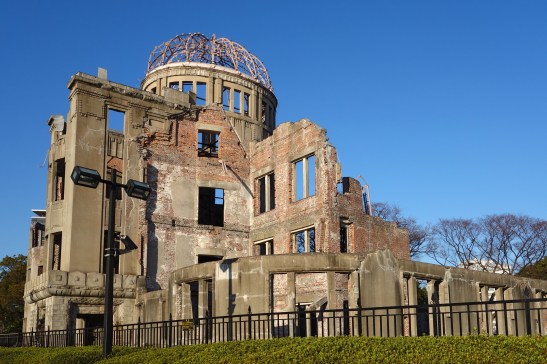
I slowly circled the ruins as the sun rose through it. Watched people come and pause, offer a prayer, leave a bottle of water for the dead. I felt a this necessary attraction, a need to be there. One more unseen and distant emotional downwinder caught in the ripples of destruction that circled out through time. I saw the sun rise above the river, and I walked across Hiroshima Peace memorial Park, which even early was full of hundreds of students, waiting in groups to visit the museum.
I paused at the concrete saddle that protected the cenotaph which contained the names of those who had been killed by the bomb. Passed walls of streamers formed by strands of origami cranes which struck me as an agreement to hope. The peace bell stood alone in its tower, no one around, and I thought to ring it.
But I didn’t. I didn’t know if it was allowed. I didn’t know if I should. I didn’t know if it would be hope. Or a lie. Or just an indulgence by an American tourist.
***
Recently I visited the Georgia Museum of Art to see Kei Ito’s Staring at the Face of the Sun.
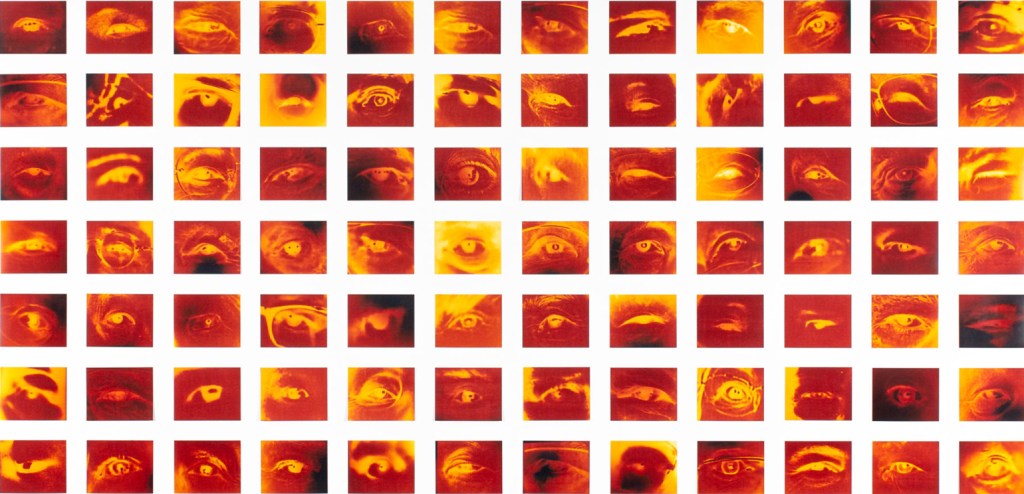
Initially I was confused. Slides hovered over 108 bricks spaced apart on the gallery floor. The next room – grainy footage of early nuclear tests streamed to a soundtrack of ominous bass electronica. It wasn’t until I reached the final room, whose walls covered with printed images from the slides blown up and hung inside black frames that were grainy and charred looking, that I felt overwhelmed. They were photos of eyes that witnessed the atomic flash at Hiroshima, or the downwind drift of nuclear particles.
The images were spaced in 27 rows stacked 4 high on gray walls. An incendiary display of yellows and oranges. Eyes, pupils, snatches of faces.

Lean close and the pupils seemed to reveal the faces, the souls of the people trapped in that moment. The ghost of a terrified child. Tumbled visage of incomprehension. A last smile caught unawares by the boom and brilliant explosion. An agony. A terror. A horror. A skull. Mouths wide as if to breathe back what has been lost, what can never be explained or understood –
Why we hate each other so much we could do this.
Why we can’t learn to stop hating.
Why it still goes on.
Text and compilation copyright 2024 Richard Krawiec
Richard Krawiec is an award-winning writer in both the U.S. and France. His French novels, Paria, Vulnerables, and Dandy, were published by Tusitala Editions, in paperback by 10/18 Univers Poche and Points Press. Krawiec is also the founder of Jacar Press, a Community Active Press that supports progressive groups and individuals. Jacar publishes a diverse assortment of poetry books and also runs an internationally-focused online magazine, One.
Discover more from Vox Populi
Subscribe to get the latest posts sent to your email.

A hauntingly beautiful article.
LikeLike
This essay shows us how, if we are to learn anything from history, we must first see it as personal: lived and felt by persons, witnessed by persons, narrated by persons. Krawiec starts with the story of his father and the father’s dreadful knowledge. But he doesn’t stop there. He goes to see Hiroshima, with his own son. And in a third part of his quest, he goes to see an art exhibit, of the eyes of Hiroshima.
LikeLiked by 1 person
Effective summary, Maura. Thank you.
>
LikeLiked by 1 person
Here is my apropos haiku which appeared on VoxPopuliSphere.com on August 6, 2020. https://voxpopulisphere.com/2020/08/06/donald-krieger-hiroshima-haiku/
leaf-clad stone ramparts
phoenix trees at rivers fork
deciduous souls
Here is a short piece written this morning in memory of Hiroshima.
79 years ago on August 6, 1945, Japan lay powerless to defend herself or do harm to others. The Soviet Union Army had occupied much of China, all of Korea, Sakhalin Island and the Kiris, Those islands had been disputed since losing them to Japan 40 years before. On that day in 1945, Russia stood poised to invade Japan.
.
At 9:16 AM, the United Stated detonated a nuclear weapon 2000 feet directly over Hiroshima’s Shima Hospital, killing 80,000 instantly and dooming 200,000 more. The Soviet Union’s aggression was checked and America’s stated reason for obliterating a civilian city, to pacify Japan and thereby save the American lives which would have been spent in an invasion, held sway then and still does.
.
Today, the United Stated and Russia are facing off in Europe with nuclear weapons again, this time over the war between Russia and Ukraine. Both nations claim to be righteous. Each has proudly detonated hundreds of nuclear weapons to demonstrate their ability to destroy their enemies. Neither attaches the label: “terrorist” to the other or to themself, yet they and so many others in the world readily do to weak nations like Iran and North Korea and to still weaker criminal organizations.
LikeLiked by 1 person
Thanks, Don.
>
LikeLiked by 1 person
Thanks for this important reflection at a time when the world is at a tipping point in so many ways.
LikeLiked by 2 people
Yes. Thanks, Robbi.
>
LikeLiked by 1 person
Today is the happy birthday of death, as Gregory Corso calls the anniversary of the attack on Hiroshima.
LikeLiked by 1 person
We must never forget that as our nation sounds alarm cries over the alleged warlike aims of other nations (Israel, of course, excepted) and the nuclear aspirations of some nations, that our nation is the ONLY nation that has ever unleashed such devastation on a people, mostly civilians. And despite the horror of the first, we came back and did it again.
LikeLiked by 3 people
Exactly. There is a lot of talk about the threat to civilization posed by terrorism, and yet our own country’s terrorism is rarely questioned.
>
LikeLiked by 1 person
Thankyou for posting this.
It is always time to review these things, and affix the to our sense of cultural selves. We are, to a man, a hideous, worded creature.
Heaven help us all.
LikeLiked by 2 people
Amen
LikeLiked by 1 person
Powerfully written. Thank you. And of course the final questions bear the burden and yet have no answers. Of course. Reminded of a question the great science fiction author, Theodore Sturgeon, posed over and over, saying “Ask The Next Question,” when interviewed about a pendant he wore, (the letter Q with an arrow piercing it.) He claimed that the symbol represented the only forward movement of our universe: to ask the next question.
LikeLiked by 2 people
A wise and beautiful response to the perplexity of our existence. Thank you, Margo.
LikeLiked by 1 person