
Vox Populi
A curated webspace for Poetry, Politics, and Nature with over 6,000,000 visitors since 2014 and over 9,000 archived posts.
Angele Ellis: “I lived in the dark” | In Grace Notes, Naomi Shihab Nye finds the music in poems about families and the incidents and accidents of personal history
Grace Notes: Poems About Families by Naomi Shihab Nye. Greenwillow Books (an imprint of Harper Collins Publishers), 2024.
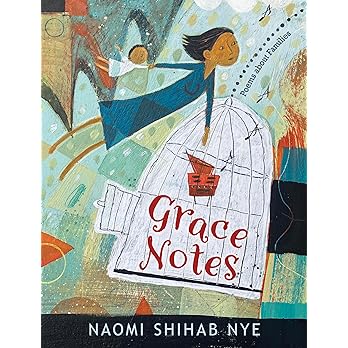
All poetry begins in song, as Naomi Shihab Nye reminds the reader, starting with the title of her latest collection, 117 mostly brief free verse poems that like songs, are both accessible and mysterious. A grace note is defined as a musical note—or any addition—that although not essential, makes a work more beautiful.
Shihab Nye is arguably the most prolific and best known contemporary Arab American poet, as well as Poetry Foundation’s Youth Poet Laureate from 2019 to 2022. Grace Notes is pitched to a broad audience—one might introduce this book to any reader from age 11 to age 91. “Poetry cares,” Shihab Nye stated in a recent interview with Porter House Review <https://porterhousereview.org/articles/an-interview-with-naomi-shihab-nye/>, in response to a question about the difference between poetry and media such as journalism. “Poetry tries to sing the quiet, subtle stories. Poetry cherishes and protects details. Poetry listens to the ones who are not in the headlines.”
Grace Notes is dedicated to Shihab Nye’s mother, Miriam Naomi Allwardt Shihab (1927-2021), an artist and teacher of German American heritage. Many of the poems throughout this book rise and fall like scales in their exploration of this mother-daughter relationship. Accessible is not synonymous with simple. Shihab Nye uses a voice that captures a child’s restless questionings, her intense and unmet needs, along with an adult’s tenderness, wry humor, and regret.
In this book’s longest poem, the ironically titled “Freedom,” the child of a generation allowed to walk alone to and from school and spend days riding bikes without adult supervision also is hiding the “bad secret” of her mother’s chronic depression and her own frantic caregiving:
…My mom trusted us.
I’m not sure she trusted herself.
Each day I walked so fast
down the Harvey hill
toward our little house
with green shutters after school.
Was she still alive?
This was the bad secret I carried.
She might not be.
You could never tell your friends.
Before I was born, my mama tried to die.
I had to check on her.
…
She never liked hanging up clothes.
They mounded in a chair,
piled like a story of previous days.
I would slide hangers
into the shoulders of Tuesday,
fold Wednesday’s sweater,
clip Thursday’s billowing skirt,
rescue crumpled Kleenexes
from every pants pocket…
Using statements punctuated by exclamation marks, the poet expresses anguished wonder at her mother’s retreat, particularly her decision to give up painting. She notes her mother’s stacked piles of canvases and the famous teachers (Max Beckmann, Philip Guston) who loved this gifted student. She recalls a poignant memory of her mother’s artist days:
…Once she had a painting in an exhibition
and hers was the only one
that got stolen. This seemed
like a compliment.
She moved to Brooklyn.
She lived in a basement.
I lived in the dark.
Another poem of childhood, “Beacon,” begins like Tolstoy: “Children who live in sad houses / hope to fix them.” School then becomes a refuge, a “relief,” a beacon to the fledgling poet:
…There might be a stage and you could stand on it.
Really? Corners of bookstores,
Basements of libraries, someone might come to listen.
Really? Someone believed you could.
The poem “Living in Jerusalem” (which, as often in Shihab Nye’s work, evokes the poet’s late father, immigrant Palestinian journalist Aziz Shihab), starts by dropping a shattering fact like a bombshell, and reminds the reader that a child has no choice but to live under fire:
After my parents divorced and remarried
within three months,
moving to Jerusalem, my father’s hometown,
didn’t seem that dramatic.
They never talked about this later.
So many things people never talk about!
Even the poet, whose job it is to talk about things, “To undo the folded lie” (as W.H. Auden wrote), is repeatedly astonished by the truth, and by the fact that the truth shifts and changes, particularly for a poet whose parent lives into extreme old age. In “Always Be,” the 94-year-old mother declares “When I leave here / maybe you can go with me” and elaborates:
…Like my neighbors did.
The daughter died
right after the mother.
Everyone shocked.
she hadn’t been ill.
…
What?
We’ll be together in heaven.
I don’t think she believes in heaven.
At least, she didn’t until yesterday.
She just wants me
to clean up after her,
what I did all my life…
And in “My Mom Serves Tea to Her Robbers,” a poem recounting how the elderly mother is swindled out of twelve thousand dollars by con men, the frustrated daughter shows how in the mother’s eyes, the episode becomes a romantic adventure:
…They were sitting at her kitchen table, smiling.
One was so handsome you wouldn’t believe.
…She felt cared for.
She was so happy they were going to save her
from the city of Dallas, which, till that day,
had always been her friend.
Since when are you scared of the city of Dallas, but not of three strange men?
Later, it was impossible to reason with her.
Yet despite everything (as the book’s title promises) a fraught relationship—as mother-daughter relationships often are—can provide indelible notes of grace. This reviewer chooses to end with “Generations,” a lovely poetic memory from “New Year’s Eve 2017:”
…My mom was watching TV
in the living room
eating apples, crackers, and cheese.
My grandson slept in a stroller
in a quiet back room.
I was related to both people,
ages ninety and one.
They were peaceful.
And that was it.
The most beautiful moment of my life.
~~~~
Angele Ellis is a Pittsburgh-based writer and editor and the author of four books, including Arab on Radar (Six Gallery), whose poems about her Arab American heritage earned a fellowship from the Pennsylvania Council on the Arts.
Copyright 2024 by Angele Ellis
Discover more from Vox Populi
Subscribe to get the latest posts sent to your email.

I just bought this book a few days ago and am always uplifted, intrigued, and moved by Naomi Shihab Nye. This book is such an open door into her life and sensibility.
LikeLike
Thank you, Joanne. I love Naomi’s writing too.
>
LikeLike
Naomi Shihab Nye’s work is powerful and moving. Must buy/read this book.
I was related to both people,
ages ninety and one.
They were peaceful.
And that was it.
The most beautiful moment of my life.
LikeLike
This review is beautiful and moving. How powerful Naomi’s excerpts are here, especially, “Before I was born, my mama tried to die.” It broke me open.
LikeLike
I didn’t know she had a new book. I will see if Better world Books has it. These few poems speak to me as child, mother, grandmother. ( identifying with the good and not so good). One of my favorite poets.
LikeLike
Thank you, thank you!
LikeLiked by 1 person
Hey Charles! It’s been a long while. Nice to hear from you! — M
>
LikeLike