
Vox Populi
A curated webspace for Poetry, Politics, and Nature with over 6,000,000 visitors since 2014 and over 9,000 archived posts.
Desne A. Crossley: O Rosie Girl
My mother had been gone seventeen years by then. It was the summer of 1967, and she and I were “home,” as she called Cincinnati. I was a Chicagoan like my father until last summer when the three of us stuffed our South Side black-middle class dreams into a moving van and headed for Palo Alto, California. There, at age twelve, I would learn what it is to be an outsider. A year later, on this visit, I could tell that my mother’s and my roots were still entwined with her family’s, deep in Ohio soil.
Mom and I were with her parents, spilling through the hall entrance into the kitchen. The kitchen walls were tiled in yellow halfway up and accented by a thin border of red and one of black. The ceiling was high. A porcelain hen and rooster perched on top of a tall white metal China cabinet beside the stove. My mother, grandfather, and I gathered at the tan formica dinette table by the kitchen window, long and wide as a door. Granddaddy sat on the right, close to Grandmama at the big sink, the back door just beyond her. Mom squeezed in at the table, on the left, her back to the pantry. She pressed her palms into the table, apprising each of us and smiling. I sat between them, facing the window that framed a slow, serene world plopped into the middle of a changing urban landscape. In the side yard, a big old tree waved its many arms before the sun, and leafy shadows bowed rhythmically across our table.
Beyond our cozy knot, neighborhood folk had rioted against racial injustice and lack of opportunity earlier that spring, just blocks from my grandparents’ and aunts’ house. Granddaddy had driven us by Montgomery Road and Gilbert Avenue, and we’d seen storefronts burnt out and scarred by vandalism. Window and door casings were fire-licked black. Like wounds, these openings gaped beneath plywood boards nailed up in a hurry. Some stores had homemade signs that read “Soul Brother Owned.” Businesses known to be black-owned were left unscathed. Those identified too late had soul brother signs scrawled frantically across the plywood. At 1622 Blair Avenue, in the tall, narrow house on the corner that my grandparents and Aunt Loodie now shared with Aunt Mary, we were snug and safe in the bright kitchen.
Like a soft little motor, Grandmama droned, “Hmmm, hmmm,” as she worked. Granddaddy leaned back in a plastic-padded metal chair with an old-fashioned pleated ruffle. He extended his arm to brush her hip with the back of his hand. He was proud of his woman—straight, imposing, and taller with her shoes on than he. She wore an apron over a shapeless flowered housedress, stockings rolled at the knee, and old-lady black leather lace-up shoes. He still called her his bride.
My grandmother energetically scrubbed and rinsed a chicken before seasoning it and filled the sink to wash dishes and pans as she cooked supper. Her way was to have the meal ready, and the pots and pans all washed at the same time—, clean as you go. She left her own story to her husband’s telling.
“Your grandmother’s father was the son of a ‘Scotch’-Irishman who owned and bred racehorses,” Granddaddy began in a voice roughened by years of smoking Lucky Strikes.
Nobody ever calls Grandmama’s father by name, I thought. It doesn’t matter?
“Rosie’s mother Martha was the colored pastry chef of that household, and he had the nerve to fall in love with her. Then he did the unforgivable—he married her!” Granddaddy boomed those last three words. “Your grandmother, Rosa Lee Hightower—my Rosie girl, my bride—was born to them on July 27, 1892, in Lexington, Kentucky.”
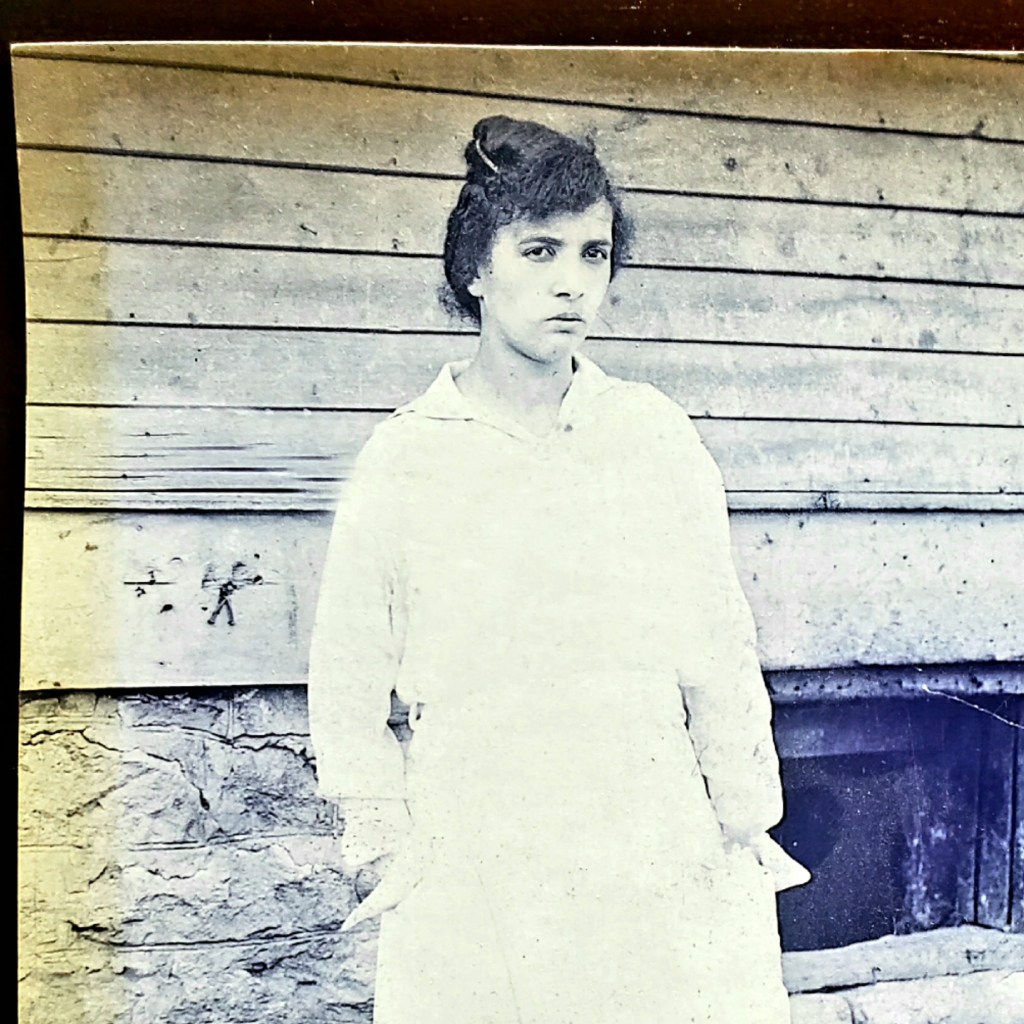
Mom jumped in as though she had a good bit part in a big play. “Mama’s father was rejected by family, cut out of his inheritance, and blocked from making a living. Breeding and racing horses was all he knew.”
My grandmother paused from cooking and dishwashing and turned to us. She rested her gnarled, white, water-wrinkled hands on the back of my grandfather’s chair, and he tipped his head back into her body. She leaned over him and squeezed his shoulder. “Labe,” she breathed into his hair. He was seventy-seven, and watching them, I noticed his hair was finally graying.
Facing me, Granddaddy continued, “When the Hightower family was young, they lived in a cramped little apartment in the colored section of town where there was no work for such a man as Rosie’s father. Whites, out of protest, refused to hire him, and the coloreds—well, of course they had no work to share. Your great-grandfather sat by the window looking out on a world that had discarded him.”
Mom said, “You know, Des, it was one thing for a white man to bed a black woman, but unthinkable that he would marry her. And it was commonplace for a black woman to be forced to open her legs to her employer or his sons. But Martha married white and returned home with the man! It was just too much. As far as her community was concerned, she threw her rebellion all up in their faces—every time she left her house. I can just hear her neighbors now: ‘She must really think she’s something—Mizz high-and-mighty-better-than-everybody-else. How dare she live like she does?’
“Mama’s father grieved himself to death while Martha took in laundry. She died young too. Thirty-five, thirty-six. She was a vain woman. Wore her corset laced so tightly it damaged her organs. Died of kidney failure.”
I watched the shadows bobbing on the table and wondered what could inspire such rebellion in my great-grandparents. I imagined Turner (that was his name, and I had to learn it on my own) as having been virile, vital, worth risking it all. I imagined Martha’s flaky pastries being irresistible—like Grandmama’s. Turner had been unable to restrain his delight. Maybe he bounded into the kitchen to compliment Martha, sunlight streaming in on her wondrous pies, sunlight a halo around her face and shoulders. The golden light and the cinnamon, bubbling fruit, and butter smells were too much. He grabbed her up in his arms. Music swelled.
At thirteen, I knew something about sex—just couldn’t imagine the nutszo-passion or the act itself. Like the belly of the whale in the Jonah story in the Bible, my mind was a huge dark cavern. I couldn’t picture what happened in the time between Turner and Martha getting carried away in the kitchen and Turner’s complete banishment from all he knew. So, I filled in that space with violins sawing madly, the kettledrum rolling, and bright cymbals crashing in the dark.
When I closed my eyes, I could see my great-grandfather’s well-dressed white family, a fierce, snarling pack of animals. The men—maybe six or seven brothers, uncles, and his father—closed in on him in the impeccable drawing room. His mother crumpled by the grand piano in a faint, and some old black servant in tails and white gloves hovered over her, nervous as a hummingbird, fanning her like crazy. The men, shouting epithets, drove Turner into the yard. His own father drew a pistol in warning.
“You’re no son of mine, you n***** lover! Get the hell out of my face and off this property and take your little n*****-bitch with you!”
Trumpets in my head blasted over the uneasy rumble of the kettledrum. Then my mind went dark as the cavern of the whale’s belly again before it jumped to Turner, depressed and unreachable, growing weaker by the day at the window. I never pictured the sad little apartment or any real lives happening inside. I imagined only the edge of his profile in thin light. He sat, his body in shadow, no longer a man, wondering how this fate could be his.
No wonder Grandmama never talked about her girlhood, I thought. Was she ever really a girl like me?
“After your great-grandfather died, Martha moved the family—Rosie was one of four children—to Cincinnati. And that’s how I met your grandmother,” Granddaddy smiled at me. His eyes twinkled, and he looked as though he had real memory of my grandmother’s life before they ever met.
I knew what was coming next—the part of her life old Rosie girl was willing to claim. I shifted in my seat to face him squarely.
“When they moved to Cincinnati, the Hightowers, of course, sought out the local colored church. Everything for us turned around the church in those days. Me? —I wasn’t the most God-fearing young man, but I’d seen Rosie and had to have a closer look. I came and knelt right by the aisle in prayer. I had my head all down so’s I’d look rev’rent,” Granddaddy smiled mischievously. “And I stole glances at her as she came floating down the aisle of Bethel Baptist in a white choir robe. Tall, skin like fresh cream, long black wavy hair twisted up in a coil at the back of her head, a far off look in her eyes. I had to pray more’n’a few Sundays—before I could look up from my clasped hands, touch the hem of her robe and whisper ‘Can I walk you home?’ at just the right time. I had never seen anybody like her.”
Mom leaned toward me and put her hand on my arm. “And Mama had never seen anybody like him—a little wiry black man, suited, for those days, like prosperous white people, in a carefully tailored jacket and kid leather dress shoes. But, then that’s about Papa’s growing up, Des, and we’re still talking about Mama.”
Granddaddy shot a sideways glance at Mom. Grandmama, known for what she left out of conversation, spoke at last: “Your grandfather and I would take long walks along the Ohio River with our friends. We had a perfect picnic spot called ‘N***** Hill.’ Picnic spots in Eden Park were claimed on a first-come-first-served basis—not on race, like most places in those days, with white getting best. At least a few of our friends perched around our spot early-enough every Sunday to reserve the park’s loveliest location, just for us.”
‘N***** Hill.’ When my grandmother said ‘n*****,’ her tongue danced over the word like she was skipping across heaven.
Granddaddy picked up the story again. “One day, Rosie made a picnic lunch for just the two of us. Neither of us spoke and time stretched. I couldn’t tell how things were going, and I was starting to get nervous. Finally, I had to say something, so I said, ‘Ain’t the gray-veye good,’ about the chicken gravy we were finishing off with bread. She smiled at me with her pretty black eyes, and I smiled back. Couldn’t even tell if the silence was a good or bad sign about our future happiness together. I just had to take it on faith, letting the quiet be awkward sometimes. After our lunch, we packed up to walk some more. I turned to my girl with my elbow offered and said, ‘Do you like chicken? —then grab a wing.’” He leaned back in his chair, slapping his round, hard belly with a chuckle.
“Your grandmother slipped her arm through mine, and that was all I needed. My courage was up. I took one deep breath then delivered my very best line: ‘How would you like to spin your wheel of conversation around my axle of understanding?’” Granddaddy roared at his own cleverness.
This was the line that won his bride. My grandfather’s story always jumped from that picnic to their married life, so I figured it was the equivalent of promising to cleave until death.
“They became husband and wife at the ages of seventeen and fifteen, respectively,” Mom said.
Grandmama had already told me once when we were alone together how young she and Granddad had been when they married, and I couldn’t believe it. Mom and Daddy would kill me if I did anything like that. Grandmama had said she and Granddaddy were adults in their community by the time they were twelve or thirteen. Both were responsible, had jobs, and were doing what they could expect to do for the rest of their lives. No college. No high school for any of her friends. They only dreamed of such privilege and knew not to waste good energy on an impossible flight of fancy like that. There wasn’t any more.
***
“Your grandmother would get this real worried, bloated look on her face when another baby was on the way. That look was all the explaining I needed; she didn’t have to say a word. Whenever I saw it, I knew I just had to work a little bit harder and take extra good care of her.
“She was sixteen and about to deliver our first child. Things got scary. Neither one of us had any experience. We didn’t know what to do. A blanket of snow covered everything. This was no night to be out, but I put Rosie into a horse-drawn wagon in the dead of night and drove her out to her father’s people in Kentucky. I was so frantic by the time we got there, I forgot my place and drove right up to the front of the house. Walked right up to the front door, to be sent back to the kitchen entrance where deliveries were made.” Granddaddy shook his head in pained memory.
I never learned his reason for not taking her to his own family, and at thirteen, I didn’t think to break into his storytelling and ask.
All this time, Grandmama had been preparing dinner, unobtrusively moving between the edge of the sink and the stove covered with steaming pots. The kitchen smelled rich—of perfect meat, cooked-down vegetables, and butter. She glanced at us, pulled out drinking glasses and the fat metal pitcher she used for iced tea, and, reaching around my grandfather, placed them on the table. She stepped to the refrigerator behind me for the ice tray then filled the pitcher with ice, tea, and lemon slices. She was perspiring and wiped her brow with the inside of her fleshy arm. From the tap, she flicked cold water on her face and dried it with a linen tea towel draped over the wall-mounted can opener.
Mom picked up where Granddaddy left off. “How dare he come to the front door?” she hissed, imitating the reaction of my grandmother’s white grandparents inside. “Papa thought an exception could be made for his pregnant wife, these people’s own blood. Papa swallowed his gall and moved Mama to the rear of the house. It was too late to turn back home across the river. Servants they’d never met led Mama away somewhere and helped to deliver the baby Dallas while Papa waited in the kitchen. Mama’s grandparents kept upstairs, their white lives as pure as they could manage.”
“I became a man that night,” Granddaddy said standing as he closed his story. “I was humiliated not knowing what to do. How could I take my Rosie on a long, dangerous ride to be treated like nothing by her own blood? What in the hell was I thinking…? It just hadn’t occurred to me they would refuse her at birthing time. I vowed that night never again to need any damn body’s help. It was up to me and nobody else. I just focused on reading the map of Rosie’s face. From now on it was just me and Rosie.”
Dinner was done. Grandmama turned off the stove without speaking. She looked satisfied. She switched her hips a little from side to side and fluttered her fingers behind her in a funny, bird-like motion—a good-bye to Mom and me, a come-hither to Granddad, who took two glasses of iced tea with him before following her out of the kitchen.
***
My mother loved to tell of the one time that my grandmother railed against my grandfather. She told it again, as we sat in the kitchen that afternoon. “Your grandmother was a hot mama—she was her husband’s lover first. But she was a mother too.
“One of your aunts—you know the one I mean—got pregnant without benefit of clergy, back in the ’30s, and your grandfather was about to die. Put his foot down about what he would not put up with. Ranting on and on about family shame. Well, Mama—bless her heart—guided him over to the fireplace and motioned for him to kneel with her there. She quietly stoked the embers of a hot fire until the poker glowed good and red. Poker raised to Papa’s face in warning, her eyes burning into his, she said in a low, deadly voice, ‘If you persist in putting what the neighbors might think before your family… if any blood-of-our-blood gets banished from this house… I will leave you this very day, but not before I make my point.’ She moved the poker close to his cheek and paused. ‘Do you fully understand me, Labe?’”
Despite the practical question—Where did a Depression mother of eight think she could go? —my grandfather actually believed his Rosie would leave him. The way Mom told it, Granddaddy immediately backed down and family harmony resumed. This aunt was the most beautiful daughter. She was a true floral artist, with a brain for business—a tireless worker, stubborn, but soft as rose petals. She was Granddaddy’s Pussycat, and, I thought, his favorite.
My aunt married her baby’s father in the nick of time, but he kept spending the food money on black lace lingerie for her. Their union didn’t last. In time, she would marry again, her former teacher.
That evening by the fireplace, Granddaddy had stomped all over Grandmama’s painful past. He made the dust of her history rise to choke them all. There had been hell to pay in the Hightower household. No, Grandmama would have no kin of hers separated from the clan. Her Labe must have realized this. But to me at thirteen, the poker story was a tale of Grandmama’s magic power. A tale of the triumph of true love.
I considered the story of the night I tried to sleep with my grandparents. Should I keep it to myself and give it more rehearsal, or just dive in? I wanted to learn to tell a story up to the standards of the family but had always been timid about it. When I had tried with the group all gathered for high entertainment, I couldn’t get the right rhythm. I had too many syllables and words that were out of place, or too few to give it flesh and bone. I was reaching for talent that just wasn’t there, and I needed to shut up. I longed for the party feeling I always felt in the story rhythms my mother and her family set. With my mother and me alone, I could give it another try, so I said, “I’ve got a story for you. My own story, not just Granddad’s and yours. Here I go.” I paused to settle myself with a deep breath. “I know she is Granddaddy’s bouquet, but she belongs to me too. I know because when I was very little, she let me hold her silver music box on the vanity. It played The Girl That I Marry over and over, more slowly each time until the song ran out. I loved to hear its tinkling melody in Grandmama’s and Granddaddy’s high-ceilinged bedroom and dream about lace valentines and devotion. I also know she belongs to me because she let me crawl in that time I begged to sleep with them. So I wouldn’t roll out, they placed me between them. Fine. I would have them all to myself for a whole night. As it turned out, one night with them was quite enough. Even in their sleep, their heads moved closer and closer together. There was no place for me to go but down. Down, down until my head was covered by the blankets. My fingers tangled in Grandmom’s nylon nightdress and the bed linens. I panicked. I tried to claw my way up her gown to the pillows and open air. My fright folded into dream, and I flailed and clawed my way up the icky-feeling nylon all night long. I spent the following day tired and grumpy. It was a big joke to everybody. Uncle Archie, your own baby brother, hooted, ‘That’ll be a lesson to you, Des. Never get in the way of those two lovebirds!’
“You had howled with the rest of them—Aunt Loodie, Uncle Archie, Daddy, and Grandmama and Granddaddy—until tears stood in your eyes.”
My mother nodded her approval of my storytelling, and I remember feeling happy enough to offer a second story. “Remember Grandmama’s 70th birthday reunion[i] and folks coming from everywhere for the celebration? Remember Uncle Jack’s and Aunt Bea’s? They have all those empty bedrooms, so they put up a lot of people from out of town, including us? Well, that Friday all the people were pouring in from everywhere, and Uncle Key came, too, with his new wife, Lil—I mean Aunt Lilly.” I had trouble putting “aunt” in front her name, and Mom now gave me a corrective look.
“Well, Mom, you could tell she didn’t like us. She kept twisting her face all up whenever our relatives would run up to each other hugging and kissing. Looked like a prune sucking lemons the whole time. I’m sorry, Mom, but she did, and it is part of the story. Well, anyway, she kept saying to Uncle Key and sometimes to nobody I could see, ‘You damned Shermans are always kissing!’ She’d say, ‘Would you look at these people think they’re special?’ And, ‘You Shermans think you’re so damned cute!’ She made it sound like it was a crime to be good looking and happy to see each other. Then somebody came up and kissed her, and she wiped the kiss off with the back of her hand. I’d never seen anybody grown up do that. I was standing right in front of her when she did it, but I don’t think she even noticed me. I wanted to say something to her, something like, ‘Sounds like a case of ugly to me,’ but, of course, I didn’t. Meanwhile, Uncle Key was looking like a copper-colored movie star and standing sort of nearby and sort of not… looking funny, like he didn’t want to be too close to her, even though he was supposed to be presenting his new wife to us. Lots of people hadn’t seen him in a long time, and they were hugging and kissing on him and laughing about life before he moved out to California and Hollywood. All that attention on him really made Lilly boil!
About that time, Grandmama came over and pulled me to a quiet dime of space near Uncle Jack’s fireplace. ‘What do you think of your new aunt?’ she asked me.
“‘I don’t know,’ I said, not knowing how to respond. ‘What do you think of her, Grandmama?’
“‘Well,’ she paused, ‘I’m a Christian woman…’ And I could tell her first impression of Lil—Aunt Lilly was not positive. We just looked at each other and giggled. And all through the celebration we’d remark again with just a wink.
“And that’s a story that lets me know Grandmama and I are real friends.”
There. I did it. At least I had stories to tell, if only I could get them out. I felt as though I’d been holding my breath. Mom clapped for me then patted my hand.
“Just one thing, Des,” Mom said. “Don’t be too hard on Lilly. People have been mean to her about her skin being so dark, and she has what you would call an ‘ugly complex.’ There’s always a reason people behave the way they do.”
I could see the sun sinking and the sky a deep postcard blue through the side yard tree. Everything looked flat, like cut-outs and stained glass. I thought of the riot blocks, where Granddaddy wouldn’t let me walk anymore. At this time of day, those streets would look mean and forsaken. Tomorrow, I would ask my mother to drive me by there again, and we could talk about what it meant. What the unrest exploding to the surface all across the country meant. What it would mean to return to our still-new house in unreal Palo Alto where no one knew who we were and dared not ask what we thought.
We heard footsteps coming closer. Grandmama had Granddaddy by the hand.
“Still talking about my bride?” Granddaddy pulled out the chair closest to the sink, like before.
My grandmother looked at us as though trying to hide a smile. She got the dishes down to set the table, humming again like a motor.
I got up to help. “Well, at least now I know you were a kid—maybe it was different then—but you were a kid like me, right?”
“Yeah, Babe, I was a kid, but an old one. The older I’ve gotten, the more fun I’ve had. Lucky for me your grandfather’s still full of play,” she winked.
I swung my arm around her and planted a kiss on her damp temple. If you left it to her to tell, you’d think she was born married and making kiss-me eyes at my grandfather, even in their old age.
Copyright 2024 Desne A. Crossley

Discover more from Vox Populi
Subscribe to get the latest posts sent to your email.

Wonderful. Made me one of the family.
LikeLike
I love hearing family legends!
>
LikeLike
Thank you, Rosemary. Glad you enjoyed it.
LikeLike
This! This is such a detailed, powerful, resonant telling of family lore set against a background of ugly, racialized reality that I am sure I will reread it and pass it along to others. I found my breath catching now and again and I yipped a little laugh out loud more than once. Just a fabulous piece of memoir. Brava!
LikeLike
Thanks, Richard. I agree.
LikeLike
What a superb, deeply touching, & fabulously told story!
LikeLike
indeed!
LikeLike
Thank you so much for your kind words, Laure-Anne. Glad you enjoyed it.
LikeLike