
Vox Populi
A curated webspace for Poetry, Politics, and Nature with over 20,000 daily subscribers and over 8,000 archived posts.
Max Graham: Food Forests Aren’t Just Nourishing. They’re Cool.
Trees and edible plants are being planted at churches, schools, street corners, and empty lots across the country to provide free shade and food to all.
.
Below the red-tile roofs of the Catalina Foothills, an affluent area on the north end of Tucson, Arizona, lies a blanket of desert green: spiky cacti, sword-shaped yucca leaves, and the spindly limbs of palo verde and mesquite trees. Head south into the city, and the vegetation thins. Trees are especially scarce on the south side of town, where shops, schools, and housing complexes sprawl across a land encrusted in concrete.
On hot summer days, you don’t just see but feel the difference. Tucson’s shadeless neighborhoods, which are predominantly low income and Latino, soak up the heat. They swelter at summer temperatures that eclipse the city average by 8 degrees Fahrenheit and the Catalina Foothills by 12 degrees. That disparity can be deadly in a city that experienced 40 straight days above 100 degrees last year—heat that’s sure to get worse with climate change.
The good news is there’s a simple way to cool things down: plant trees. “You’re easily 10 degrees cooler stepping under the shade of a tree,” said Brad Lancaster, an urban forester in Tucson. “It’s dramatically cooler.”
A movement is underway to populate the city’s street corners and vacant lots with groves of trees. Tucson’s city government, which has pledged to plant 1 million trees by 2030, recently got $5 million from the Biden administration to spur the effort—a portion of the $1 billion that the U.S. Forest Service committed last fall to urban and small-scale forestry projects across the United States, aiming to make communities more resilient to climate change and extreme heat.
But in Tucson and many other cities, tree-planting initiatives can tackle a lot more than scorching temperatures. What if Tucson’s million new trees—and the rest of the country’s—didn’t just keep sidewalks cool? What if they helped feed people, too?
That’s what Brandon Merchant hopes will happen on the shadeless south side of Tucson, a city where about one-fifth of the population lives more than a mile from a grocery store. He’s working on a project to plant velvet mesquite trees that thrive in the dry Sonoran Desert and have been used for centuries as a food source. The mesquite trees’ seed pods can be ground into a sweet, protein-rich flour used to make bread, cookies, and pancakes. Merchant, who works at the Community Food Bank of Southern Arizona, sees cultivating mesquite around the city and surrounding areas as an opportunity to ease both heat and hunger. The outcome could be a network of “food forests,” community spaces where volunteers tend fruit trees and other edible plants for neighbors to forage.
“Thinking about the root causes of hunger and the root causes of health issues, there are all these things that tie together: lack of green spaces, lack of biodiversity,” Merchant said. (The food bank received half a million dollars from the Biden administration through the Inflation Reduction Act.)
Merchant’s initiative fits into a national trend of combining forestry—and Forest Service funding—with efforts to feed people. Volunteers, school teachers, and urban farmers in cities across the country are planting fruit and nut trees, berry bushes, and other edible plants in public spaces to create shade, provide access to green space, and supply neighbors with free and healthy food. These food forests, forest gardens, and edible parks have sprouted up at churches, schools, empty lots, and street corners in numerous cities, including Boston, Philadelphia, Atlanta, Seattle, and Miami.
“It’s definitely growing in popularity,” said Cara Rockwell, who researches agroforestry and sustainable food systems at Florida International University. “Food security is one of the huge benefits.”
There are also numerous environmental benefits: Trees improve air quality, suck carbon from the atmosphere, and create habitat for wildlife, said Mikaela Schmitt-Harsh, an urban forestry expert at James Madison University in Virginia. “I think food forests are gaining popularity alongside other urban green space efforts, community gardens, green rooftops,” she added. “All of those efforts, I think, are moving us in a positive direction.”
Researchers say food forests are unlikely to produce enough food to feed everyone in need of it. But Schmitt-Harsh said they could help supplement diets, especially in neighborhoods that are far from grocery stores. “A lot has to go into the planning of where the food forest is, when the fruits are harvestable, and whether the harvestable fruits are equitably distributed.”
She pointed to the Philadelphia Orchard Project as an emblem of success. That nonprofit has partnered with schools, churches, public recreation centers, and urban farms to oversee some 68 community orchards across the city. Their network of orchards and food forests generated more than 11,000 pounds of fresh produce last year, according to Phil Forsyth, co-executive director of the nonprofit.
Some of the sites in Philadelphia have only three or four trees. Others have over 100, said Kim Jordan, the organization’s other executive director. “We’re doing a variety of fruit and nut trees, berry bushes and vines, pollinator plants, ground cover, perennial vegetables—a whole range of things,” Jordan said.
The community food bank in Tucson started its project in 2021, when it bought six shade huts to shelter saplings. Each hut can house dozens of baby trees, which are grown in bags and irrigated until they become sturdy enough to be planted in the ground. Over the past three years, Merchant has partnered with a high school, a community farm, and the Tohono O’odham tribal nation to nurse, plant, and maintain the trees. So far they’ve only put a few dozen saplings in the ground, and Merchant aims to ramp up efforts with a few hundred more plantings this year. His initial goal, which he described as “lofty and ambitious,” is to plant 20,000 trees by 2030.
The food bank is also organizing workshops on growing, pruning, and harvesting, as well as courses on cooking with mesquite flour. And they’ve hosted community events, where people bring seed pods to pound into flour—a process that requires a big hammer mill that isn’t easy to use on your own, Merchant said. Those events feature a mesquite-pancake cook-off, using the fresh flour.
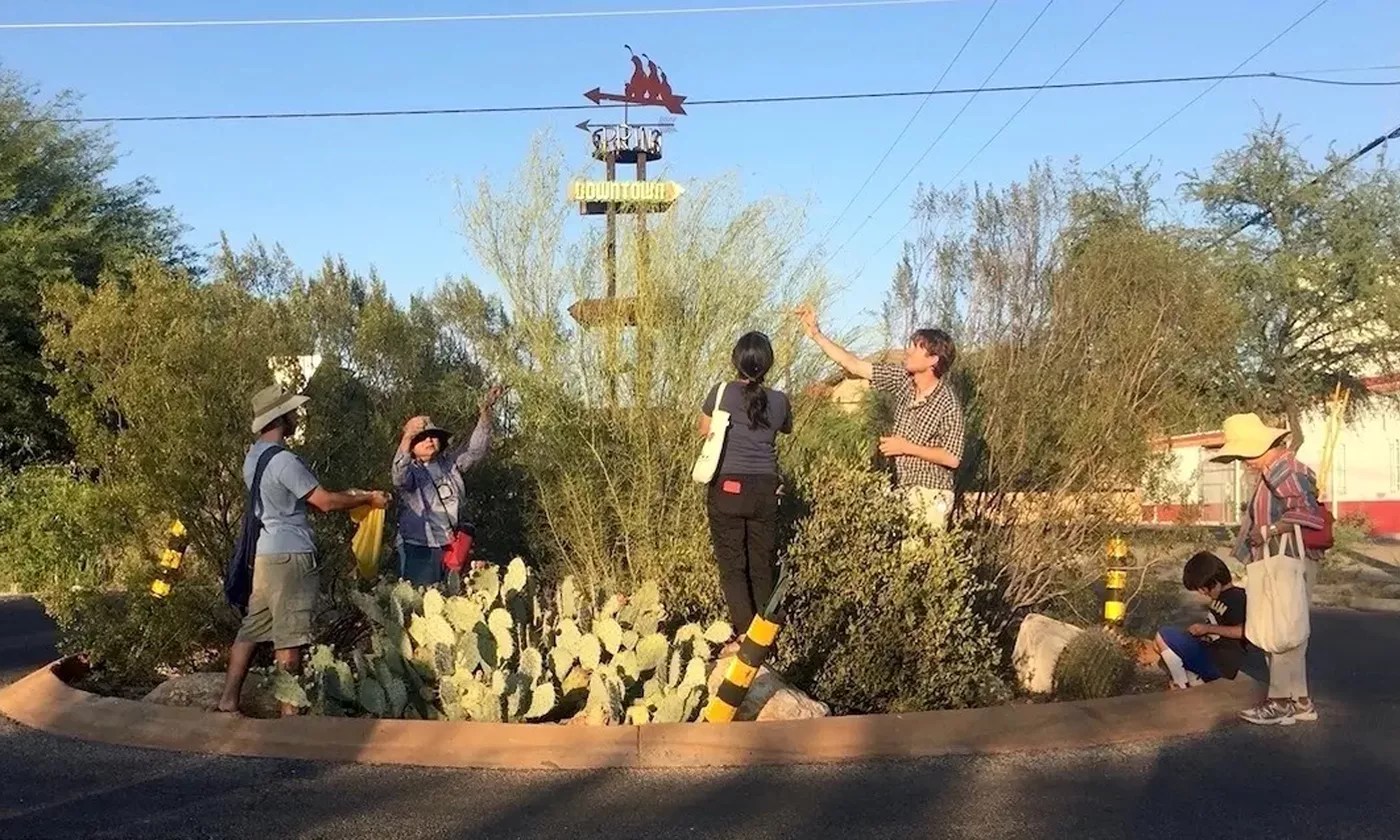
Merchant is drawing on a model of tree-planting that Lancaster, the urban forester, has been pioneering for 30 years in a downtown neighborhood called Dunbar Spring. That area was once as barren as much of southern Tucson, but a group of volunteers led by Lancaster—who started planting velvet mesquite and other native trees in 1996—has built up an impressive canopy. Over three decades, neighborhood foresters have transformed Dunbar Spring’s bald curbsides into lush forests of mesquite, hackberry, cholla and prickly pear cactus, and more—all plants that have edible parts.
“There are over 400 native food plants in the Sonoran Desert, so we tapped into that,” Lancaster said. “That’s what we focused our planting on.”
The Dunbar Spring food forest is now what Lancaster calls a “living pantry.” He told Grist that up to a quarter of the food he eats—and half of what he feeds his Nigerian dwarf goats—is harvested from plants in the neighborhood’s forest. “Those percentages could be much more if I were putting more time into the harvests.” The more than 1,700 trees and shrubs planted by Lancaster’s group have also stored a ton of water—a precious commodity in the Sonoran Desert—by slurping up an estimated 1 million gallons of rainwater that otherwise would have flowed off the pavement into storm drains.
Another well-established food forest skirts the Old West Church in Boston, where volunteers have spent a decade transforming a city lawn into a grove of apple, pear, and cherry trees hovering over vegetable, pollinator, and herb gardens. Their produce—ranging from tomatoes and eggplants to winter melons—gets donated to Women’s Lunch Place, a local shelter for women without permanent housing, according to Karen Spiller, a professor of sustainable food systems at the University of New Hampshire and a member of Old West Church who helps with the project.
“It’s open for harvest at any time,” Spiller said. “It’s not, ‘Leave a dollar and pick an apple.’ You can pick your apple and eat your apple.”
Merchant wants to apply the same ethic in Tucson: mesquite pods for all to pick—and free pancakes after a day staying cool in the shade.
MAX GRAHAM is a journalist in Alaska, and the former food and agriculture fellow at Grist. Max has reported on agriculture and oil development in rural Alaska; the Yukon River’s vanishing salmon; a microchip gold rush in Oregon; coal mining in Pennsylvania; and urban ‘food forests’ and community fridges across the United States.
This article originally appeared in Grist.
PHOTO BY BRAD LANCASTER/DUNBAR/SPRING NEIGHBORHOOD FORESTERS.
Discover more from Vox Populi
Subscribe to get the latest posts sent to your email.

This is great news. The mainstream media would never report this information. At this time the big corporations are the ones mostly in charge of feeding us, but their handling of our foods has resulted in our foods being left with less nutrients. The manufacturing of our foods and other products has resulted in the contamination of our air, our waters, and our soils. Our government is attempting to fix the problem, but they are not working fast enough to diminish the wrong. So that people getting together to plant trees for shade and for cleansing of the air, and planting plants that grow food, is extremely important at this time.
But spreading the news that this is being done, increases the awareness of the problem. It is a problem that needs as many people as possible to become involved.
LikeLike
Yes, a lot of food found in grocery stores tastes good, but is toxic.
>
LikeLike
Thank you, just wanted to say that my mother’s birthday was yesterday March 12, and she is now 97 years old. I believe she owes her health to becoming a vegetarian. She became more dedicated to being a vegetarian when she turned eighty, and it has paid off. Her mind is clear. She is able to call her bank to check on her account, and she is able to subtract and add, when planning to make purchases. She does take high blood pressure medications, but her blood pressure has remained steady for many years. She has not had any other heart problems.
Thanks to all the fine quality vegetables, such as dark green vegetables, red and orange vegetables, starchy vegetables, and legumes (beans and peas), all color fruits, grains, seeds, and plant proteins.
So, stay with it, it pays off.
LikeLike
Thanks, Luz. Good for your mother! I’ve been a vegan for 15 years, and it has changed my life, giving me good health and a clear conscience.
>
LikeLike
Is this Michael Simms? I know you are one of the administrators of Vox Populi, and that you have been a vegan for many years, so it must be Michael, but none the less not 100% certain.
But if it is Michael. Thank you, Michael. Stay with the vegan food plan, it pays off. I’ve heard it even positively nourishes one’s mood. Stay happy.
LikeLike
Yes, Luz. This is me, Michael Simms. I am the only editor and adminstrator of Vox Populi. I’ve been a vegan for 15 years, and the focused diet has saved my life and kept me happy. Thanks for your good wishes.
>
LikeLike
Wow, what a good idea. What a wonderful initiative!
LikeLike
Yes, planting fruit and nut trees and bushes are becoming a thing in American cities.
M.
>
LikeLike
And our neighborhood came with jacaranda trees in front, but I am growing a Toyon ( California native) next to it so when there is no longer water, he birds will have its berries and I will have the shade
LikeLike
Lovely.
>
LikeLiked by 1 person