
Vox Populi
A curated webspace for Poetry, Politics, and Nature with over 6,000,000 visitors since 2014 and over 9,000 archived posts.
Penny Rosenwasser: A Jewish American Says “Not in My Name!”
On my desktop is a photo of seven Palestinian babies at Al-Shifa Hospital, lying next to each other on a bed. Lacking fuel, nurses had moved 36 babies from their incubators and placed them together, so they could keep each other warm—and alive. I was a preemie myself; I’m here now because I had an incubator with fuel when I was born. When I look at the photo, I can’t breathe.
Today mothers in Gaza are writing children’s names on their small bodies, so that if they are killed, someone will know who they are. For others, relief workers use the initials WCNSF to indicate “Wounded Child, No Surviving Family.”
Rewind to July 1989: While watching a play about a Jewish nurse’s letter, written as she was caring for Palestinian children dying after the 1982 Sabra and Shatila refugee camps massacre—I broke down. Christian Phalangists had committed the murders, but Israeli soldiers allowed the Phalangists into the camps. Tears streaming, I wondered, How do I stretch myself enough to treasure my Jewishness, and also face the Israeli army’s inhumanity to Palestinians?
Months later I was traveling to Palestine/Israel, to witness the First Intifada and participate in an Israeli women’s peace conference. I stayed in Palestinian homes in villages and refugee camps in the West Bank and Gaza. I also lived in Jewish homes and marched for an end to the Occupation with Israeli women activists, many of them lesbians. That 1989 trip changed my life. I’ve now been back seven times, including as co-leader of four Middle East Children’s Alliance women’s peace delegations.
I’ve visited grieving Palestinian parents whose children were shot and killed by Israeli soldiers. In Rafah camp in Gaza, our host Ali showed us where 20 homes had just been demolished by Israeli bulldozers—an area the size of a football field—leaving 100 people without shelter overnight. In one home that was left standing, where the children’s bedroom wall bore fist-sized artillery holes from Israeli army shelling, I met Deeah. Two years old, he had bright brown eyes and was wearing pajamas with elephants on them. His mother told us that he was so frightened from the constant bombardment, he still didn’t speak. He cried most of the time.
In Gaza City, our host Ali introduced our group: “These are Jews, and they are standing with us for peace.” I saw scrawled on a Khan Younis camp wall: “If you destroy our houses, you will not destroy our souls.”
Afterward, I published an op-ed in the San Francisco Chronicle about my experiences. I received many heartwarming messages in response. There was one message, though, on my voicemail: “Have you ever heard of the Holocaust? Too bad they missed you.”
I am a white, queer Ashkenazi Jewish feminist, born four years to the day after the last death march left Auschwitz. One can’t talk about Palestine/Israel without talking about antisemitism—because it was the systematic slaughter, 78 years ago, of one-third of world Jewry that drove many terrified Jews to escape Europe to what we now call Palestine/Israel. Most other countries, including the United States, allowed very few Jewish refugees in.
Then, in 1948, it was armed Jewish militias who drove out 750,000 Palestinians, confiscating their land and homes, raping and killing some—known as the Nakba (“catastrophe”). This forcing people off their land, with no chance to return, was and is ethnic cleansing.
Israeli Jewish journalist Amira Hass, whose parents survived Auschwitz, said recently in an interview that “Palestinians in Gaza … who are under 30 years old have never seen a mountain in their lives. A mountain.” Because they have never been allowed to leave Gaza.
I’m honored to have been a founding national board member of Jewish Voice for Peace (JVP). JVP started in Berkeley in 1996, meeting in members’ living rooms; then, during the Second Intifada (2000–2005), a feisty band of Jews began building JVP’s organizational infrastructure. Through both turmoil and triumphs, in 2007 we boosted ourselves onto the national stage. JVP now has one million followers on Instagram and a growing newsletter list.
Organizing a grassroots, multiracial, intergenerational movement of U.S. Jews in solidarity with Palestine, today JVP is the largest progressive Jewish anti-Zionist organization worldwide. We also speak out against antisemitism. It is no more antisemitic to criticize Israeli government policies than it is anti-American to criticize U.S. policies. It would only be antisemitic if you were criticizing Jews as Jews.
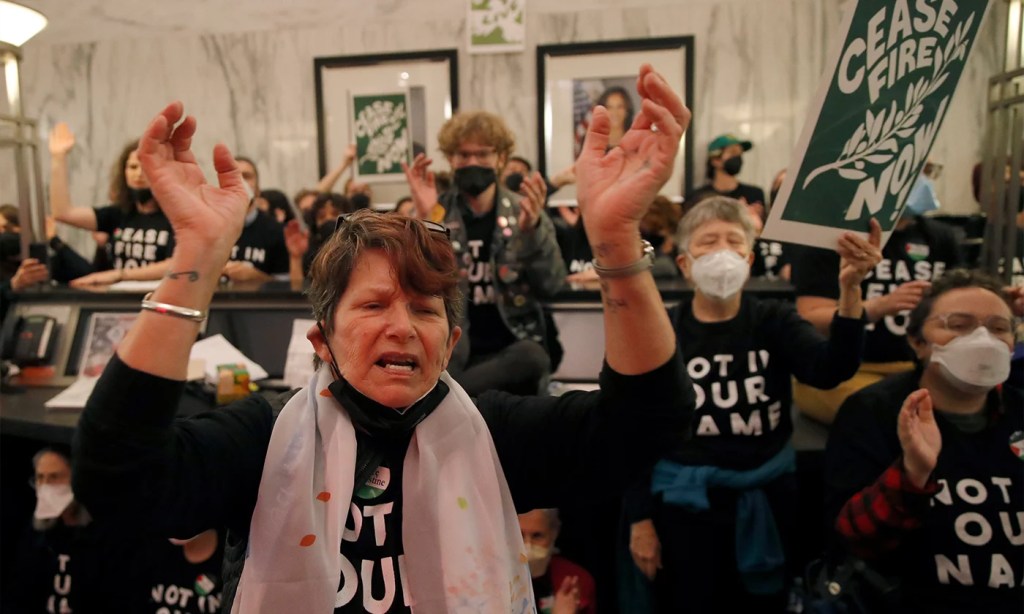
Since Oct. 7, JVP members have led or co-led the majority of the high-profile U.S. actions in solidarity with Gaza and in demanding a ceasefire: sit-ins at the Capitol Rotunda, Manhattan’s Grand Central Station, and the Statue of Liberty, and blocking White House entrances—plus actions in Oakland, California; Los Angeles; Chicago; Boston; Albuquerque, New Mexico; Seattle; on campuses; and more—a total of 70 actions to date. One day after JVP and IfNotNow activists shut down L.A.’s Hollywood Boulevard, the L.A. Times became the first major paper to call for a ceasefire.
Over 2,000 have been arrested, including rabbis. In Sacramento, California, JVP helped lead protests at the California Democratic Party Fall Endorsing Convention, placing 500 pairs of children’s shoes to represent Gazan children killed. Rabbi Jessica Rosenberg, from JVP’s Rabbinical Council, said, “When I see what is happening in Gaza, I think about what I wanted people to do for my ancestors … and that is what I’m called to do.”
I’m horrified that my hard-earned U.S. tax dollars are sent to the Israeli military, that the $3.8 billion in U.S. aid to Israel actually goes to U.S. weapons manufacturers. Along with all American taxpayers, I am directly implicated in the deaths of more than 6,000 children in Gaza.
Gazan aid worker Wafaa El-Derawi has related how “hundreds of people … [are] still under the rubble. … This is what could happen to us any moment.” In a report for the Middle East Children’s Alliance, where she is on staff, she said, “The psychological impact is unbearable. … Our brains cannot absorb it. … When we sleep we try to choose the places that might give us a chance to survive if the house is bombed. … We think about it all the time.” I try to imagine living like this; it feels unbearable. My culpability in this horror drives me to do all I can to end it.
On Nov. 13, I was among 700 Jews and allies, including rabbis, led by JVP and IfNotNow, who occupied Oakland’s Federal Building for seven hours. Our shirts read “Jews say Ceasefire Now!” and “Not in My Name”; and 472 of us were arrested in the largest protest of Jews in solidarity with Palestinians in California history.
As a song leader that day, I was pouring my grief and my outrage out of my body and into the songs, and hundreds were right there with me. Leading the Israeli anthem “Lo Yisa Goy”—“and everyone ’neath a vine and fig tree, shall live in peace and unafraid”—I felt the tears. I kept remembering those Palestinian babies trying to survive without an incubator. I wonder, with a Palestinian child being killed every 10 minutes, if all of our Jewish, Palestinian, and related actions could stop the genocide even one day or one hour earlier, how many lives could we save?
.
Palestinian American, Muslim, and interfaith groups, Rabbis for Ceasefire—also students, legislative aides, health workers, more—are blocking bridges and highways, staging die-ins and walkouts, interrupting legislators, and passing resolutions calling for apermanent ceasefire. To date, 50 members of Congress have called for a ceasefire. Relatives of hostages and victims, and 35 Israeli organizations are also demanding a ceasefire, despite intense repression inside Israel.
I ask us to hold several truths simultaneously, to let our hearts break for all of it. The war crimes committed by Hamas were a hideous, brutal massacre—and the revenge that the Israeli government is inflicting on Gaza is genocide.
I am a racial justice leader in my Oakland synagogue: Ethnic cleansing and genocide are not part of my Judaism. I am committed to a future where every Palestinian life and every Israeli life is seen as equally precious, a future where both peoples live in freedom, equality, and safety. This means ending the Israeli occupation of the West Bank, ending the siege of Gaza, and ending the system of apartheid, in which Palestinians are denied the rights given to Jewish Israelis.
I saw a heartbreaking story on television, of an Israeli Jewish mother desperately trying to learn if her daughter Adi, who was at the music festival that Hamas attacked, was being held captive or was dead. This mother asked, how could human beings do such a thing? Her pain went right to my heart. And it made me wonder, does she not know how IDF soldiers have killed innocent Palestinian children for decades?
Queer Jewish philosopher Judith Butler calls this the “grievability factor”: Whose suffering gets attention? Jewish author Anna Baltzer wrote: “My question is, if you were more shaken by the Israeli lives lost in one day than 75 years of killing … of Palestinians, why is that?”
I’m trying every day to keep my heart open—to hold on to my humanity. JVP knows that Palestinian safety and liberation, and Jewish safety and liberation, go hand in hand. Years ago, the youth wing of JVP wrote: “We refuse to knowingly oppress others. … We will not carry the legacy of terror. … We won’t buy the logic that slaughter means safety. … We commit to equality, solidarity, and integrity. … We seek breathing room and dignity for all people.” I feel this in my bones.
U.S. media and politicians keep framing this struggle with divisive rhetoric. But I keep remembering the words of my host Amal, in Deheisheh refugee camp in 2002—of the common thread connecting us as Jews, as Palestinians, as human beings. After pouring us tea, Amal looked up at me, saying, “We don’t want to push the Jews into the sea. All we want is food on the table, no Israeli soldiers in the street, a safe place for our children to play. A chance for them to have a future.”
| PENNY ROSENWASSER , Ph.D., is the author of the award-winning book Hope into Practice: Jewish Women Choosing Justice Despite Our Fears. A founding board member of Jewish Voice for Peace, she is a racial justice leader in her Oakland synagogue. Penny co-teaches an Anti-Arabism/Antisemitism class at City College of San Francisco with a Palestinian colleague; she chaired the Jewish Caucus of the National Women’s Studies Association, where she is also a member of Feminists for Justice in Palestine, and she is an advisory board member of the Center for Jewish Nonviolence. |
First published in YES! Magazine. Included in Vox Populi with permission.
Discover more from Vox Populi
Subscribe to get the latest posts sent to your email.

“I’m trying every day to keep my heart open—to hold on to my humanity.” ❤️💔
LikeLike
I admire Penny immensely.
>
LikeLike
“I ask us to hold several truths simultaneously, to let our hearts break for all of it. ” Shared
LikeLike
Thanks Barbara.
LikeLiked by 1 person
We all should know that a new bill has been introduced in Congress that would set up a Commission to Study Anti-Semitism and it would have the power to subpoena people (and deny them their 5th Amendment rights) who are deemed critical of Israel, etc. Should that pass, people like Penny would be subject to career loss, etc. simply for being anti-Zionist. This would be a complete re-incarnation of McCarthyism that ruined lives and careers in the early 1950s.
LikeLike
An attempt to censor speech is very dangerous. Fortunately, being retired and financially stable, I could withstand a censorious questioning, but many people are simply afraid to speak out. This is clearly an example of McCarthyism.
LikeLike
Probably far-right theatrics. In an op-ed about anti-semitism, Chuck Schumer clearly distinguished criticism of Israel from anti-semitism. https://www.nytimes.com/2023/11/29/opinion/chuck-schumer-jews-antisemitism.html
LikeLike
I understand why Arlene Weiner feels that way but, in fact, those bills are not coming from the far-right, but from very mainstream members of Congress playing to AIPAC. This is dangerous territory, when statements in support of Palestinian rights are automatically deemed anti-Semitic. In fact, the blanket use of the term devalues it and risks the proper and appropriate use of it being ignored. We have, in the last few days, witnessed Congress becoming outraged over the comments of some university presidents in a hearing about anti-Semitism in which they allegedly cited free speech rights when they were asked if it was permissible when student protestors called for the extermination of Jews on their campuses. But no member of Congress, nor the university presidents pointed out that such a demand for extermination was ever uttered by those protestors. It is simply AIPAC and the ADL insisting that demands for Palestinian rights and a permanent ceasefire should be automatically categorized as anti-Semitic. And while the furor continues over both real (appropriate) and alleged anti-Semitism, the slaughter of Palestinian civilian continues on a pace unlike anything seen on any population by any state in modern times.
LikeLike
So important. Shared!
LikeLike
Thanks for sharing, Rose Mary!
>
LikeLike
I’m sickened by the carnage in Gaza. But I’m also sickened by the accounts of the savagery of the attacks by Hamas on Oct. 7–which some of them documented proudly by wearing GoPro cameras. Among the murdered were people working for peace. And children.
LikeLike
Arlene, I agree. What Hamas did on Oct. 7 was horrible and indefensible. However, our tax money didn’t support it. My protests against Hamas and the IDF mean nothing to them, but my protests against the US providing arms to Israel, combined with the protests of millions of other Americans, might have an effect. I proudly stand as an ally of Jewish Voice for Peace, my representative to Congress Summer Lee, and other peace activists, trying to bring an end to the slaughter in Gaza.
LikeLike
Penny’s wonderful piece only points out, once again, that when try to avoid discussion of Palestine, they often say, “Well, it’s complicated.” When, in fact, it’s not. It is decades long occupation, ethnic cleansing, and disenfranchisement of a besieged people by an oppressor. And, although apparently the lessons of the Jewish resistance in the Warsaw Ghetto have been forgotten, oppression ALWAYS breeds resistance.
LikeLike
Thanks, Mel.
>
LikeLike
This is the clearest discussion of this I’ve read – a discussion of the current ‘war’ and its long and often brutal history. While there are many complicated pieces, Penny Rosenwasser gives us an absolutely correct perspective for ALL of us to come to. “. . . a future where every Palestinian and every Israeli life is seen as equally precious , , , where both people live in freedom, equality, and safety.” A future that holds no more horrific numbers of dying children (including innocent infants).
Bravo Penny Rosenwasser!
LikeLike
Thanks, Jacki. I admire Penny a great deal. As Professor Dumbledore says, “It takes courage to stand up to your enemies, and even more courage to stand up to your friends.”
>
LikeLike
Thank you Penny Rosenwasser for telling this story and doing this work. It must be told again, and again, and again.
LikeLike
Indeed, the story must be told.
>
LikeLike