
Vox Populi
A curated webspace for Poetry, Politics, and Nature with over 6,000,000 visitors since 2014 and over 9,000 archived posts.
Sandy Solomon: Diary from a Tomato Cannery, 1912
At the cannery a sign reads
“6 o’clock a.m. darn sharp.”
It’s hard to rise at five, harder still
to be at work twelve hours or more
with just a half hour off for lunch.
Tomatoes come in wagons or sail boats.
They’re stacked in the yard or on the wharf.
Then they’re trundled in on trucks.
Then they’re scalded.
Then they’re peeled.
Then they’re packed.
Then they’re weighed.
The factory is large and low,
and has no windows,
no seats of any kind for anyone.
Sixty-four skinners stand
at long tables. They stand over
the scalded tomatoes. They work in slop
and slush all day. Their feet are soaked,
and, despite their aprons, their clothes are wet
through.
They earn four cents a bucket.
Today they struck for five.
Tomatoes covered the table
as the boss considered their demand.
It took him twenty minutes to agree.
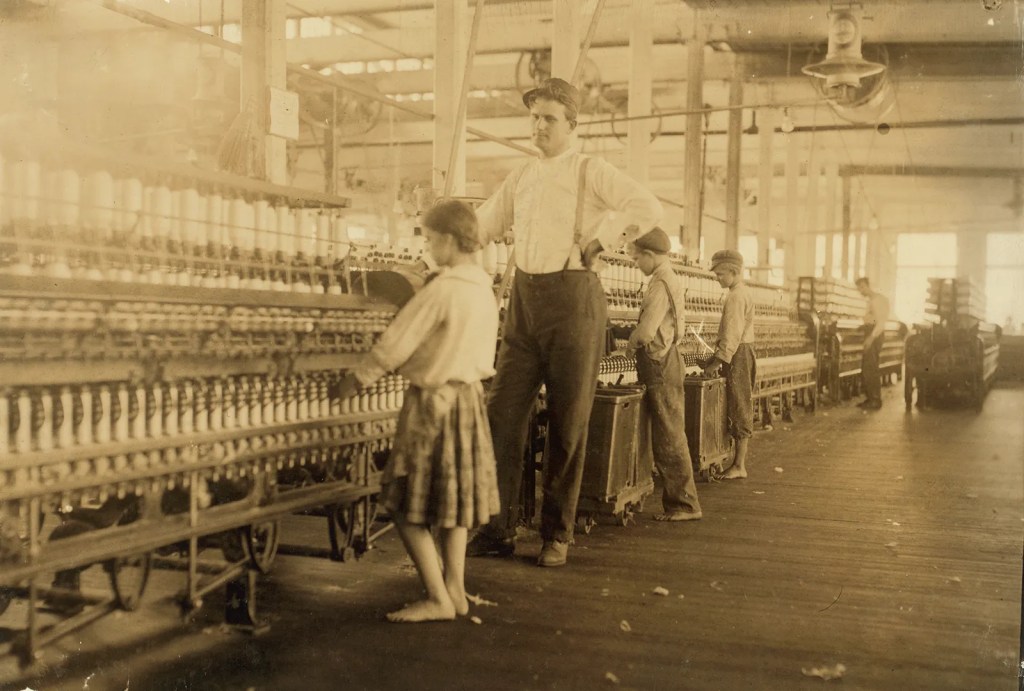
Of the twenty-five children in our factory
most are under twelve years old,
some no more than six or seven.
Many women bring their young ones
to work beside them. A mother helped
by two children can sometimes make
as much as five dollars in a day.
I walked part way home with a girl of ten
who’d peeled tomatoes from 6 am
to 6:30 in the evening.
“Things to eat is so high,” she said.
“We can’t go to school. We gotter work.”
The young ones strain
to carry buckets
brimming with tomatoes.
Such effort in their little faces!
Each bucket weighs
as much as forty pounds.
One girl of ten, so small we call her Tiny,
carried all day and skinned between times.
She ran a nail in her foot and limped about
with one shoe, one stocking off.
The wages are too low to stop work
for less than the most serious reason.
I was moved to another table today
where the sides are shallower,
and I got so wet through!
I’m dead tired, and my shoulder aches
like a bad tooth. I am dead tired,
and these are the conditions in which we work.
~
After a journal excerpted in Revelations: Diaries of Women; Mary Jane Moffat and Charlotte Painter, editors; Vintage 1975
Copyright 2023 Sandy Solomon. Previously published in Prairie Schooner and in a special issue on Work. Included in Vox Populi by permission of Sandy Solomon.
Sandy Solomon‘s poems have appeared in The New Yorker, The New Republic, The Threepenny Review, The Gettysburg Review, Partisan Review, and Ploughshares. Her book, Pears, Lake, Sun , won the Agnes Lynch Starrett Award from the University of Pittsburgh Press.
Discover more from Vox Populi
Subscribe to get the latest posts sent to your email.

Not just in the US. In Britain too. Abhorrent. And in the US child labour is alive and kicking. Appalling.
LikeLike
In coldly capitalistic analysis, there is a surplus of poor children, so their work can be utilized cheaply. This is exactly why the laws against child labor should be more strictly enforced.
M.
>
LikeLike
Sadly, the union movement won’t be able to reach its full potential on behalf of working people till the Taft-Hartley Act is repealed and states can no longer declare themselves “right-to-work.”
LikeLike
exactly. Thanks, John.
LikeLike
The decline in unions paralleled the rise of the ultra rich with bosses/owners making a much greater multiple of the workers’ pay. I’m glad to see unions rising again but fear they will be squashed.
LikeLike
Thanks, Barbara. Yes, the decline of unions parallels the rise of the super wealthy. Americans have produced enormous wealth in recent generations, but workers have not benefited.
>
LikeLiked by 1 person
And how were many of these conditions ended? Workers formed unions, took job actions, interrupted the flow of profits, often at critical times in production. Anyone who thinks there is another way other than workers acting collectively, is living in an alternative reality or has a “comfortable” job with very decent wages far removed from the daily life of most workers. And if you think, “Well, but that was the past, that doesn’t happen anymore.”, you should read this article from the NYT about farmworkers toiling well past normal retirement age to feed us who then receive no benefits except the “right” to work until death. https://www.nytimes.com/2023/12/05/us/aging-undocumented-farmworkers.html
LikeLiked by 1 person
I agree completely, Mel. Workers in fast food, agriculture, meat processing and other industries are abused terribly. Universities, those bastions of political correctness, are among the worst offenders with the exploitation of adjuncts, interns, and grad students, as well as cafeteria workers, groundskeepers and cleaning staff. Unions are the only salvation for workers.
>
LikeLiked by 2 people
Agree and some union drives are beginning to take that on.
LikeLiked by 1 person