
Vox Populi
A curated webspace for Poetry, Politics, and Nature with over 6,000,000 visitors since 2014 and over 9,000 archived posts.
Baron Wormser: Five Easy Pieces
It’s natural when one grows old to ask what one has lived through, as in: What happened? Having asked that question, another one immediately pops up: What lens does one look through? It could be the lens of progress, both social and material, which will provide a very different view from the lens of nationalist wars and environmental degradation. Of course, both lenses pertain, while sorting them out pertains to one’s mental health on any given day. Another lens, however, can be a work of art that originates from the beginning, as it were, of one’s adult life. Such a lens forcibly struck me recently in the form of a movie released in 1970 when I was twenty-two. The movie was Five Easy Pieces.
To say the movie was not a typically upbeat Hollywood movie would be to err on the side of understatement. The movie is an utter downer, wrenchingly uncompromising, as it tells the tale of Bobby Dupea, a man running from everyone and, most of all, running from himself. As played by Jack Nicholson, Bobby is suffering from a severe lack of feeling. A talented musician as a youth, he has lost the feeling not just for music but for life. He indulges in sex and alcohol and toys with a woman, a waitress brilliantly played by Karen Black, and tries to connect with another woman, but it is all a burlesque, a sad parody of vitality. Rayette, the waitress Bobby lives with, calls him the “moodiest man” she has ever known. That’s a fair description but it only scratches the unhappy surface.
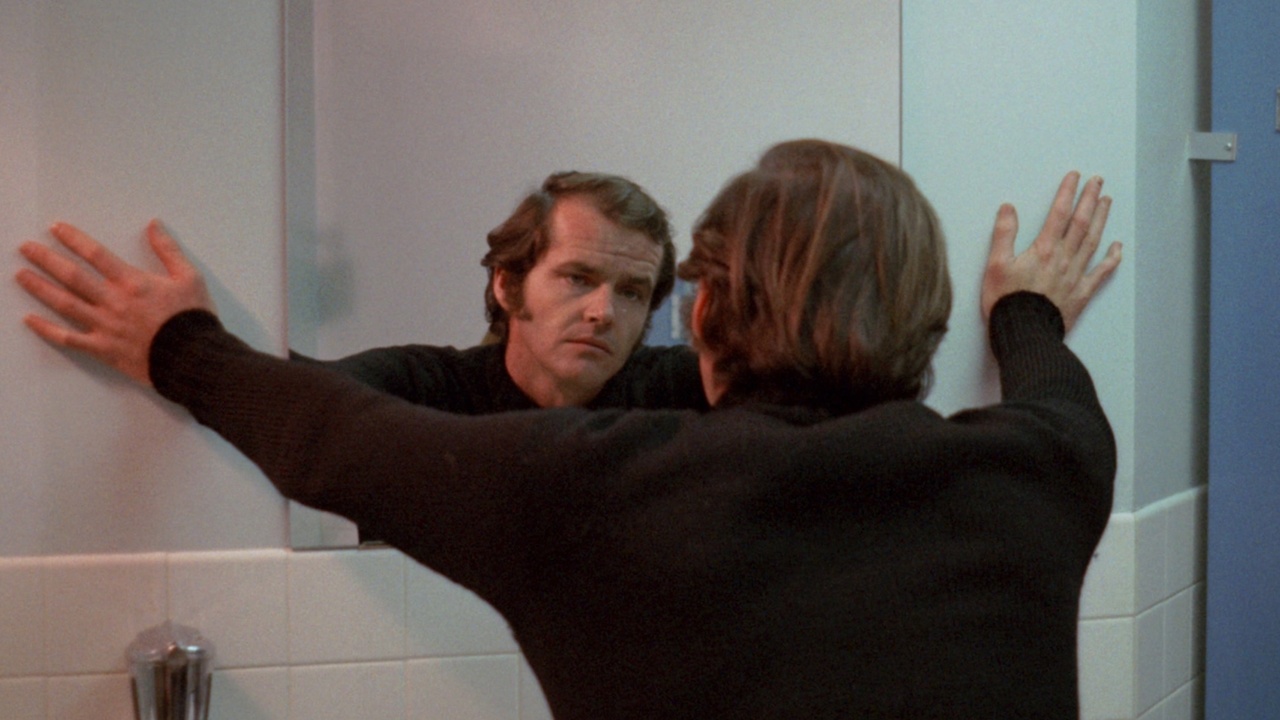
We are made to understand that Bobby’s father, whom he visits in the course of the movie and who has had two strokes, has been emotionally remote, a great musician who expected much of his children. Bobby had the talent to do much but we infer that at some point he lost interest. As in many movies, the back story is sketchy. Instead, we are thrown into the maelstrom of Bobby’s considerable angers. We sink and swim with him, which is to say we sink. At the movie’s end, he abandons Rayette at a truck stop in the woods of Washington State and hitches a ride with a logging truck. He lacks a jacket and a wallet but then he has no need of any appurtenances. Before getting in the truck, he goes into a men’s room and looks at himself in a mirror. It isn’t vanity that prompts his looking. It’s existential, his regarding himself and thus observing the terrible weight of his life. What can he do but flee?
He wouldn’t be the first man in any time and place who has walked out on a woman. He would be, however, representative of a fault line that was made explicit in the late 1960s and that has given a certain dire cast to my life in the United States. I mean amid the hustle and bustle of the cars, elections, stores, technologies, and ballgames a feeling that all this is headed nowhere, that little to no thought is being given to why we are living the way we live and that to raise the issue is very bad form. We are born into this world and it is our task to participate. The society’s purposes must be ours, even if they seem dubious and wrongheaded. One life for each of us and one only, a life that in the United States has been defined, however opportunistically, by the word “free,” a word crucial to another movie from that time, also with an unhappy ending, Easy Rider. You probably know the song: “All he wanted was to be free.” Bobby Dupea doesn’t set out on a motorcycle because there is no place for him to set out to. Disillusion is in his bones and won’t let go.
Telling Bobby to cheer up and get with the program, which is what the women in the movie are certainly entitled to saying, is not going to cut it. The river inside Bobby runs deeper than well-meant advice. Though various shibboleths have been on display in the course of my life, notably the version of individualist democracy the United States has been peddling to the world, overtly and covertly, a certain aimlessness has kept peeking through. Unlike some movies that emerged from the fire of the war in Vietnam, Five Easy Pieces is apolitical, although for someone who lived through the 1960s the absence created by the assassinations of the Kennedys, Malcolm X, and Martin Luther King, Jr, is bound to haunt the proceedings. No fixes or answers offer themselves. The movie insists on a human predicament as it is played out in a particular place and time. Bobby is a loner who is not going to join anything. We can criticize him as selfish, irresponsible, cruel, and impossible. All true. The pain, however, is his, perhaps the one thing he truly does have. He doesn’t blame anyone for it, much less the nation he finds himself in. His habit of avoidance is honest. If only it weren’t his face in the mirror.
Rayette is very much working-class, a devotee of country-western music and a fan of Tammy Wynette. This puts her at the opposite end of the spectrum from Bobby’s classical origins. At one point, we hear Bobby play some Chopin. He plays reasonably well but promptly derides his performance. Plainly, musical culture has not inspired him. In the real world, he can and does work. Thus at the beginning of the movie we see him with a buddy in an oil field in west Texas where the question—“What’s it to you?”—might be on anyone’s this-is-life-get-used-to-it lips. Toward the movie’s end, Bobby blows up at some intellectual types who hang out at his father’s well-appointed house and make pronouncements. We sympathize but Bobby only knows what he doesn’t like. It’s a long list and beer can’t drown it. Yet if freedom only plays out as consuming, if the depth of freedom is never assayed, what good is it? It is of course plenty good to people who have suffered from lack of freedom but that answer is unreal to Bobby who only knows what he has been bequeathed—a grand sense of musical history and the pity of his own being. He is hungry for some relevance but the commercial, man-made American landscape is merely tawdry. He doesn’t thrill to nature and the spectacle of all those trees. Beyond sex, he has a hard time thrilling to another woman. What was the title of the album by Big Brother and the Holding Company from 1968? Cheap Thrills. A come-on and a doom.
Is there some lurking idealism in Bobby? I don’t see any. I speak from the experience of my own lurking idealism, a quality that has slowly and surely leaked away during my lifetime. I don’t regret it. Great expectations are typically pointless and at their political, great-leap-forward worst have been murderous. What’s much harder to come by is some honesty which doesn’t make life socially unlivable. It’s here, once more, that the movie refuses to give in to expectations or a lessening of consequences. The music that Bobby has been brought up on and for which he has displayed a true aptitude is compounded of deep feeling that often issues in beautiful drama. It is music, however, sound that can’t be translated into words and whose ineffable purity mocks human actions. Musicians play on. And, yes, countries in their various ways, sometimes demented, play on. That continuity can be comforting or upsetting but Bobby doesn’t play on. Bobby has the dis-ease that is bred in the easy-going yet overbearing ways of his nation. We see the left-behind Rayette looking around at the end of the movie: Where is Bobby? It’s a question that I suspect will haunt me for the remainder of my time in this world. We see him at one point getting angry at a waitress who refuses to give him wheat toast because it isn’t on the menu. The menu is everything, yet not everything is on the menu. Far from it. For all the hoopla, the endless menu of “news,” that situation—for me—is what happened. As far as spirit is concerned, it has been—as the movie foretold with uncanny accuracy—a time of dearth.
Copyright 2023 Baron Wormser. First published in Vox Populi.
From 1975 to 1998 Baron Wormser lived with his family in Mercer, Maine, in an off-the-grid house on forty-eight acres. His memoir, The Road Washes Out in Spring: A Poet’s Memoir of Living Off the Grid, concerns that experience.
Discover more from Vox Populi
Subscribe to get the latest posts sent to your email.

I so admire (and envy of course) Baron’s talent in synthetic thinking — each time I read one of his essays or pieces I have the same flabbergasted reaction: “How does he DO that”?!
LikeLiked by 1 person
I know what you mean, Laure-Anne. I admire the grace of Baron’s progression of thought.
>
LikeLiked by 1 person
Another brilliant piece by Baron Wormser. I have to see that film again. It was such a mirror of our lives at the time. And will be as valid today as it was then. “…observing the terrible weight of his life”. Yes, all our lives have a “terrible weight”, accumulated over the years of being frustrated and seemingly helpless. Nothing has changed.
LikeLiked by 1 person
Well, Jack Nicholson has changed. And so have I. A “terrible weight” hangs over my belt.
>
LikeLiked by 2 people
🙂
LikeLiked by 1 person
1970. Five Easy Pieces. Before that, Easy Rider. Though they were said to be definitive of my era I never saw them. I had been to Mississippi, I had ridden my motorcycle, but since 1967 I had been enclosed in a marriage, trapped into thinking I was worthless by a brilliant physicist, motorcycle rider, violent alcoholic, whose father could only berate him because he didn’t choose to follow his family’s destiny of becoming a physician. I was called ‘the mouse’ by those who knew us. I was told biologists were dumb and I was too dumb to go back to get my PhD anyway. He started his PhD in quantum mechanics at ucla twice but if he finished it meant I could start mine and he did not want me where I could find other intelligent, less angry men. True to form of abused spouses, I stayed for 9 years, finally escaping when his accelerated drinking/ abuse portended my death. When he died in a fiery explosion in a speedboat competition ( in a boat he built) years after I remarried and had two beautiful children, I felt both relief and devastation. (The abused woman thinking someday he would change?). Wow. Why does Vox Populi seem to evoke the necessity to tap out long responses on my phone. I rarely watch TV. Perhaps I should find those movies.
LikeLiked by 1 person
Thanks for sharing this, Barbara.
>
LikeLiked by 1 person
TMI.
LikeLike