
Vox Populi
A curated webspace for Poetry, Politics, and Nature with over 6,000,000 visitors since 2014 and over 9,000 archived posts.
David Kirby: The Questions That Matter Most by Jane Smiley (review)
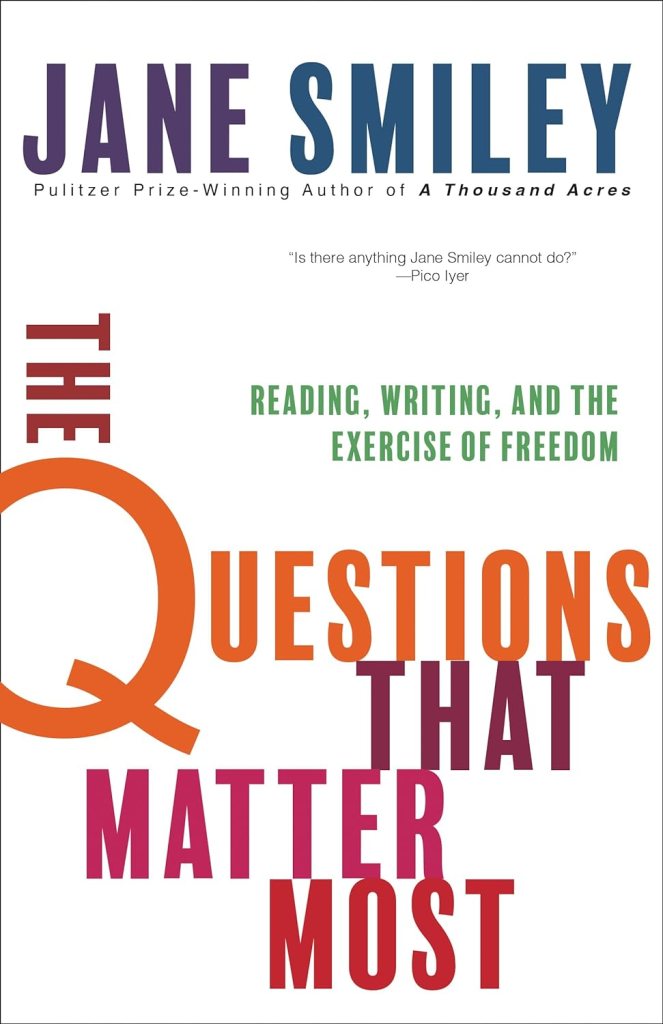
The Questions That Matter Most: Reading, Writing, and the Exercise of Freedom
By Jane Smiley
Heyday Books, 256 pages, $22.00
.
One of the perks of being a writer is that people who don’t write are happy to explain to you what you are doing and why. But the best explanation I’ve ever seen is in the Tennessee Williams’ story “The Resemblance Between a Violin Case and a Coffin,” in which Tom, a twelve-year-old boy who is jealous of his older sister’s boyfriend but also attracted to him, says, “And it was then, about that time, that I began to find life unsatisfactory as an explanation of itself and was forced to adopt the method of the artist of not explaining but putting the blocks together in some other way that seems more significant to him.”
The key word here is “blocks.” If you’re in a fix the size of the fictional Tom’s or his creator’s (Williams’ given name was “Thomas.” of course), you’re not going to get anywhere splitting hairs. The only way out is to break the predicament into its big chunks—you have a sister, she’s straight, you’re gay, she has a boyfriend you hope will disappear, yet you’re drawn to him and so you want him to stick around—and move them here and there like pieces of furniture until the messy room that is your life starts to look the way you want it to.
That is essentially the message of The Questions That Matter Most. The title of the first essay in this collection says as much. “My Absent Father” describes a parent who disappears from the author’s life when she is still in diapers, first when he is sent to a veteran’s hospital with something like PTSD and then divorcing her mother and moving out altogether. Smiley lived for a while with her grandparents, whose house in St. Louis the father would drive up and down in front of, hoping to get a glimpse of his daughter. He stopped once when she was seven, and she sat in his lap for a while as he chatted with her grandfather, “and then my father walked down to the street and got into his car.”
A few years later, her mother remarries. Smiley’s stepfather is “portly and kind,” even “saintly,” but alas, not “mythic.” Far more crucial as heroic figures are her new stepbrother and a couple of cousins, all-American rascals she calls “the Tom Sawyers,” guys as good-looking as they were good-natured and wild to just the right degree: “if one didn’t have a motorcycle,” says Smiley, “another one did.”
Near the end of “My Absent Father,” she admits she came to realize that he actually did her a favor by removing himself from her life; from the little she saw of the way he treated her mother, she sees that “he would have made sure that I knew I was female, and that females have limited capacities and defined roles.” In fact, by freeing her from his tyranny, he gave her two gifts: he let her become “a person who was never taught what not to try,” and although Smiley doesn’t exactly put it this way, he got her to start moving those blocks around the way Tom does in that Tennessee Williams story.
Boy, did that ever pay off. Smiley wrote a handful of well-received novels in the eighties and then hit it big with A Thousand Acres, a best-seller based on the King Lear story that received a Pulitzer Prize in 1992 and was adapted into a film with an all-star cast (Michelle Pfeiffer, Jessica Lange, Jason Robards) a few years later. Later books included more novels, a biography of Charles Dickens, and a memoir; little wonder that in 2001 she was elected to the American Academy of Arts and Letters and won the PEN USA Lifetime Achievement Award for Literature in 2006.
In other words, Smiley has been out and about for a good long time, and it shows. These essays impart home truths about writing and life with deftness, clarity and insight. What they don’t do is talk directly about the freedom she champions in this book’s title. Yet that idea is implicit on almost every page. She writes about motherhood more than once (Smiley has five children herself), and says in a memorable passage from an essay called “Can Mothers Think?”:
While the feminists are arguing whether motherhood is politically correct, and male novelists are worrying, as they have been at least all of my life, that the novel is dying, and the critics are asserting that the novel is deeply corrupt and the authors are dead, the mothers are busily, energetically, and prolifically exploring undiscovered territory within their own psyches, and therefore within the psyches of our readers, who are, as some of the letters I get attest, embarrassingly grateful.
Smiley is fond of blue-collar metaphors, and in a wonderful essay about aging writers aptly entitled “Why Go On?” she takes Tennessee Williams’ description of the creative process one step farther when she says, “what keeps me going is something almost mechanical—the sense of previously disparate parts locking together, becoming one, and giving off energy.”
Even when she misses the mark, she does so in a way that engages and instructs. Most of the other essays in this collection are about other authors (Kafka, Willa Cather, Jessica Mitford, Alice Munro), but the best-known of these (because the most controversial) is “Say It Ain’t So, Huck,” where she offers Uncle Tom’s Cabin as a better model for writers than Twain’s best-known novel, playing off of and trying to refute Hemingway’s assertion that “all modern American literature comes from one book by Mark Twain called Huckleberry Finn.”
Here Smiley makes a point and misses one. The point she makes is that the last third of Twain’s novel is racist and cruel, whereas Stowe’s masterpiece radiates compassion and empathy from beginning to end. No one would argue with that, but the fact is that Twain rescued American literature from the soulless style of writers like James Fenimore Cooper by taking on the vernacular of an uneducated boy who talks the way people did then and do now.
The point she misses is that the best writing often contains an element of the weird, the bizarre, the outlandish, the alienating. Call it wildness, if you will: “I caught a glimpse of a woodchuck stealing across my path,“ wrote Thoreau in Walden, “and felt a strange thrill of savage delight, and was strongly tempted to seize and devour him raw; not that I was hungry then, except for that wildness which he represented.” We think of Thoreau as a proto-hippie chilling on the shore of a pond, but even he wanted to taste raw meat from time to time.
Yes, Twain goes over the top in the final pages of his book, but the best writers often do. I know college instructors who say Thomas Middleton is as great a playwright as Shakespeare, but they don’t get very good evaluations on the Rate My Professors site: even a 19-year-old can tell that Hamlet is superior to The Revenger’s Tragedy. Roy Blount, Jr. wrote that for Smiley to say it would have been better for American literature to have grown out of Uncle Tom’s Cabin “is like saying it would be better for people to come from heaven than from sex.” My personal take is in an essay I wrote a few years ago which says that The Adventures of Huckleberry Finn is not about America, it is America, warts and all. This is why, when I’ve taught my university’s 19th-century U.S. novel class, I’ve often included both the Twain and Stowe novels as well as Harriet Jacobs’ Incidents in the Life of a Slave Girl, a book which reveals more about plantation life than either of the others.
Every writer who has moved the blocks of their life around the way Tennessee Williams says knows there are two parts to the process. The first part is the orderly, sun-lit part that consists of pondering and planning and then executing the actual process, and the second is the bats-and-owls-in-the-trees part that is wild and unpredictable and that can either sink a writing project or turn it into something people will talk about forever. To that first part, you’re unlikely to find a better guide than Jane Smiley.
Copyright 2023 David Kirby
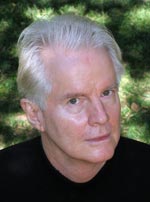
David Kirby is the Robert O. Lawton Distinguished Professor of English at Florida State University. He has received many honors for his work, including fellowships from the Guggenheim Foundation and the National Endowment for the Arts, and his work appears frequently in the Best American Poetry and Pushcart Prize volumes. Kirby is the author of numerous books, including The House on Boulevard St.: New and Selected Poems, which was a finalist for the 2007 National Book Award in poetry.
Discover more from Vox Populi
Subscribe to get the latest posts sent to your email.

Intelligent, interesting. Taught me something and made perfect sense. I loved to go with the logic of the piece.
LikeLike
Yes, David Kirby has an easy brilliance. He makes his startling observations look inevitable
LikeLike
I don’t know why, but this gives me hope on a morning I have been beating myself up after misunderstanding an assignment for a class yesterday. Already trying to dispel an obvious observation of being over the hill in a class of genius young writers, I arrived without hearing aids. I might as well have sat and pounded my cane saying, “speak up, Sonny!”
LikeLike
I know the experience, Barbara.
>
LikeLiked by 1 person
Thank you for posting this wonderful catch-up review on an otherwise terrible morning. I just echo laureanne, just a little echolalia from here.
LikeLiked by 1 person
Thanks, Maryjane. Sorry you’ve had a terrible morning.
M.
>
LikeLiked by 1 person
Such brilliant structure & arguments — such intelligent observations. Thank you David, & thank you Mike!
LikeLiked by 2 people
David is a master of explaining what works in a book and what doesn’t.
>
LikeLiked by 1 person
My darling Laureanne. . . .
LikeLiked by 1 person