
Vox Populi
A curated webspace for Poetry, Politics, and Nature with over 20,000 daily subscribers and over 8,000 archived posts.
Douglas Penick: “I am old”
As more and more of us live to advanced years, it is crucial to accept and even embrace our condition.
.
Much to my surprise, I find that I’m now part of a large minority that is often ignored, frequently disdained, and regularly segregated.
I am old.
And indeed, it’s quite a shock to find that the world in which I worked, struggled, dreamed, and loved now regards me quite differently than it did only 10 years ago. Growing old, it seems, is a condition that Western post-industrial society and culture do not consider meaningful, useful, or even valid. And yet, the truth is, and this is also a surprise, that as we become old, we enter a time of life, even with its losses and deficits, that is not a defective version of youth or middle age, but is something quite different, with its own qualities, discoveries, and surprises.
But as the world becomes perhaps more distant and out of our control, we begin to see patterns we had never imagined or only dimly sensed.
“Ageism” is an attitude people inflict on themselves. Old people are what almost everyone will become. But somehow, this part of existence is treated as something that must be actively ignored, as if old age were an infectious disease transmitted by acknowledging it. Or a misfortune that can be averted by denying it. “You’re only as old as you think you are,” said my son recently. “Only young people think that,” I snapped. Contemplating dying and death is, it seems, more appealing than imagining being old.
Most books and articles on aging offer brisk, hard-nosed advice about patient management or wishful thinking packaged as self-help. But Atul Gawande has written with unsparing clarity about the bleak fate of institutional powerlessness, offered in the name of “care” and “safety,” which almost half of us face in old age. The number of euphemisms for “old” proliferate, as if by not using the word, we could forestall the fact. But the intense and complex inner experiences that come with aging are rarely probed.
We cannot escape the fact that old age is a time of loss. Old, we experience depletion in many parts of our lives. Our bodies and senses weaken, become unreliable in unforeseen ways, fall subject to illness, and require more attention simply to continue a reasonable level of function. More difficult is the loss of friends and family and the changes in the social institutions where we once had a place. Most difficult and certainly most frightening is the threat or actual loss of mental capacity. None of these occurrences are part of how we thought of ourselves or planned our future. As we age, our lives become strangely unrecognizable. We realize that life is no longer in our control. And old age ends only when we enter a terrain that is truly and completely unknown.
Thus, more than any other time in life, old age is the time of deepest and most pervasive uncertainty. The uncertainty regarding our financial sustainability is not the least of these, but somehow comes to epitomize the perilousness of our situation. How we will manage being ourselves, being in our world, is no longer obvious. So we feel the world moving away from us. We can no longer reach out and grasp and cling, control and shape what’s happening. Our future is no longer limitless. It is genuinely and utterly unknowable.
But as the world becomes perhaps more distant and out of our control, we begin to see patterns we had never imagined or only dimly sensed. Our world, our selves become less stable and less secure. Everything is more intensely transitory. Situations, objects, places, people become, moment by moment, very deeply to be cherished, valued; loved, not in spite of being impermanent, but because they and we are only together for this moment. Colors become more vivid, momentary smells, sudden sounds, temperatures and textures, memories, ideas, gestures appear, vanish, and only briefly detach themselves from the flow of sensoria. We take less and less for granted.
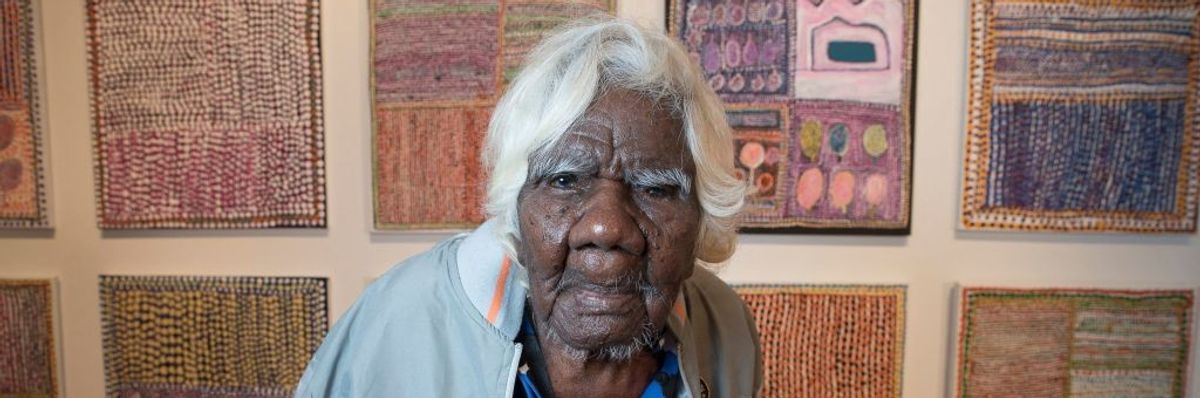
Late in their lives, Titian, Michelangelo, O’Keeffe, Tagore, Jean Rhys, Palladio, Daisy Loongkoonan, Paul Cézanne, Janáček, Maria Martinez, Stravinsky, and many others found new and unexpected ways of looking at themselves and their world. They continued and even extended their arts. In old age, as their bodies weakened and the world changed, they did not look away. Instead, in worlds of decline and loss, they experienced new tonalities, new music, new patterns. Having exhausted more conventional possibilities, they discovered new relationships to melody and harmony, to narrative, to color, form, light, and space. They found unforeseen paths, articulated subtleties and beauties never before encountered. The work they have left us and the stories of their lives are signposts for us.
This is not to say that we, the old, will all accomplish extraordinary things. But our situation, the actual experience of aging, is an opening for all of us. We here encounter something unexpected, sometimes frightening, sometimes revelatory. And now, as more and more of us live to advanced years, it is crucial to accept and even embrace our condition. This time of life offers new viewpoints in a world that cannot stop its habitual obsession with consuming and polluting. It does so, even as those who care for us cannot imagine our inner life, the uncertainty, peril, and, above all, the continued restless searching which is mind itself. Old age may seem too painful to contemplate and explore, but indeed we must. It is a time of life we might wish to ignore but which all of us, the living, will and must share. It is inevitable. And it is, in its own way, a gift.
For, as Thoreau once said, “Not ‘til we are lost… not ‘til we have lost the world, do we begin to find ourselves and realize where we are and the infinite extent of our relations.”
First published in Common Dreams. Licensed under Creative Commons.
DOUGLAS PENICK‘s book of essays, The Age of Waiting, centered on the sensibility of ecological collapse, was published in 2021 by Arrowsmith Press. In March, 2024, New York Review Books will publish The Oceans of Cruelty, which retells an ancient Indian story cycle, exploring narrative, magic, and toxic social norms. This article is the topic of his newest book, Winter Light.
Discover more from Vox Populi
Subscribe to get the latest posts sent to your email.

Taking Stock
I’m still a man.
Now feeling irrelevant.
There’s no respect for age unless
you’re a 3,000 year old skeleton
found in a cave somewhere.
~Marc A. Crowley
LikeLiked by 2 people
Thanks, Marc!
>
LikeLiked by 1 person
I particularly admired: “as we become old, we enter a time of life, even with its losses and deficits, that is not a defective version of youth or middle age, but is something quite different, with its own qualities, discoveries, and surprises. ” Having been a single mother of three for decades, a teacher, writer, gardener, daughter, friend, caretaker, wife, poet, and so on, I assure you that — a month away from my 80th, I cherish and deeply enjoy being old, with time, WITH TIME to be curious, to listen, to explore, to read, to write, to walk my dog and meet strangers who don’t mind a “nice old lady” chatting with them for a minute or two — or sometimes much longer encounters & talks, during which the most deeply personal confidences will be offered to me grateful that I had the time to listen, to ask questions. For I think that old age offers the immense privilege of having the time to be **curious** — and that curiosity opens to such a wealth of new moments, experiences and impressions. I can look long at a beautiful face in line for the cashier’s, and be amazed, elated, grateful and in awe with its youth and radiance, or watch a red-tailed hawk’s cursives in the sky for the longest time, or a sparrow taking a bath in dust, or be moved almost to tears looking at the exhausted strawberry picker picking up & hugging his little daughter, and nod, smiling at him — his smile back at me a blessing. Yes, my knees hurt. A lot. Yes, my heart cramps when I think of, and miss my late husband, or remember my beloved dead friends (their number growing and growing), and more and more I can’t remember simple words like “paragraph” instead of “stanza” or yesterday I couldn’t remember “license plate”! But 99% of the time people are glad to try to help me remember — probably thinking they hope they won’t be as forgetful as I am…but, dear dear readers, being old (and blessed by having a roof over my head, and a mostly OK health)offers such pure, such ardently beautiful moments. I, for one, am a peaceful (but raging at Fascist politics, racism, anti-Semitism, and environmental tragedies), nostalgic (for being able to dance, for example, or ride a motorcycle), yet happy, grateful, arthritic, forgetful, clumsy, Tylenol-popping, maniacally curious & life-loving old woman.
LikeLiked by 3 people
Oh my, Laure-anne… what a beautiful tribute to growing old. I’ve copied your paragraph and put it on my desktop to be read and re-read as a walk through my remaining years. Thank you!
>
LikeLiked by 1 person
Love this. Me, too!
LikeLike
Laureannebosselaar, I turned 82 on the day you posted this, and I can’t tell you how much your words mean. Your final sentence is me, too, in a nutshell!
LikeLiked by 1 person
Thank you, Sarah!
LikeLiked by 1 person
I am OLD. (almost 86). And, yes, ““Ageism” is an attitude people inflict on themselves.” And, yes, sometimes life adds insult to ‘injury’ and our bodies are no longer quite as reliable, all the people who have somehow accompanied us are slowly leaving. And yet (life has so far been kind to me) my anger, my passions, my love, my creativity seem endless. I think it depends also on the society in which you live. I have not found ageism from others a problem.
LikeLiked by 2 people
Thanks for sharing, Rosemary.
>
LikeLike
And so I write about it. And perhaps I imagine the side glances of my half century younger classmates. Perhaps they just hold in their aggravation of having to repeat, repeat as I wonder if any of them can hear me.
LikeLike
The other writers are lucky to have you among them, Barbara.
>
LikeLiked by 1 person
“Your name….a memory lost. Is it a cleansing,
Allowing a simple bliss in being and yellows,
Without the words to anguish or sadden?”
LikeLiked by 1 person
Beautiful, Leo. Thank you.
>
LikeLiked by 1 person